Business Banking — Do I Really Need a Separate Account?
It's one of the most commonly asked questions among new sole traders: "Do I actually need a separate bank account for my business?" The short answer is no — there's no legal requirement for sole traders to have a separate business account. But the slightly longer answer is that having one can make your life significantly easier.
In this guide, we'll look at the pros and cons, help you decide whether a separate account is right for you, and walk through what to look for if you do decide to open one.
The Legal Position
Let's start with the facts. If you're a sole trader, you are not legally required to have a separate business bank account. Unlike limited companies, which must keep company finances entirely separate from personal ones, sole traders and the businesses they run are considered the same legal entity. Your money is your money, whether it came from a client or from your day job.
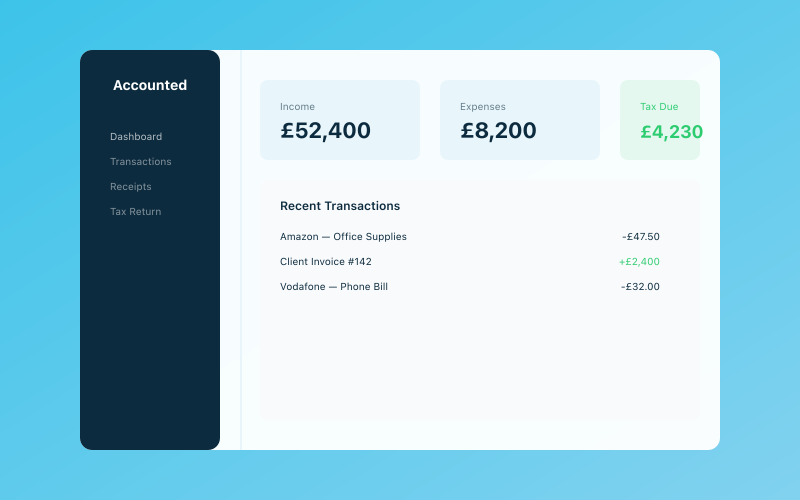 Your Accounted dashboard — income, expenses, and tax at a glance
That said, just because something isn't legally required doesn't mean it isn't a good idea. There are plenty of things that aren't mandatory but make running a business considerably smoother — and separating your finances is near the top of that list.
If you're a limited company director, the rules are different. Company money belongs to the company, not to you personally, so a separate business account is essential. But for sole traders, it's a choice.
Why Separating Your Finances Makes Sense
Even though you don't have to, here are some compelling reasons to open a separate account:
Easier bookkeeping. This is the big one. When all your business income and expenses flow through a single, dedicated account, it's far simpler to track what's coming in and what's going out. You're not wading through takeaway orders and supermarket shops trying to find the genuine business transactions.
If you use bookkeeping software like Accounted, having a separate account means your bank feed is clean and focused. Every transaction is business-related, which makes categorisation quicker and more accurate. Penny, the AI bookkeeping assistant, works best when it's not trying to distinguish between your Friday night pizza and a client lunch.
Clearer picture of your business finances. With everything in one place, you can see at a glance how much money your business has, what you're owed, and what you owe. That clarity is invaluable when it comes to making decisions about pricing, spending, and growth.
Less stress at tax time. When your Self Assessment deadline rolls around, having a clean set of business transactions means you (or your accountant) can prepare your return much more quickly. No more scrolling through twelve months of mixed personal and business spending trying to remember what was what.
Professional credibility. If you're invoicing clients, having payments come into a dedicated business account looks more professional. Some clients, particularly larger ones, may prefer to pay into a business account rather than a personal one.
HMRC investigations. If HMRC ever decides to look into your affairs, having a separate business account makes it much easier to demonstrate that your records are accurate and complete. Mixed accounts can raise questions and make investigations more complicated — and more stressful — than they need to be.
The Case for Not Bothering
In fairness, there are situations where a separate account might not be necessary:
Very low turnover. If your self-employment is a small side hustle bringing in a few hundred pounds a month, the volume of transactions may be low enough to manage within your personal account without much hassle.
Cost. Some business bank accounts charge monthly fees, and if you're just starting out and watching every penny, that's a cost you might prefer to avoid. That said, there are now plenty of free business accounts available (more on that below).
Simplicity. If you're already keeping careful records and your personal spending is minimal, adding another account might feel like unnecessary complexity.
For most sole traders, though, the benefits of separation outweigh the inconvenience of opening another account. The time you save on bookkeeping alone usually makes it worthwhile.
Business Account vs Personal Account — What's the Difference?
It's worth understanding that a "business bank account" and a "personal account used for business" are not quite the same thing.
A business bank account is specifically designed for business use. It typically offers features like:
- Integration with accounting software
- The ability to set up business direct debits and standing orders
- Invoicing tools
- Multiple user access (useful if you later take on a bookkeeper or accountant)
- Business overdraft facilities
A personal account can technically be used for business transactions if you're a sole trader, but most personal account terms and conditions actually prohibit business use. If your bank spots regular business transactions going through a personal account, they may ask you to switch to a business account or close your personal one.
So while there's no legal requirement for a separate account, your bank's own rules might push you towards one anyway. It's worth checking the terms and conditions of your current personal account if you're planning to use it for business.
What to Look for in a Business Bank Account
If you've decided to open a separate account, here are the key things to consider:
Fees. Some business accounts are completely free; others charge a monthly fee ranging from a few pounds to £15 or more. Free accounts are fine for most sole traders, especially when starting out. Look at what's included — some free accounts charge for specific transactions like cash deposits or international transfers.
Features. Think about what you actually need. If you're a freelancer who invoices clients and gets paid by bank transfer, you probably don't need a lot of bells and whistles. But if you deal in cash, need to accept card payments, or want built-in invoicing tools, look for accounts that offer those features.
Integration. If you use bookkeeping software, check whether the bank account integrates with it. A direct bank feed saves you from manually entering transactions and reduces the chance of errors. Accounted integrates with most major UK business bank accounts, so your transactions are pulled in automatically.
Customer service. When something goes wrong — and at some point, something will — you want to be able to get help quickly. Read reviews and check whether the bank offers phone support, live chat, or just email.
App quality. Most of your day-to-day banking will probably happen on your phone. A well-designed app with good notifications, easy transfers, and clear transaction history makes a real difference to your daily experience.
Popular Business Bank Accounts for Sole Traders
Here's a quick overview of some of the more popular options in the UK (as of early 2026):
Starling Bank — free business account with no monthly fees, a well-regarded app, and good integration with accounting software. Probably the most popular choice among sole traders right now.
Tide — another free option with useful features like built-in invoicing and receipt scanning. Good for sole traders who want everything in one place.
Mettle (by NatWest) — free, no minimum balance, and backed by a high-street bank. Simple and straightforward.
HSBC Kinetic — free for the first year (then £8/month). Offers the reassurance of a major high-street bank.
Monzo Business — free plan available, or a paid plan (£7/month) for additional features like tax pots and invoicing.
Barclays Business — free for the first year. One of the few high-street banks still offering a dedicated small business account with branch access.
The best account for you depends on your priorities. If you want the best app experience, Starling and Monzo are hard to beat. If you prefer the security of a high-street name, HSBC or Barclays might suit you better. And if you want built-in business tools, Tide is worth a look.
Setting Up Your Account for Success
Once you've opened your business account, here are a few tips to make the most of it:
Move all business transactions to the new account. Update your invoices with the new bank details, move any business direct debits across, and make sure all client payments go into the business account from now on.
Pay yourself a regular amount. One of the benefits of a separate account is that you can set up a regular transfer to your personal account — effectively paying yourself a "salary." This makes personal budgeting much easier and helps you avoid accidentally spending money you'll need for tax.
Set aside money for tax. A common approach is to transfer a percentage of every payment you receive into a savings pot or separate account earmarked for your tax bill. A good rule of thumb is 25-30% of your profits, depending on your income level. Some business accounts let you create separate pots or spaces for this purpose.
Connect it to your bookkeeping software. If you're using Accounted, connect your new bank account straight away. This means your transactions are automatically imported and categorised, and you've got a real-time view of your business finances from day one.
Keep personal transactions out. This sounds obvious, but it's tempting to use your business card for a quick personal purchase. Resist. The whole point of a separate account is clean separation. If you do accidentally use the wrong card, make a note of it so you can exclude it from your business records.
What if You're Already Using a Personal Account?
If you've been running your business through a personal account for a while, it's not too late to switch. Open a new business account, update your invoicing and payment details, and start fresh. You don't need to close your old personal account — just stop using it for business.
For the period where your business transactions were mixed in with personal ones, you'll need to go through and identify the business transactions manually. It's a bit tedious, but it only needs to be done once. Your bookkeeping software can help with this — connect the old account, tag the business transactions, and then disconnect it once you've caught up.
Going forward, everything will be cleaner and simpler. It's one of those tasks that feels like a hassle at the time but pays off enormously in the long run.
Related Reading
Start your free trial and see how Accounted simplifies your bookkeeping.
Accounted helps UK sole traders stay on top of their bookkeeping and tax. Start your free 30-day trial at getaccounted.co.uk
Accounted keeps your books sorted automatically so you can focus on running your business. See Accounted →
Business & Operations Advisors
Our business advisors cover the practical side of running a UK sole trader business — from HMRC registration to managing growth. Content is written for real business owners in plain English, not accountants.
Ready to try Accounted?
Join UK sole traders who are simplifying their bookkeeping and tax.
Start your 14-day free trial