B Corp Certification — Is It Relevant for Sole Traders?
B Corp certification has become one of the most recognisable marks of a socially and environmentally responsible business. Names like Patagonia, Innocent, and The Body Shop have popularised the idea that businesses can be a force for good, and the distinctive "Certified B Corporation" logo has become a trust signal for ethically minded consumers. But if you're a sole trader, you might be wondering: is B Corp certification actually relevant to you?
The short answer is that it's complicated. The longer answer involves understanding what B Corp certification actually requires, whether sole traders are eligible, and whether there are better alternatives for small, one-person businesses. Let's work through it.
What Is B Corp Certification?
B Corp certification is administered by B Lab, a US-based non-profit organisation. To become a Certified B Corporation, a business must meet rigorous standards across five areas: governance, workers, community, environment, and customers. The assessment is comprehensive, covering everything from your supply chain practices to your employee benefits, environmental policies, and community engagement.
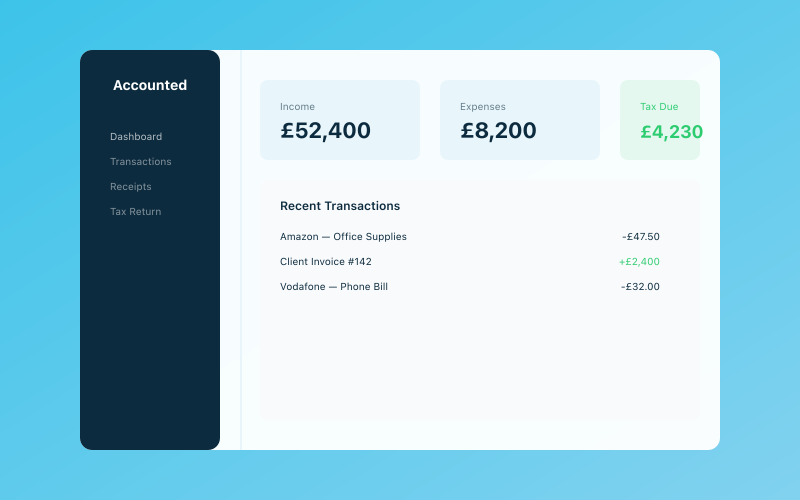 Your Accounted dashboard — income, expenses, and tax at a glance
The process involves completing the B Impact Assessment (BIA), an online questionnaire that scores your business across those five areas. You need a minimum score of 80 out of 200 to qualify. After that, your responses are verified by B Lab, and if you pass, you pay an annual certification fee based on your revenue.
B Corp certification isn't a legal structure — it's a third-party accreditation. In the UK, it sits alongside (but is separate from) the legal frameworks for social enterprises, community interest companies (CICs), and charitable organisations.
Can Sole Traders Actually Get B Corp Certified?
Technically, B Corp certification is open to businesses of all sizes and structures, including sole traders. B Lab doesn't exclude unincorporated businesses from the assessment. However, the practical reality is more nuanced.
The B Impact Assessment was designed primarily for incorporated businesses — companies with employees, formal governance structures, and supply chains. Many of the questions in the assessment relate to topics that simply don't apply to a one-person sole trader: employee benefits, board diversity, worker ownership, formal environmental management systems, and so on.
As a sole trader, you'd likely find that a significant portion of the assessment isn't relevant to your business. This makes it harder to score the 80 points needed for certification, because many of the scoring opportunities aren't available to you. It's not impossible, but it requires scoring very highly in the areas that do apply.
There's also the cost to consider. B Corp certification fees start at around £1,000-£2,000 per year for small businesses, plus the time investment in completing and verifying the assessment. For a sole trader earning, say, £30,000-£50,000 a year, that's a meaningful chunk of revenue for a certification that your customers may or may not recognise.
What Are the Benefits of B Corp?
For businesses that do get certified, the benefits can be significant:
Brand credibility. The B Corp logo is increasingly recognised by consumers, particularly in sectors like food, fashion, beauty, and professional services. It signals that your business has been independently verified as meeting high social and environmental standards.
Networking and community. B Corp businesses gain access to a network of like-minded companies, which can lead to partnerships, referrals, and collaborative opportunities. The B Corp community is active and supportive.
Attracting talent. For businesses with employees, B Corp status can help attract people who want to work for purpose-driven organisations. This is less relevant for sole traders, but it's a key benefit for growing businesses.
Structured improvement. The B Impact Assessment itself is valuable, even if you don't pursue certification. It forces you to think critically about your business practices across multiple dimensions and identifies areas where you could improve.
Client requirements. Some larger companies prefer (or require) their suppliers to hold sustainability certifications. B Corp is one of the most recognised, so it can open doors in certain supply chains.
The Downsides for Sole Traders
While the benefits are real, there are some specific challenges for sole traders:
Cost relative to revenue. As mentioned, the annual fee can be significant for a small business. You need to weigh whether the commercial benefit (new clients, higher prices, stronger brand) justifies the expense.
Assessment design. The BIA isn't optimised for one-person businesses. You'll spend time answering questions that don't apply, and you may struggle to reach the minimum score simply because many scoring categories aren't available to you.
Administrative burden. The verification process takes time and requires documentation. As a sole trader already juggling client work, admin, and bookkeeping, the added complexity might not be welcome. That said, if you're using Accounted to keep your finances and records organised, you'll already have much of the documentation you need — Penny keeps everything tidy, which makes any certification process smoother.
Limited recognition. While B Corp awareness is growing, it's still strongest among certain demographics and in certain sectors. If your clients are local consumers rather than ethically minded millennials, the logo on your website might not move the needle.
Alternatives to B Corp for Sole Traders
If B Corp certification feels like too much for your situation, there are several alternatives that might be more appropriate:
Social Enterprise Mark. This is a UK-based certification for businesses that exist primarily for a social or environmental purpose. It's more accessible than B Corp for smaller businesses and is well-recognised in the UK social enterprise sector.
Buy Social. Social Enterprise UK's Buy Social directory lists verified social enterprises and can connect you with buyers who specifically want to purchase from purpose-driven businesses.
Green certifications. Depending on your sector, there may be industry-specific environmental certifications that are more relevant and more affordable. The Green Tourism award, ISO 14001 (environmental management), or sector-specific schemes like the Soil Association certification for organic businesses.
Self-declaration with evidence. You don't need a formal certification to communicate your values. Many sole traders successfully position themselves as sustainable or ethical businesses by being transparent about their practices — listing their commitments on their website, sharing what they do differently, and providing evidence (such as using renewable energy, sourcing locally, or donating a percentage of profits).
1% for the Planet. This programme asks businesses to donate 1% of their annual revenue to environmental causes. It's simpler and cheaper than B Corp, and it gives you a recognisable badge for your marketing. At £30,000 turnover, that's £300 per year — a modest commitment with a tangible impact.
Using the B Impact Assessment Without Certifying
One of the best-kept secrets of the B Corp world is that you can complete the B Impact Assessment for free, without committing to certification. The assessment is available online and gives you a score and detailed feedback across all five impact areas.
For sole traders, this is incredibly valuable. You get a structured framework for evaluating your business's social and environmental performance, with specific suggestions for improvement. You can track your score over time and set goals for getting better — all without paying the certification fee.
Think of it as a free sustainability audit for your business. You might discover that you're already doing better than you thought in some areas, and that there are easy wins in others. For example, the assessment might prompt you to switch to a green energy supplier, formalise your environmental policy, or review your supply chain — all things that can improve your business regardless of whether you display a B Corp logo.
The Financial Side
Whether you pursue B Corp certification or any alternative, the associated costs are generally tax-deductible. Certification fees, membership subscriptions, and the cost of meeting certification requirements (such as environmental audits or policy development) all fall under professional fees or subscriptions, which are allowable expenses for sole traders.
If you're investing in changes to meet certification standards — upgrading to energy-efficient equipment, switching to sustainable materials, or implementing a waste reduction programme — those costs are deductible too, either as revenue expenses or through capital allowances. Our guide to sole trader expenses covers these categories in detail, and for bigger purchases, our capital allowances guide explains how to claim.
Using Accounted, you can track these costs as they arise and see how they affect your overall tax position. Penny categorises expenses automatically, so you'll know exactly how much your sustainability commitments are costing — and how much tax relief you're getting back.
So, Is B Corp Right for You?
B Corp certification is a powerful tool for businesses that are large enough to take full advantage of the assessment framework and that operate in markets where the certification carries weight. For sole traders, it's a tougher sell — the cost, the administrative burden, and the assessment design all work against very small businesses.
That doesn't mean you should ignore it entirely. The B Impact Assessment is a genuinely useful tool for any business, and you can use it for free. If your score is high enough and you operate in a sector where B Corp status would genuinely attract clients or open doors, the investment might be worthwhile.
For most sole traders, though, a combination of genuine sustainable practices, transparent communication, and a simpler certification (like 1% for the Planet or the Social Enterprise Mark) will deliver more bang for your buck. The most important thing isn't the badge — it's the substance behind it.
And if you're looking for an easy place to start building more sustainable business habits, getting your finances in order is a surprisingly effective first step. Understanding where your money goes helps you identify waste, track the impact of changes, and make better decisions. It's not glamorous, but it works.
Accounted helps UK sole traders stay on top of their bookkeeping and tax. Start your free 30-day trial at getaccounted.co.uk
Related reading:
- Sole Trader Expenses — The Complete List
- Capital Allowances and the Annual Investment Allowance
- How to Write a Business Plan
Related Reading
- Annual Accounts for Small Companies — What's Required
- Pivoting Your Business — When and How to Change Direction
- How to Write Proposals That Win Work (With Templates)
Start your free trial and see how Accounted simplifies your bookkeeping.
Accounted keeps your books sorted automatically so you can focus on running your business. See Accounted →
Business & Operations Advisors
Our business advisors cover the practical side of running a UK sole trader business — from HMRC registration to managing growth. Content is written for real business owners in plain English, not accountants.
Ready to try Accounted?
Join UK sole traders who are simplifying their bookkeeping and tax.
Start your 14-day free trial