How to Write Proposals That Win Work (With Templates)
Why Most Proposals Don't Win
You've had a great initial conversation with a potential client. They're interested, you're excited, and they ask you to "send over a proposal." So you spend two hours writing something up, send it off... and never hear back.
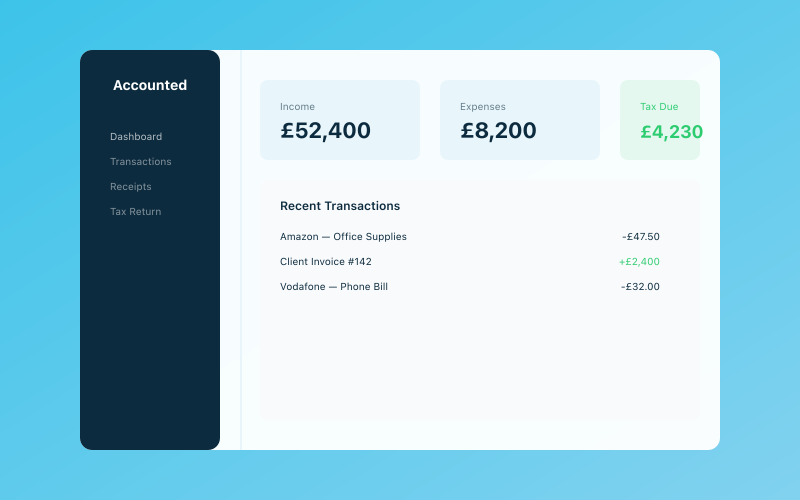 Your Accounted dashboard — income, expenses, and tax at a glance
If this sounds familiar, you're not alone. Most proposals fail not because the work being offered is wrong, but because the proposal itself doesn't do its job. A proposal isn't just a price list — it's a sales document, a trust-builder, and a preview of what it's like to work with you.
Let's break down what makes a proposal actually win work, and give you a framework you can use immediately.
The Anatomy of a Winning Proposal
Every effective proposal follows a similar structure. You can adjust the details for your industry, but the bones are the same.
1. The Opening — Show You Listened
The first section of your proposal should prove that you understand the client's problem. Not your solution — their problem. Summarise what they told you during your initial conversation: what they need, why they need it, what's not working currently, and what success looks like for them.
Example:
"You mentioned that your current website isn't generating enquiries, and that potential customers are finding your competitors instead. You need a site that ranks well in local search results and converts visitors into phone calls, ideally within three months of launch."
This immediately separates your proposal from the generic ones that start with "About Us" or a list of services. The client thinks, "Yes, they get it."
2. The Proposed Solution
Now outline what you'll do and how you'll do it. Be specific enough that the client understands the scope, but not so detailed that you're giving away your methodology for free.
Break the work into clear phases or deliverables:
- Phase 1: Discovery and Research — competitor analysis, keyword research, content audit
- Phase 2: Design and Build — wireframes, design concepts, development
- Phase 3: Content and Launch — copywriting, testing, go-live
- Phase 4: Optimisation — 30-day review, adjustments, analytics setup
Each phase should include what the client gets (deliverables) and roughly how long it takes. This gives them a sense of momentum and progress rather than a vague "we'll sort it out."
3. The Investment (Not the Price)
Language matters. Calling it an "investment" rather than a "cost" or "price" subtly frames the work as something that delivers returns rather than something that takes money.
More on pricing approaches in a moment — this is where most proposals are won or lost.
4. The Timeline
Give realistic dates. If the client says they need it done by a specific date, work backwards from there. If there's no hard deadline, suggest one — open-ended timelines lead to open-ended projects.
Include key milestones:
- Week 1-2: Discovery and planning
- Week 3-4: First drafts / concepts
- Week 5: Client review and feedback
- Week 6-7: Revisions and final delivery
5. About You (Brief)
Notice this comes near the end, not the beginning. By now, the client has seen that you understand their problem and have a clear plan. A short section about your experience, relevant past projects, and any testimonials reinforces their confidence.
Keep it to 3-4 paragraphs maximum. If you have case studies or portfolio pieces that are directly relevant, link to them.
6. Terms and Next Steps
Outline your standard terms (payment schedule, revision policy, what's included and excluded) and make the next step crystal clear. "To proceed, simply reply to this email" or "Sign below and I'll send an invoice for the deposit."
Pricing Presentation — Value-Based vs Hourly
How you present your price has an enormous impact on whether the client says yes.
The Problem with Hourly Rates
When you quote hourly rates, you're inviting the client to do maths. "£75 per hour... how many hours will it take... is that reasonable... could I find someone cheaper?" You're also being compared directly to every other person who charges by the hour, which turns your expertise into a commodity.
Worse, hourly billing penalises you for being efficient. If you've spent 10 years getting really good at something and can do it in 2 hours, why should you earn less than someone who takes 10?
Value-Based Pricing
Value-based pricing focuses on what the work is worth to the client, not how long it takes you. A website that generates £50,000 in new business per year is worth far more than a website that cost £3,000 to build.
When presenting value-based pricing in your proposal:
- Connect the price to the outcome. "This project represents an investment of £4,500 — based on your average customer value of £800, this pays for itself with just six new customers."
- Offer options. Three tiers (good, better, best) let the client choose their level of investment and make the middle option look like good value.
- Include everything. No surprise add-ons. The price covers everything you discussed.
The Three-Tier Approach
Offering three options is one of the most effective pricing strategies in proposals:
Essential (£2,500) — the core work, no extras Professional (£4,500) — everything in Essential plus additional value (e.g., content writing, additional pages, training) Premium (£7,000) — everything in Professional plus ongoing support, priority service, etc.
Most clients choose the middle option. This is the one you actually want them to pick, so price and scope it accordingly.
Proposal vs Quote vs Estimate
These terms get confused constantly. Here's the difference:
- Estimate — a rough idea of cost, not binding. "It'll probably be around £2,000-3,000." Useful early in conversations before you know the full scope.
- Quote — a fixed price for defined work, usually binding. "The work as described will cost £2,750." Common in trades and standardised services.
- Proposal — a comprehensive document that outlines the problem, solution, pricing, and terms. Used when the work is complex enough to need explaining, or when you're competing against other providers.
If a potential client asks for a "quote" but the work is complex, send a proposal. You'll stand out from competitors who just send a number.
Digital Proposal Tools
You can absolutely create proposals in Google Docs or Word, but purpose-built tools can make your proposals look more professional and give you useful data:
- Better Proposals — templates, analytics (you can see when the client opens it), and e-signatures
- Proposify — similar features with more customisation
- PandaDoc — proposals, quotes, and contracts in one platform
- Canva — free templates if you want something visual
- Notion — good for interactive proposals you can share as a link
The advantage of tools like Better Proposals and Proposify is that you can see whether the client has opened your proposal and how long they spent on each section. This intelligence helps you time your follow-up perfectly.
The Follow-Up Strategy
Sending a proposal and waiting is a recipe for disappointment. You need a follow-up plan.
Timing Your Follow-Up
- Same day as sending: Quick email or message saying "Just sent the proposal over — let me know if you have any questions"
- 3 days later: "Wanted to check the proposal landed safely. Happy to jump on a quick call to walk through it if that's helpful"
- 7 days later: "Following up on the proposal I sent last week. I've got availability starting [date] if you'd like to move forward"
- 14 days later: Final follow-up. "Completely understand if the timing isn't right — just wanted to touch base before I allocate that time to another project"
After four follow-ups with no response, let it go. You can always check back in a couple of months with a casual message, but chasing beyond this point rarely converts and can damage the relationship.
Following Up Without Being Pushy
The key is adding value with each follow-up rather than just asking "have you decided?" Share a relevant article, mention a case study that's similar to their situation, or offer to adjust the proposal based on feedback. Each touch point should give them a reason to reply.
Common Proposal Mistakes
Making It All About You
The client doesn't care about your company history, your mission statement, or your office renovation. They care about their problem and whether you can solve it. Lead with their needs, not your credentials.
Sending It Too Late
If a client asks for a proposal on Monday, don't send it on Friday. Aim for 24-48 hours. The longer you take, the more their enthusiasm cools and the more likely they are to go with someone faster. If you need more time to put together a thorough proposal, let them know: "I'll have the full proposal to you by Wednesday."
Not Having Clear Terms
Vague terms lead to scope creep, which leads to disagreements, which leads to late or disputed payments. Your proposal should clearly state what's included, what's not, how many revisions are covered, payment milestones, and what happens if the project scope changes.
Overcomplicating It
A 20-page proposal for a £2,000 project is overkill. Match the depth of your proposal to the scale of the work. For smaller projects, a well-structured one-page proposal can be just as effective as a lengthy document.
When to Say No to an Opportunity
Not every piece of work is worth proposing for. Learning to say no saves you time and helps you focus on the right clients. Consider saying no when:
- The budget is significantly below what the work is worth
- The client's expectations are unrealistic for the timeline or budget
- You don't have the skills or capacity to do the work well
- Your gut tells you the client will be difficult to work with
- The work doesn't align with where you want your business to go
A polite decline ("Thanks for thinking of me — I don't think I'm the right fit for this particular project, but I'd recommend reaching out to...") preserves the relationship and shows professionalism.
Keeping Track of Your Proposals
As your business grows, track your proposals in a simple spreadsheet: client name, date sent, value, status, and follow-up date. Over time, you'll see patterns — your win rate, average deal size, how long clients take to decide. This data helps you forecast income, something Accounted can help you track alongside your existing revenue and expenses.
A Simple Proposal Template
Here's a bare-bones template you can copy and customise:
[Your Business Name] Proposal for [Client Name] Date: [Date]
Understanding Your Needs [2-3 paragraphs summarising what the client told you]
Proposed Approach [Your solution, broken into phases with deliverables]
Investment Options
- Option A — [name]: £[amount]
- Option B — [name]: £[amount]
- Option C — [name]: £[amount]
Timeline [Key milestones and dates]
About [Your Business] [Brief background, relevant experience, 1-2 testimonials]
Terms
- 50% deposit to begin, 50% on completion
- [X] rounds of revisions included
- Additional work quoted separately
- [Your standard terms link]
Next Steps To go ahead, reply to this email confirming your preferred option. I'll send a deposit invoice and we can get started.
Writing better proposals takes practice, but the framework above will put you ahead of most competitors from day one. Spend the time to get it right — your proposals are often the difference between winning work and wondering why the phone isn't ringing.
Related Reading
Start your free trial and see how Accounted simplifies your bookkeeping.
Accounted keeps your books sorted automatically so you can focus on running your business. See Accounted →
Business & Operations Advisors
Our business advisors cover the practical side of running a UK sole trader business — from HMRC registration to managing growth. Content is written for real business owners in plain English, not accountants.
Ready to try Accounted?
Join UK sole traders who are simplifying their bookkeeping and tax.
Start your 14-day free trial