How to Set Payment Terms That Clients Actually Respect
You've set your payment terms to 30 days. Your client pays on day 47. You set them to 14 days. They pay on day 31. Sound familiar? You're not alone. Late payment is one of the most persistent headaches for UK sole traders and freelancers, and it often comes down to one thing — payment terms that clients either don't understand, don't take seriously, or simply ignore.
But here's the thing: payment terms aren't just words on an invoice. Done properly, they're a framework that sets expectations, protects your cash flow, and gives you recourse when things go wrong. The key is knowing how to set them up, communicate them, and enforce them in a way that clients actually respect.
Why Payment Terms Matter More Than You Think
Cash flow is the lifeblood of any business, but it's especially critical when you're a sole trader. You don't have a corporate safety net, a line of credit, or a finance department to smooth things out. When a client pays late, it's your rent, your bills, and your groceries that are affected.
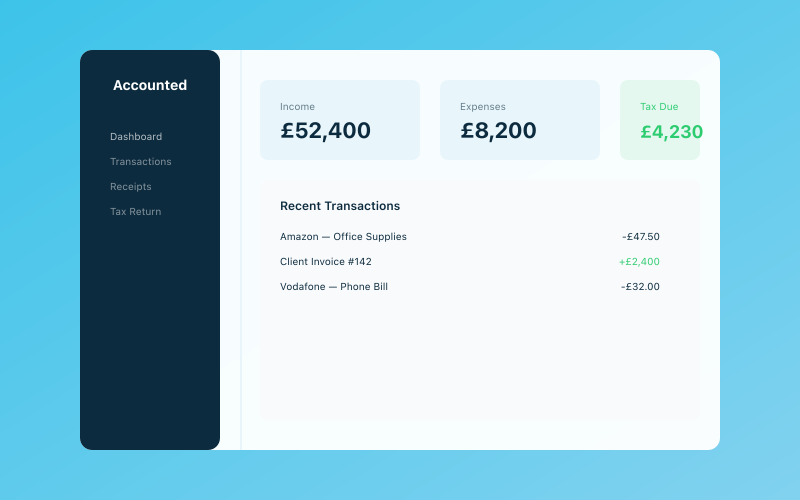 Your Accounted dashboard — income, expenses, and tax at a glance
Good payment terms don't just tell a client when to pay. They establish the tone of your business relationship. They communicate that you're professional, that you value your time, and that you expect fair treatment in return. Weak or ambiguous terms, on the other hand, send the opposite message — that payment is flexible, negotiable, or not really that important.
According to the Federation of Small Businesses, late payments affect over half of UK small businesses, and many report waiting an average of 72 days beyond their payment terms. That's not a minor inconvenience — it's a structural problem. But you can't fix the whole system. What you can do is make your terms as clear and enforceable as possible.
Choosing the Right Payment Window
The most common payment terms in the UK are Net 30 (payment due within 30 days of the invoice date), but this isn't a rule. It's just a convention, and it may not be the right one for your business.
Net 14 is increasingly popular among freelancers and sole traders. It's a reasonable window that gives clients time to process the payment without leaving you waiting a full month. For smaller invoices, this often works well.
Net 7 or Due on Receipt are appropriate when the work is completed quickly and there's no reason for a lengthy payment window. If you've done a half-day of consultancy, waiting 30 days for £500 is disproportionate. Due on Receipt is particularly common for one-off services.
Net 30 remains standard for larger contracts and corporate clients. Many larger companies have internal payment cycles that make shorter terms impractical, so pushing for Net 7 with a corporate client might not be realistic.
Milestone payments are worth considering for longer projects. Instead of invoicing everything at the end, break the project into phases and invoice at each milestone — 30% upfront, 30% at midpoint, 40% on completion, for example. This keeps your cash flow steady and reduces the risk of a large sum going unpaid.
The right choice depends on your industry, your client base, and your cash flow needs. The important thing is to choose deliberately rather than defaulting to Net 30 because everyone else does.
How to Communicate Terms So They Stick
Setting payment terms is one thing. Making sure clients actually know about them — and take them seriously — is another.
Include terms in your proposal or quote. Don't wait until the invoice to mention payment terms. If a client agrees to work with you based on a proposal that clearly states "Payment terms: Net 14 from invoice date," the expectation is set before any work begins.
Put terms in your contract or written agreement. Even a simple email confirmation should include your payment terms. If there's ever a dispute, having written evidence that the terms were agreed in advance is invaluable.
State terms clearly on every invoice. The due date should be prominent — not buried in small print at the bottom. Include both the payment terms (e.g., "Net 14") and the actual due date (e.g., "Due by 21 March 2026"). Making the client do arithmetic reduces the chance they'll pay on time.
Explain the consequences of late payment upfront. If you charge late payment interest (which you're legally entitled to do — more on that in a moment), say so in your terms. "Invoices not paid within 14 days are subject to statutory interest at 8% plus the Bank of England base rate." This isn't aggressive — it's transparent.
Discuss terms verbally. When onboarding a new client, mention your payment terms in conversation. "Just so you're aware, I invoice at the end of each month with 14-day terms. Does that work for your payment process?" This gives them a chance to flag any issues before work starts and removes any excuse for surprise later.
Using Incentives and Consequences
Carrots and sticks both have their place when it comes to encouraging timely payment.
Early payment discounts can be effective for certain clients. Offering 2-3% off for payment within 7 days of a Net 30 invoice gives the client a tangible reason to pay early. This works best with larger invoices where the discount is meaningful — on a £200 invoice, a 2% discount is only £4, which isn't much of a motivator.
Late payment fees are a legitimate deterrent. Under the Late Payment of Commercial Debts (Interest) Act 1998, you have the legal right to charge interest on late commercial payments at 8% above the Bank of England base rate, plus fixed compensation of £40-£100 depending on the size of the debt. Including this information in your terms gives you both the right and the evidence to charge it if needed.
Suspension of work is another tool. If a client isn't paying for completed work, it's entirely reasonable to pause any ongoing projects until the balance is cleared. Again, this should be stated in your terms: "We reserve the right to suspend services if invoices remain unpaid beyond the agreed terms."
Payment plans can be offered as a middle ground. If a client is struggling but genuinely wants to pay, proposing a structured plan shows goodwill while still getting you paid. Just make sure any plan is confirmed in writing.
Building Terms Into Your Workflow
Your payment terms shouldn't exist in isolation. They should be woven into your entire client workflow.
Before the project: terms are agreed in the proposal or contract.
During the project: milestone invoices go out on schedule, and any deposit payments are collected before work begins.
On completion: the final invoice is sent immediately, with clear terms and a specific due date.
After the due date: an automated reminder goes out on the day after the invoice is due, followed by further reminders at set intervals.
Accounting software makes this process much easier. In Accounted, for instance, you can set default payment terms for each client, and Penny will flag overdue invoices so you can follow up promptly. Automating reminders means you don't have to remember who owes what — the system handles it for you.
For more on structuring this workflow, have a look at our article on how to invoice correctly in the UK.
What to Do When Terms Are Ignored
Even with the best terms in the world, some clients will pay late. The question is how you respond.
First reminder (1-3 days overdue): A friendly email. "Just a quick note that invoice #1234 was due on [date]. Could you let me know when to expect payment?" Keep it light.
Second reminder (7-10 days overdue): A firmer email referencing the original terms. "As per our agreed terms, this invoice was due on [date] and is now [X] days overdue. I'd appreciate prompt payment to avoid any late payment charges."
Third contact (14+ days overdue): A phone call or formal letter. At this point, you should reference your right to charge statutory interest and compensation. For email templates you can use at each stage, see our guide on chasing invoices.
Beyond 30 days overdue: Consider formal debt recovery. A letter before action, followed by a claim through the small claims court if necessary. This is a last resort, but knowing the process exists gives you confidence to enforce your terms.
The key is consistency. If you let one client pay 20 days late without consequence, word gets around — either literally or just in the way that client treats your future invoices. Being consistent about enforcement, even when it feels awkward, trains clients to take your terms seriously.
Terms That Protect You and Respect Your Clients
Good payment terms aren't about being aggressive or difficult. They're about clarity and fairness. You've done the work, you deserve to be paid, and both you and your client benefit from knowing exactly when and how that payment will happen.
Set terms that reflect your business needs, communicate them clearly from the start, include them on every document, and follow up consistently when they're not met. It might feel uncomfortable at first, especially if you're used to being the "relaxed" one about money. But clients who respect you will respect your terms — and those who don't were never going to be good clients anyway.
For a deeper look at creating invoices that support your payment terms, check out how to create a professional invoice.
Related reading:
- How to Invoice Correctly in the UK
- How to Create a Professional Invoice
- Chasing Invoices — Email Templates That Actually Work
Accounted helps UK sole traders stay on top of their bookkeeping and tax. Start your free 30-day trial at getaccounted.co.uk.
Related Reading
- Exit Strategies — What Happens When You Want to Stop
- When to Hire Help — Signs Your Business Is Ready to Grow
Start your free trial and see how Accounted simplifies your bookkeeping.
Accounted keeps your books sorted automatically so you can focus on running your business. See Accounted →
Business & Operations Advisors
Our business advisors cover the practical side of running a UK sole trader business — from HMRC registration to managing growth. Content is written for real business owners in plain English, not accountants.
Ready to try Accounted?
Join UK sole traders who are simplifying their bookkeeping and tax.
Start your 14-day free trial