Exit Strategies — What Happens When You Want to Stop
Every Business Needs an Exit Plan
Nobody likes thinking about endings, especially when you are in the thick of building something. But having an exit strategy is not pessimistic — it is practical. Whether you are planning to retire in twenty years, considering selling your business, or simply thinking about what happens if life throws you a curveball, knowing your options gives you control.
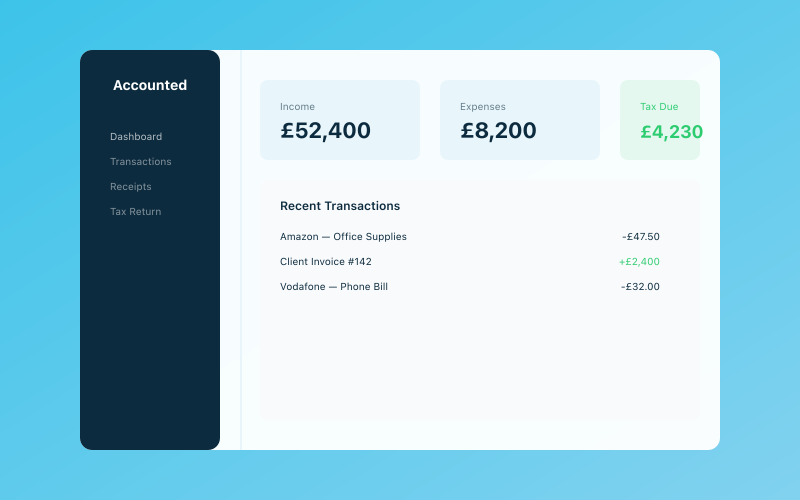 Your Accounted dashboard — income, expenses, and tax at a glance
For sole traders, exit planning looks quite different from larger businesses. You are the business, which creates unique challenges and opportunities when it comes to stepping away.
Your Exit Options
Selling Your Business
Yes, you can sell a sole trader business — even though legally there is no separate entity to transfer. What you are actually selling is a combination of:
- Goodwill — The value of your reputation, brand recognition, and the expectation of future earnings
- Client list and relationships — Often the most valuable asset for service-based sole traders
- Equipment and assets — Vehicles, tools, machinery, computers
- Stock and inventory — If applicable
- Intellectual property — Designs, content, processes, trade names
The tricky part is valuation. Sole trader businesses are harder to value than limited companies because so much of the value is tied to you personally. A plumber's client list is less transferable than, say, a launderette's customer base, because clients may have chosen you specifically.
Typical Valuation Methods
There is no single formula, but common approaches include:
- Multiple of annual profit — Typically one to three times annual net profit for small businesses
- Asset-based valuation — The total value of tangible assets plus an estimated goodwill figure
- Revenue-based valuation — A percentage of annual turnover, common in recurring-revenue businesses
Getting a professional valuation is worthwhile if your business has significant value. An accountant experienced in business sales can help you arrive at a realistic figure.
Closing Down
If selling is not viable or desirable, you may simply want to close your business. This is perfectly straightforward for sole traders, but there are several steps to follow to do it properly.
Transferring to a Limited Company
Sometimes the exit from sole trading is not an exit from business altogether — it is a transition to a different structure. If your business has grown to the point where a limited company makes more sense, you can transfer your sole trader business into a newly incorporated company.
This is not technically "closing" your business, but it does involve ceasing your sole trader trade, which triggers many of the same tax events.
Closing Down — The Step-by-Step Process
Complete Your Outstanding Work
Finish any committed projects, deliver outstanding orders, and fulfil your contractual obligations. If you cannot complete certain commitments, communicate with those clients as early as possible and offer alternatives.
Collect Outstanding Payments
Chase any unpaid invoices. Once you have ceased trading, collecting old debts becomes more difficult. Set a firm deadline and consider offering a small discount for prompt payment if necessary.
Pay Your Suppliers
Settle all outstanding bills, including any hire purchase or leasing agreements. Check contracts for early termination fees.
Notify HMRC
This is the critical step that many people overlook. You must tell HMRC that you have stopped being self-employed. You can do this:
- Online through your Government Gateway account
- By calling the HMRC Self Assessment helpline
- By completing the cessation details on your final tax return
You should notify HMRC as soon as possible after you stop trading. The date you give as your cessation date determines your final accounting period.
Cancel Your VAT Registration
If you are VAT-registered, you must deregister for VAT when you stop trading. You will need to submit a final VAT return and may need to account for VAT on any stock or assets you keep for personal use.
Cancel Business Insurance
Notify your insurance providers and cancel any policies that are no longer needed. Check whether you are entitled to a refund for any unused premium.
Inform Your Clients and Suppliers
Give reasonable notice to anyone you have ongoing relationships with. Where possible, recommend alternative providers — this protects your professional reputation even as you step away.
Your Final Tax Return
When you cease trading, you will need to file a final Self Assessment tax return covering the period from the start of the tax year to your cessation date. Here is what to include:
Final Trading Profits
Calculate your profits for the final period of trading. If you use the cash basis, include all income received and expenses paid up to and including your cessation date. If you use accrual accounting, include all income earned and expenses incurred, regardless of when payment was actually made.
Overlap Relief
If you have overlap profits from when you started trading, your cessation is when you finally claim relief for them. Overlap profits arise because, in your first years of trading, some profits were effectively taxed twice due to the basis period rules.
Overlap relief is deducted from your final year's profits, potentially reducing your tax bill significantly. If you do not know your overlap figure, check your records from your first year of trading or ask HMRC.
With the basis period reform that took effect from 2023/24, many sole traders dealt with their overlap profits during the 2023/24 transitional year. If you used the transitional provisions, you may no longer have overlap profits to claim on cessation.
Capital Gains on Business Assets
When you cease trading, any business assets you keep for personal use or sell are subject to capital gains tax. This includes:
- Vehicles
- Equipment and machinery
- Property used for business
- Goodwill (if sold)
The gain is calculated as the disposal proceeds (or market value if you keep the asset) minus the original cost, adjusted for any capital allowances previously claimed.
Business Asset Disposal Relief (formerly Entrepreneurs' Relief) may be available, which reduces the CGT rate to 10% on qualifying gains up to a lifetime limit of £1 million. To qualify, you must have been carrying on the business for at least two years before cessation.
National Insurance
Your Class 2 and Class 4 National Insurance obligations end when you cease trading. However, you will owe NI on your final period's profits in the usual way — Class 4 at 6% on profits between £12,570 and £50,270, and 2% above that.
Payments on Account
If you have been making payments on account, HMRC will automatically cancel future payments once they process your cessation. However, you may want to contact them proactively to reduce your next payment on account if your final year's profits are lower than previous years, to avoid overpaying.
Pension Planning for Retirement
If you are leaving self-employment for retirement, pension planning deserves serious attention — ideally well before your exit date.
The State Pension
You need 35 qualifying years of National Insurance contributions to receive the full new State Pension (currently £221.20 per week). Check your NI record on the government website and consider making voluntary contributions to fill any gaps, especially as Class 2 contributions at £3.45 per week are remarkably good value.
Private Pensions
As a sole trader, you are responsible for your own pension provision. If you have been contributing to a personal pension or SIPP, those contributions attract tax relief at your marginal rate. In your final trading years, maximising pension contributions can be a very tax-efficient use of your profits.
You can contribute up to £60,000 per year (or your total earnings, whichever is lower) and carry forward unused allowance from the previous three years.
Pension vs Savings
Having accessible savings is important too. Pensions are locked away until you reach the minimum pension age (currently 55, rising to 57 from April 2028), so you need cash reserves to bridge any gap between stopping work and accessing your pension.
Planning Your Exit Timeline
A well-planned exit typically takes twelve to twenty-four months. Here is a rough timeline:
12-24 months before: Start reviewing your finances, speak to an accountant, begin pension planning, consider whether to sell or close.
6-12 months before: Notify key clients if selling or closing, begin marketing the business if selling, start reducing commitments gradually.
3-6 months before: Finalise any sale agreements, chase outstanding debts, settle supplier accounts, notify HMRC.
1-3 months before: Complete remaining work, cancel insurances and subscriptions, submit final VAT return if applicable.
Cessation date: Stop trading, notify HMRC officially.
After cessation: File final Self Assessment by the following 31 January, keep records for at least five years after the 31 January filing deadline.
Record-Keeping After You Stop
Even after you close your business, HMRC requires you to keep your business records for at least five years after the 31 January filing deadline for your final tax return. So if your final return is for the 2025/26 tax year (filed by 31 January 2027), you must keep records until at least 31 January 2032.
Penny, the AI bookkeeper within Accounted, keeps your records digitally, which means you do not need boxes of paper cluttering up your home for years after you have stopped trading. Having everything organised digitally also makes it straightforward if HMRC ever has questions about your final return.
Making It a Good Ending
However you choose to exit, doing it thoughtfully protects your finances, your reputation, and your peace of mind. Start planning earlier than you think you need to, keep your records immaculate, and do not be afraid to get professional advice on the tax implications.
Accounted can help you maintain a clear picture of your finances throughout the exit process, so you know exactly where you stand at every step. Because a good exit is one you planned for — not one that catches you off guard.
Related reading
- Self Assessment Tax Return — Your Complete Guide
- Cash Basis vs Accrual Accounting — Which Is Right for You?
- Starting a Limited Company vs Sole Trader
Related Reading
- How to Deal With Scope Creep (And Protect Your Profits)
- Subscription Business Models — Accounting and Tax
Start your free trial and see how Accounted simplifies your bookkeeping.
Accounted keeps your books sorted automatically so you can focus on running your business. See Accounted →
Business & Operations Advisors
Our business advisors cover the practical side of running a UK sole trader business — from HMRC registration to managing growth. Content is written for real business owners in plain English, not accountants.
Ready to try Accounted?
Join UK sole traders who are simplifying their bookkeeping and tax.
Start your 14-day free trial