VAT Flat Rate Scheme: Is It Right for Your Business?
What Is the VAT Flat Rate Scheme?
The VAT Flat Rate Scheme (FRS) is a simplified way of accounting for VAT. Instead of tracking VAT on every individual purchase and sale, you pay HMRC a fixed percentage of your gross (VAT-inclusive) turnover.
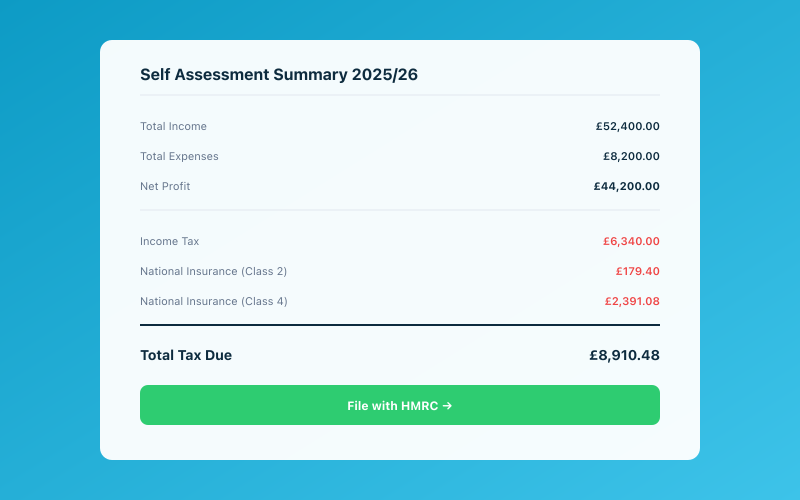 Your Accounted dashboard shows your real-time tax position
Here's the basic idea: if you're a management consultant on the flat rate scheme, your sector rate is 14%. You charge clients 20% VAT but only pay HMRC 14% of gross turnover. The 6% gap is yours to keep.
How It Works
Under standard VAT: VAT on sales – VAT on purchases = Amount owed to HMRC
Under the Flat Rate Scheme: Gross turnover × your flat rate percentage = Amount owed to HMRC
You still charge customers the standard 20% VAT. The difference is how you calculate your payment to HMRC. You ignore VAT on most purchases (except capital assets over £2,000 including VAT).
A Worked Example
A freelance graphic designer with a 14.5% flat rate invoices £10,000 + £2,000 VAT = £12,000 gross. Purchases total £1,500 + £300 VAT.
Standard VAT: £2,000 – £300 = £1,700 owed Flat Rate Scheme: £12,000 × 14.5% = £1,740 owed
In this case, FRS costs £40 more. But if purchases were only £500 + £100 VAT, standard VAT would mean paying £1,900, while FRS stays at £1,740. The less you spend on VAT-able purchases, the more FRS benefits you.
Flat Rate Percentages by Sector
| Business Type | Flat Rate % | |--------------|------------| | Accountancy or bookkeeping | 14.5% | | Computer and IT consultancy | 14.5% | | Management consultancy | 14% | | Journalism or photography | 11% | | Hairdressing or beauty | 13% | | Building or construction | 9.5% | | Food or drink retail | 4% | | Cleaning services | 12% | | Transport or storage | 10% |
HMRC lists over 50 categories. If your business spans multiple, use the rate for the highest-turnover category.
First-Year Discount
In your first year of VAT registration, you get a 1% discount on your flat rate. So 14.5% becomes 13.5% for 12 months from your VAT registration date.
The Limited Cost Trader Test
If you're classified as a limited cost trader, your rate jumps to 16.5% regardless of sector. At 16.5%, FRS rarely saves money.
You're a limited cost trader if your goods purchases (not services) are either:
- Less than 2% of gross turnover, or
- Less than £1,000 per year (£250 per quarter)
"Goods" means physical items — stock, materials, stationery, fuel. It excludes services, capital assets, food/drink for staff, and vehicles. Most service businesses — consultants, designers, copywriters — will be limited cost traders.
When FRS Saves Money
FRS works well when:
- Your sector rate is low (construction at 9.5%, food retail at 4%)
- You have few VAT-able purchases
- You pass the limited cost trader test
- You're in your first year of VAT registration
FRS costs you money when:
- You're a limited cost trader (16.5% rate)
- You make significant VAT-able purchases you'd otherwise reclaim
- Your sector rate is 14% or above
How to Join and Leave
Joining: You must be VAT-registered with expected turnover of £150,000 or less in the next 12 months. Apply through your HMRC Government Gateway account.
Leaving: You must leave if your total business income exceeds £230,000 in any 12-month period. You can leave voluntarily at any time by writing to HMRC. After leaving, you must wait 12 months before rejoining.
Making the Decision
The best way to decide is to run the numbers for your specific business. Take your last four quarters and calculate what you would have paid under both methods:
- Standard VAT: VAT on sales minus VAT on purchases
- Flat Rate: Gross turnover multiplied by your sector rate (or 16.5% if limited cost trader)
If you're using MTD-compatible software, you can often run both calculations side by side. The answer will be clear from the numbers.
As a rough rule of thumb: if you spend less than about 40% of your turnover on VAT-able goods and services, the flat rate scheme is worth investigating. If you're a service business buying mainly other services, check the limited cost trader test first — it's likely to push you to 16.5%, which almost always costs more than standard VAT.
Remember that the first-year 1% discount can tip the balance. Even if FRS is marginal in year two, it might save you money in year one after registering for VAT.
Get Started with Accounted
Whether you're on the Flat Rate Scheme or standard VAT, Accounted handles your MTD VAT submissions seamlessly. Penny tracks your VAT automatically and submits returns directly to HMRC. Start your free trial today — no credit card required.
Further Reading
- View the current income tax rates on GOV.UK.
- HMRC lists all allowable expenses for self-employed individuals.
Related Reading
Penny, your AI bookkeeper, tracks your tax position in real time and flags opportunities to reduce your bill. Meet Penny →
Tax & Compliance Specialists
Our tax specialists have decades of combined experience in UK sole trader and small business taxation, MTD compliance, and HMRC submissions. All content is reviewed against current HMRC guidance before publication and updated quarterly to reflect legislative changes.
Ready to try Accounted?
Join UK sole traders who are simplifying their bookkeeping and tax.
Start your 14-day free trial