Tax-Efficient Pension Withdrawal Strategies for Self-Employed
After years of building up pension savings, the way you withdraw that money can make a significant difference to how much tax you pay. Self-employed people have more flexibility — and more complexity — when it comes to managing pension income alongside potentially variable self-employment earnings.
This guide covers the key strategies for withdrawing from your pension in a tax-efficient way, including the 25% tax-free lump sum, the choice between drawdown and annuity, managing your income to stay within the basic rate band, and the Money Purchase Annual Allowance (MPAA) that applies if you access your pension early.
The 25% Tax-Free Lump Sum
The headline benefit of pension withdrawals is the 25% tax-free lump sum. When you access your defined contribution pension (also called a money purchase pension), you can take 25% of the fund value completely free of income tax.
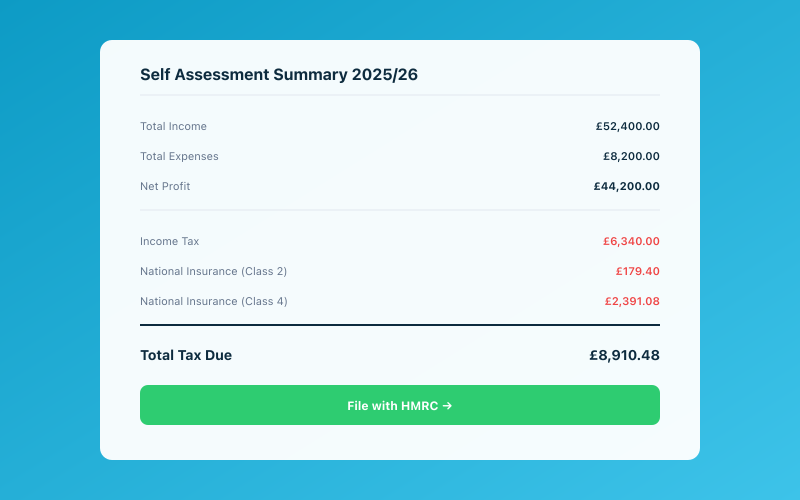 Your Accounted dashboard shows your real-time tax position
How It Works
You can take the 25% tax-free element in two ways:
-
As a single lump sum: Take 25% of your total pension pot as one tax-free payment. The remaining 75% stays invested and is taxed as income when you withdraw it.
-
In stages (uncrystallised funds pension lump sum — UFPLS): Each time you make a withdrawal, 25% of that withdrawal is tax-free and 75% is taxable. This approach allows you to spread your tax-free entitlement over multiple withdrawals.
Which Approach Is Better?
Taking the lump sum upfront gives you immediate access to a large tax-free amount, which can be useful for paying off a mortgage, making a large purchase, or investing elsewhere.
Taking it in stages through UFPLS can be more tax-efficient over time because:
- Each withdrawal has its own 25% tax-free portion
- You have more control over how much taxable income you receive each year
- You can manage your withdrawals to stay within lower tax bands
The right approach depends on your overall financial situation and what you need the money for. There is no one-size-fits-all answer.
The Lump Sum Allowance
The tax-free lump sum is subject to the Lump Sum Allowance (LSA) of £268,275 (for the 2025/26 tax year). This is the maximum amount you can take as tax-free lump sums across all your pension schemes during your lifetime. If you have transitional protection from the old Lifetime Allowance regime, your LSA may be higher.
For most self-employed people, pension funds are well below this threshold, but it is worth being aware of if you have multiple pension schemes or if your investments have performed exceptionally well.
Drawdown vs Annuity
Once you have taken your tax-free lump sum (or decided to take it in stages), you need to decide how to access the remaining taxable portion of your pension. The two main options are flexi-access drawdown and an annuity.
Flexi-Access Drawdown
With drawdown, your pension fund stays invested and you withdraw income as you need it. You choose how much to take and when.
Advantages:
- Complete flexibility over the amount and timing of withdrawals
- Your pension fund continues to grow (potentially) while you draw from it
- You can adjust withdrawals based on your other income each year
- Any remaining fund can be passed to beneficiaries on death (usually tax-free if you die before 75)
Disadvantages:
- Investment risk — your fund can go down as well as up
- Longevity risk — you could run out of money if you live longer than expected
- Requires ongoing management and decision-making
- Income is not guaranteed
Annuity
An annuity provides a guaranteed income for life in exchange for all or part of your pension fund. You hand over your fund to an insurance company, and they pay you a regular income.
Advantages:
- Guaranteed income for life — no risk of running out
- No investment decisions to make
- Predictable and stable income for tax planning
Disadvantages:
- Once purchased, you generally cannot change or cancel it
- Your fund is gone — nothing to pass to beneficiaries on death (unless you buy a guarantee period or joint-life annuity)
- Annuity rates may not keep pace with inflation unless you buy an inflation-linked annuity
- You lose flexibility
Managing Income to Stay in the Basic Rate Band
One of the most effective tax strategies for pension withdrawals is managing your total income to stay within the basic rate band (up to £50,270 in 2025/26).
Why This Matters
Income tax rates for pension withdrawals (after the 25% tax-free portion) are:
| Tax band | Rate | |---|---| | Personal allowance (up to £12,570) | 0% | | Basic rate (£12,571 to £50,270) | 20% | | Higher rate (£50,271 to £125,140) | 40% | | Additional rate (over £125,140) | 45% |
The jump from 20% to 40% is significant. If you can keep your total taxable income (from all sources) within the basic rate band, you halve the tax on each additional pound of pension income.
Strategies for Staying in the Basic Rate Band
Combine Tax-Free and Taxable Withdrawals
If you need £30,000 of pension income, taking it as UFPLS means £7,500 is tax-free and £22,500 is taxable. Combined with the personal allowance, you would pay no tax on the first £12,570 and 20% on the remaining £9,930 — a total tax bill of £1,986.
Spread Withdrawals Across Tax Years
Rather than taking large lump sums, spread withdrawals across multiple tax years to keep each year's income below the higher rate threshold. This is particularly effective in the years between stopping work and reaching State Pension age.
Coordinate with Self-Employment Income
If you are still self-employed but winding down, time your pension withdrawals for years when your self-employment income is lower. This allows you to fill up the basic rate band with pension income without pushing into the higher rate.
The Personal Allowance Trap
Be particularly careful if your total income (including pension withdrawals) approaches £100,000. Between £100,000 and £125,140, the personal allowance is tapered away at a rate of £1 for every £2 of income above £100,000. This creates an effective marginal tax rate of 60% in this band.
If possible, keep your total income either below £100,000 or above £125,140 to avoid this trap. Large one-off pension withdrawals can accidentally push you into this zone.
The Money Purchase Annual Allowance (MPAA)
If you access your pension flexibly — by taking income through drawdown or UFPLS — you trigger the Money Purchase Annual Allowance (MPAA). This is one of the most important rules for self-employed people who may still want to contribute to a pension.
What the MPAA Does
Once triggered, the MPAA reduces the amount you can contribute to a money purchase pension (and still receive tax relief) from the standard £60,000 annual allowance to just £10,000 per year.
When the MPAA Is Triggered
The MPAA is triggered when you take taxable income from your pension. Specifically:
- Taking a UFPLS (25% tax-free, 75% taxable)
- Taking income from flexi-access drawdown
- Taking income from a flexible annuity
The MPAA is not triggered by:
- Taking your 25% tax-free lump sum on its own (without touching the remaining fund)
- Buying a lifetime annuity
- Taking small pot lump sums (from pots worth £10,000 or less)
Why This Matters for Self-Employed People
Many self-employed people have variable income. In a good year, you might want to make large pension contributions to reduce your tax bill. But if you have already triggered the MPAA by accessing your pension, your contribution limit is capped at £10,000.
This is a permanent restriction — once triggered, the MPAA applies for the rest of your life. You cannot undo it.
Planning Around the MPAA
If you think you may want to make substantial pension contributions in the future (for example, if your business income is expected to increase), consider delaying flexible access to your pension. Alternatives include:
- Taking your 25% tax-free lump sum only (without touching the remaining 75%)
- Buying a lifetime annuity (which does not trigger the MPAA)
- Using other savings or investments before touching your pension
Let Accounted Help You Plan
While Accounted is primarily a bookkeeping tool, understanding your self-employment income is essential for pension planning. Accounted gives you a clear, real-time view of your business profits, and Penny, your AI bookkeeper, tracks your income throughout the year — so you can make informed decisions about pension contributions and withdrawals based on accurate, up-to-date figures. Start your free trial and take control of your financial picture.
Related Reading
-
The Pension Annual Allowance: What Happens If You Exceed £60,000?
-
Annual Investment Allowance Explained: Claim 100% of Equipment Costs
Start your free trial and let Penny handle your bookkeeping automatically.
Penny, your AI bookkeeper, tracks your tax position in real time and flags opportunities to reduce your bill. Meet Penny →
Tax & Compliance Specialists
Our tax specialists have decades of combined experience in UK sole trader and small business taxation, MTD compliance, and HMRC submissions. All content is reviewed against current HMRC guidance before publication and updated quarterly to reflect legislative changes.
Ready to try Accounted?
Join UK sole traders who are simplifying their bookkeeping and tax.
Start your 14-day free trial