How Much Should Self-Employed People Put Into a Pension?
You know you should be saving into a pension. But how much? Too little and you will not have enough to retire on. Too much and your business might struggle with cash flow today. This guide gives you practical numbers, worked examples at different income levels, and strategies to make your pension contributions work harder for the 2025/26 tax year.
The Simple Rule of Thumb
A widely used guideline is to take the age at which you start saving for a pension, halve it, and save that percentage of your income each year. So if you start at 30, aim for 15%. Start at 40, aim for 20%.
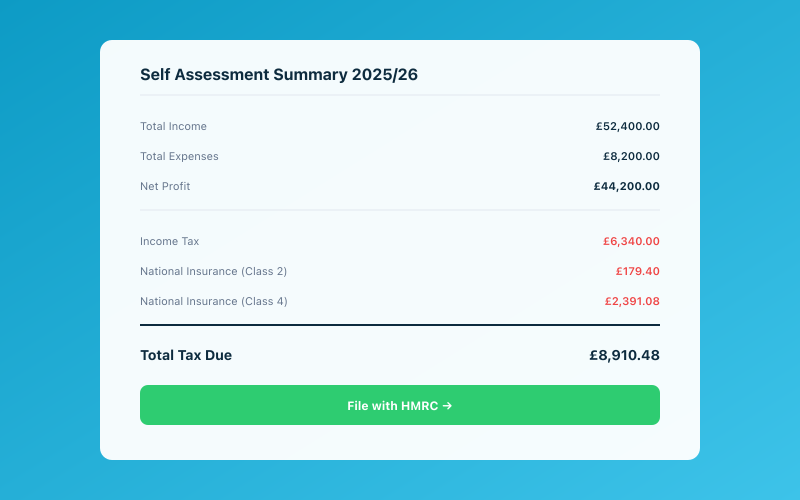 Your Accounted dashboard shows your real-time tax position
That is a useful starting point, but it assumes consistent contributions over many years. Self-employed income is rarely consistent. A more practical approach for most sole traders and freelancers is to aim for 10-15% of your annual profit, adjusting up in good years and down in lean ones.
The key point: something is always better than nothing. If 10% feels like too much right now, start with 5% and increase it over time. The tax relief alone makes every contribution worth more than it costs you.
The Annual Allowance: Your Ceiling
For 2025/26, the annual allowance is £60,000. This is the maximum amount of pension contributions that receive tax relief in a single tax year. It covers everything — your personal contributions, any employer contributions (if you are also employed), and the tax relief added by your pension provider.
There is an important catch: your tax-relieved contributions cannot exceed your relevant UK earnings. If your self-employed profit is £40,000, the most you can contribute with tax relief is £40,000, not £60,000.
If you have no relevant earnings in a tax year, you can still contribute up to £3,600 gross (you pay £2,880 and the provider claims £720 in basic rate relief). This can be useful in a year when your business makes a loss.
How Tax Relief Boosts Your Contributions
Tax relief is the reason pensions are the best savings vehicle for most people. Here is how it works at each tax band for 2025/26.
Basic rate taxpayers (earnings £12,571 to £50,270)
You get 20% tax relief. For every £80 you pay in, the pension provider claims £20 from HMRC, putting £100 into your pension. Your actual cost per £100 contributed: £80.
Higher rate taxpayers (earnings £50,271 to £125,140)
You get 40% tax relief in total. The provider claims 20% automatically, and you claim the other 20% through Self Assessment. Your actual cost per £100 contributed: £60.
Additional rate taxpayers (earnings over £125,140)
You get 45% tax relief in total. Your actual cost per £100 contributed: £55.
This means higher earners get proportionally more benefit from pension contributions. If you are close to the higher rate threshold, a pension contribution can keep you in the basic rate band, effectively giving you 40% relief on that portion.
Worked Examples at Different Income Levels
Let us look at what sensible pension contributions might look like for self-employed people at different income levels.
Example 1: Sole trader earning £30,000 profit
Contribution: 10% = £3,000 per year (£250 per month)
After basic rate tax relief, this only costs £2,400 out of pocket (you pay £200 per month, the provider adds £50).
Over 25 years at a 5% average annual return, this could grow to roughly £150,000. That is not a fortune, but combined with the state pension it provides a reasonable base.
Tax saving: £600 per year in tax relief added to your pot.
Example 2: Freelancer earning £50,000 profit
Contribution: 12% = £6,000 per year (£500 per month)
At this income level, you are right at the edge of the higher rate threshold (£50,270 for 2025/26). A £6,000 pension contribution reduces your taxable income to £44,000, keeping you entirely within the basic rate band.
Without the pension contribution, you would pay 40% tax on roughly £5,730 of your income (the bit above £50,270, offset by your personal allowance). The pension contribution saves you about £1,146 in additional tax.
After basic rate relief at source: you pay £4,800 and the provider adds £1,200. You would then also claim back the higher rate relief on the portion that falls above the higher rate threshold through Self Assessment.
Over 25 years at 5% growth: approximately £300,000.
Example 3: Contractor earning £80,000 profit
Contribution: 15% = £12,000 per year (£1,000 per month)
With a profit of £80,000, a good chunk of your income falls in the 40% tax band. A £12,000 pension contribution reduces your taxable income to £68,000, cutting the amount taxed at 40%.
You pay £9,600 per year (£800 per month). The provider adds £2,400 in basic rate relief. You then claim an additional £2,400 in higher rate relief through Self Assessment, which comes off your tax bill.
Effective cost: £7,200 per year for a £12,000 contribution.
Over 25 years at 5% growth: approximately £600,000.
Example 4: High-earning consultant at £120,000
Contribution: £30,000 per year
At this income level, maximising pension contributions becomes a serious tax planning tool. A £30,000 contribution reduces taxable income from £120,000 to £90,000.
But there is an extra benefit here. Once your income goes above £100,000, you start losing your personal allowance — it reduces by £1 for every £2 of income over £100,000. This creates an effective marginal tax rate of 60% on income between £100,000 and £125,140.
A £30,000 pension contribution brings income to £90,000, well below the £100,000 threshold. This restores the full personal allowance (£12,570), meaning you avoid that 60% effective tax rate on a big slice of income.
Tax relief on the contribution: up to 60% effective rate on part of it. That makes the real cost of a £30,000 contribution significantly less than £30,000.
Using Carry Forward for Bumper Years
If you have a particularly good year, you can use carry forward to contribute more than £60,000 and still get tax relief. Carry forward lets you use unused annual allowance from the previous three tax years.
For example, if you only contributed £10,000 in each of the last three years, you have £50,000 of unused allowance per year (£60,000 minus £10,000), giving you £150,000 of carry forward. Add that to the current year's £60,000 and you could contribute up to £210,000 in one year, as long as your earnings support it.
This is especially useful for self-employed people whose income varies significantly. You do not need to contribute the same amount every year. Contribute what you can, and make up for it in good years.
How Pension Contributions Interact with Tax Bands
Pension contributions reduce your taxable income, which can have knock-on effects beyond the direct tax saving.
Staying below the higher rate threshold
If your income is between £50,271 and about £60,000, a pension contribution can bring you back into the basic rate band. This saves 40% tax on the amount you contribute that would otherwise have been taxed at 40%.
Protecting your personal allowance
As mentioned above, income over £100,000 triggers a loss of personal allowance. Pension contributions reduce income for this purpose, potentially saving you 60% on every pound contributed in that range.
Child benefit high income charge
If your income is between £60,000 and £80,000, you may be subject to the High Income Child Benefit Charge (it was £50,000-£60,000 before April 2024). Pension contributions reduce your adjusted net income, which could take you below the threshold and avoid the charge entirely.
Practical Tips for Self-Employed Pension Saving
Start now. Compound growth means starting 10 years earlier can double your pot by retirement, even with the same total contributions.
Automate it. Set up a monthly direct debit to your pension on the day your biggest client typically pays. Treat it like a bill.
Increase contributions with income. Every time you give yourself a pay rise, increase your pension contribution by at least half the rise amount.
Use good years to catch up. If you have a bumper year, make a lump sum contribution. The tax relief is immediate.
Do not raid the pot. You cannot access your pension until age 57 (rising from 55 in April 2028). That is the point — it is for retirement, not a rainy day fund. Keep a separate emergency fund for short-term needs.
Knowing Your Numbers with Accounted
The hardest part of pension planning when you are self-employed is knowing what you can actually afford. If your books are a mess, you are guessing. Accounted gives you a clear, up-to-date view of your profit so you can make informed decisions about how much to contribute. Penny, the AI bookkeeper, keeps your records tidy and can flag when you have had a strong quarter — the perfect time to top up your pension.
Start your free trial of Accounted and get the clarity you need to plan your pension contributions with confidence, not guesswork.
Related Reading
-
Carry Forward Pension Allowances: Use Previous Years' Unused Allowance
-
Pension Contributions Before Tax Year End: Why April Matters
-
Loss Relief for Sole Traders: How to Use Business Losses to Reduce Tax
Start your free trial and let Penny handle your bookkeeping automatically.
Penny, your AI bookkeeper, tracks your tax position in real time and flags opportunities to reduce your bill. Meet Penny →
Tax & Compliance Specialists
Our tax specialists have decades of combined experience in UK sole trader and small business taxation, MTD compliance, and HMRC submissions. All content is reviewed against current HMRC guidance before publication and updated quarterly to reflect legislative changes.
Ready to try Accounted?
Join UK sole traders who are simplifying their bookkeeping and tax.
Start your 14-day free trial