Tax Year End Planning: 15 Things to Do Before 5 April 2026
The tax year ends on 5 April 2026. Once that date passes, any unused allowances and reliefs for 2025/26 are gone for good. You cannot carry most of them forward. Use them or lose them.
This is your practical checklist of 15 things to review before the deadline. Some take five minutes. Others might need a conversation with your accountant. All of them could save you money.
1. Use Your Personal Allowance
Everyone gets a personal allowance of £12,570 for the 2025/26 tax year. Income up to this amount is tax-free. If you are not using it — for example, if your income is being paid through a company without a salary, or you have not taken enough drawings — you are wasting free tax relief.
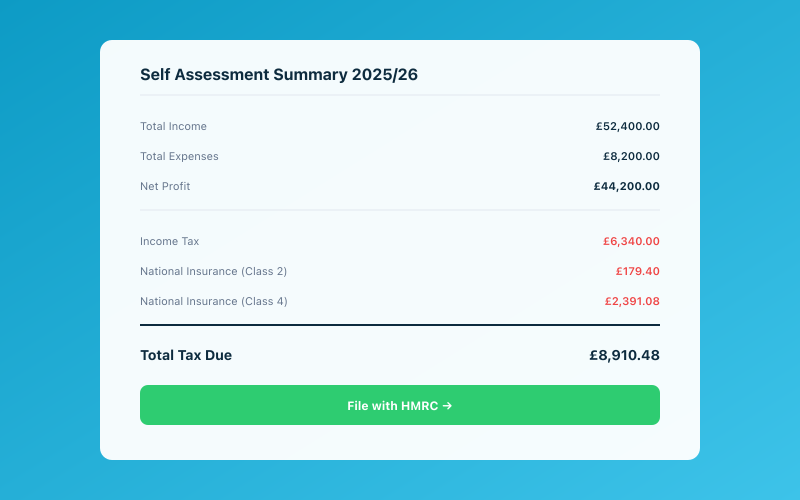 Your Accounted dashboard shows your real-time tax position
For company directors: make sure you have paid yourself at least £12,570 in salary before 5 April.
2. Use Your ISA Allowance
You can put up to £20,000 into an ISA in the 2025/26 tax year. All returns inside an ISA — interest, dividends, and capital gains — are completely tax-free. If you have spare cash sitting in a taxable savings account, moving it into a Cash ISA or Stocks and Shares ISA before 5 April is one of the simplest tax-saving moves available.
The £20,000 limit resets on 6 April 2026. If you do not use this year's allowance, you cannot add it to next year's.
3. Maximise Pension Contributions
Pension contributions are one of the most powerful tax reliefs available. You can contribute up to £60,000 a year (the annual allowance) and get tax relief at your marginal rate.
If you are a basic rate taxpayer, every £80 you put into a pension becomes £100 thanks to automatic tax relief. Higher rate taxpayers can claim an extra 20% through Self Assessment, making a £60 net cost for every £100 in the pension. Additional rate taxpayers benefit even more.
Carry Forward Unused Allowance
If you did not use your full £60,000 allowance in the previous three tax years (2022/23, 2023/24, or 2024/25), you can carry forward the unused portion and use it this year. This lets you make a much larger contribution — potentially up to £180,000 or more on top of this year's £60,000.
Check your pension statements from the last three years to see how much headroom you have.
4. Use the Dividend Allowance
The dividend allowance for 2025/26 is £500. Dividends within this allowance are tax-free, regardless of which tax band they fall into. If you are a company director who has not yet declared any dividends, consider declaring at least £500 before 5 April.
The allowance cannot be carried forward.
5. Use the Capital Gains Tax Annual Exemption
You can make capital gains of up to £3,000 in the 2025/26 tax year without paying CGT. This exemption cannot be carried forward to next year.
If you have investments showing a gain and you were planning to sell, consider selling before 5 April to use this year's exemption. You could even sell and immediately repurchase (known as "bed and ISA" if you buy back inside an ISA, or "bed and spouse" if your partner buys them), though be aware of the 30-day rule for buying back the same shares.
6. Harvest Capital Losses
If you have investments that are sitting at a loss, consider selling them before 5 April. Capital losses can be offset against capital gains in the same year, or carried forward indefinitely to use against future gains.
This is called tax-loss harvesting. It does not create cash out of thin air, but it can reduce your CGT bill now or in the future.
7. Time Your Dividends Carefully
If you are a company director, think about whether to declare dividends before or after 5 April. It depends on your overall income:
- If taking more dividends this year would push you into a higher tax band, consider waiting until after 6 April.
- If you have unused basic rate band this year but expect to be in a higher band next year, take dividends before 5 April.
- If your income is just above £100,000, be careful — every £2 of income above £100,000 reduces your personal allowance by £1, creating an effective 60% tax rate between £100,000 and £125,140.
8. Record All Business Expenses
Go through your bank statements, credit card bills, and receipts for the whole tax year. Are there business expenses you have forgotten to record? Materials, tools, travel, subscriptions, phone bills, insurance, training courses — every legitimate expense reduces your taxable profit.
This is one area where keeping on top of things throughout the year pays off. If you use Accounted, Penny has been categorising your expenses as they happen, so there should be nothing to catch up on. If you have been using a shoebox method, now is the time to empty that shoebox.
9. Review Trading Losses
If your business made a loss in 2025/26, you have several options:
- Carry the loss forward to offset against future profits from the same trade
- Offset the loss against your other income in the same year
- Carry the loss back to offset against income in the previous year
The right choice depends on your overall income picture. If you had a profitable year last year and a loss this year, carrying back could generate a tax refund. Talk to your accountant about the best option.
10. Make Gift Aid Donations
Charitable donations made through Gift Aid are a tax-efficient way to support causes you care about. The charity claims back basic rate tax (25p for every £1 you give), and if you are a higher or additional rate taxpayer, you can claim the extra relief through Self Assessment.
You can also carry back Gift Aid donations. A donation made between 6 April 2026 and 31 January 2027 (the SA filing deadline) can be treated as if it was made in 2025/26, useful if you were in a higher tax band this year than you expect to be next year.
11. Check Your Marriage Allowance
If you are married or in a civil partnership, and one of you earns less than £12,570 while the other is a basic rate taxpayer, the lower earner can transfer £1,260 of their personal allowance to the higher earner. This saves up to £252 in tax.
You can apply for Marriage Allowance through GOV.UK. If you have not claimed it for earlier years, you can backdate it by up to four years.
12. Pay Your Student Loan Correctly
If you are self-employed with a student loan, your repayments are calculated through Self Assessment. Make sure you know which plan you are on and that the correct plan type is recorded, because the repayment thresholds differ. Overpaying because the wrong plan is on your return is money you will have to claim back.
13. Review Your Tax Code
If you are employed alongside your self-employment (or you receive a pension), check that your tax code is correct. An incorrect tax code can mean you overpay or underpay tax throughout the year. Your latest payslip or P60 will show your code. If it looks wrong, contact HMRC.
14. Plan for Payments on Account
If your Self Assessment bill was more than £1,000 for 2024/25, HMRC will have asked you to make payments on account towards your 2025/26 bill. These are two instalments, each half of the previous year's bill, due on 31 January and 31 July.
If your income has dropped significantly this year, you can apply to reduce your payments on account. Do this before 31 January to avoid paying more than you owe and then waiting for a refund.
15. Tidy Up Your Records
Beyond immediate tax savings, make sure your records for the 2025/26 tax year are complete and organised. You need to keep them for at least five years after the 31 January submission deadline (so until January 2033 at the latest for this year's return).
Make sure you have:
- Bank statements for all business accounts
- Receipts for all expenses
- Invoices issued and received
- Mileage logs
- Records of any assets bought or sold
- Pension contribution statements
- Dividend vouchers (if you run a company)
Having everything in order now saves hours when it comes time to prepare your tax return, and protects you if HMRC opens an enquiry.
Do Not Leave It to the Last Minute
Every year, people lose out because they leave tax year end planning too late. Pension providers get overwhelmed with contribution requests in late March. ISA applications take time to process. Accountants are swamped.
Start working through this list now. Some items — like ISA contributions and pension top-ups — need to be completed before 5 April, which is closer than you think.
Accounted helps you stay on top of your finances all year, so tax year end is a review rather than a panic. Penny tracks your income, expenses, and allowances automatically, flagging anything that needs attention before the deadline. Start your free trial today and make this your most organised tax year yet.
Related Reading
Start your free trial and let Penny handle your bookkeeping automatically.
Penny, your AI bookkeeper, tracks your tax position in real time and flags opportunities to reduce your bill. Meet Penny →
Tax & Compliance Specialists
Our tax specialists have decades of combined experience in UK sole trader and small business taxation, MTD compliance, and HMRC submissions. All content is reviewed against current HMRC guidance before publication and updated quarterly to reflect legislative changes.
Ready to try Accounted?
Join UK sole traders who are simplifying their bookkeeping and tax.
Start your 14-day free trial