What is the VAT Flat Rate Scheme and Should You Use It?
If your business is VAT registered and your VAT-taxable turnover is £150,000 or less (excluding VAT), you may be eligible for the VAT Flat Rate Scheme. Instead of calculating the exact VAT you owe by subtracting input VAT from output VAT on every single transaction, you simply pay a fixed percentage of your gross turnover to HMRC. For some businesses, this saves both time and money. For others, it costs more than standard VAT accounting.
This guide explains exactly how the Flat Rate Scheme works, lists the rates by trade sector, covers the limited cost trader rule that catches many service businesses, and helps you decide whether it is right for you.
How Standard VAT Works (A Quick Recap)
Under normal VAT accounting, you charge VAT on your sales (output VAT) and reclaim the VAT you pay on business purchases (input VAT). Every quarter, you pay the difference to HMRC. If you charged more VAT than you paid, you owe HMRC. If you paid more than you charged, HMRC refunds the difference.
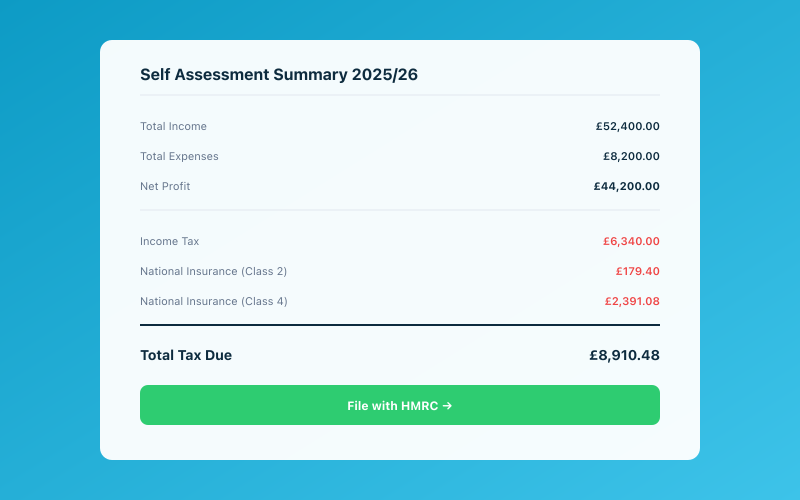 Your Accounted dashboard shows your real-time tax position
This system requires you to track the VAT on every purchase and sale, separate items at different VAT rates, and keep detailed records. For businesses with lots of transactions, it is time-consuming.
How the Flat Rate Scheme Works
Under the Flat Rate Scheme, you still charge VAT to your customers at the standard rate (20%) on your invoices. However, instead of calculating your VAT liability by netting off input and output VAT, you pay HMRC a flat percentage of your VAT-inclusive (gross) turnover.
The percentage depends on your type of business and is lower than 20%, because it is designed to account for the input VAT you would otherwise reclaim. The difference between what you charge your customers (20%) and what you pay HMRC (your flat rate) is yours to keep.
A Simple Example
Suppose you are a management consultant and your flat rate is 14%. In a quarter, you invoice clients £12,000 plus VAT of £2,400, giving a gross total of £14,400.
Under standard VAT, you would pay HMRC the £2,400 output VAT minus any input VAT on your purchases. If you spent £1,000 plus £200 VAT on business costs, you would owe £2,400 minus £200 = £2,200.
Under the Flat Rate Scheme, you pay HMRC 14% of £14,400 = £2,016.
In this example, the Flat Rate Scheme saves you £184 per quarter — £736 per year.
Flat Rate Percentages by Trade Sector
HMRC publishes a list of flat rate percentages for different types of business. Here are some of the most common:
| Business type | Flat rate % | |---------------|------------| | Accountancy or book-keeping | 14.5% | | Advertising | 11% | | Computer and IT consultancy or data processing | 14.5% | | Computer repair services | 10.5% | | Estate agency or property management | 12% | | Hairdressing or other beauty treatment | 13% | | Journalism or publishing | 12% | | Labour-only building or construction | 14.5% | | Management consultancy | 14% | | Photography | 11% | | Plumbing or heating | 9.5% | | Real estate activities | 14% | | Secretarial services | 13% | | Transport or storage | 10% | | Any other activity not listed | 12% |
The full list is available on GOV.UK. If your business does not fit neatly into one category, use the one that most closely matches your main business activity.
First-Year Discount
In your first year of VAT registration, you get a 1% discount on your flat rate. So if your normal flat rate would be 14%, you pay 13% in year one. This makes the scheme particularly attractive for newly VAT-registered businesses.
The Limited Cost Trader Rule
This is the rule that catches many service businesses. If you are a limited cost trader, your flat rate is fixed at 16.5% regardless of your trade sector.
What Is a Limited Cost Trader?
You are a limited cost trader if your spending on goods (not services) in a VAT quarter is either:
- Less than 2% of your VAT-inclusive turnover, or
- Less than £1,000 (if your VAT-inclusive turnover is more than £50,000 per quarter)
"Goods" in this context means physical items that you buy and use in your business. It does not include:
- Services (accountancy fees, insurance, software subscriptions)
- Capital expenditure (equipment that would normally be claimed as a capital allowance)
- Food and drink for yourself or your staff
- Vehicle costs (fuel, repairs, insurance)
For many service businesses — consultants, freelancers, IT contractors, designers — expenditure on physical goods is very low. A consultant who spends most of their money on software subscriptions, train fares, and professional fees may easily fall below the 2% threshold, making them a limited cost trader.
Why 16.5% Matters
At a flat rate of 16.5%, the Flat Rate Scheme almost always costs you more than standard VAT accounting. Here is why:
If your turnover including VAT is £14,400 (that is, £12,000 plus £2,400 VAT), your Flat Rate payment to HMRC would be 16.5% of £14,400 = £2,376.
Under standard VAT, you would pay the full £2,400 minus any input VAT you reclaim. Even if your input VAT is very small — say £100 — you would owe £2,300, which is still less than £2,376. And if your input VAT is higher than £24, standard VAT is cheaper.
In short, the limited cost trader rule was introduced in 2017 specifically to prevent service businesses from profiting from the Flat Rate Scheme when their goods purchases were negligible. If you are a limited cost trader, the Flat Rate Scheme is almost certainly not worth it.
When the Flat Rate Scheme Saves You Money
The scheme tends to save money when:
- Your flat rate is relatively low — businesses like plumbing (9.5%), transport (10%), or photography (11%) have lower rates that leave a bigger margin between what you charge and what you pay.
- You have few reclaimable purchases — if your input VAT would be low under standard VAT anyway, the flat rate percentage is likely to work in your favour.
- You are not a limited cost trader — you spend a meaningful amount on physical goods.
- You are in your first year — the 1% discount makes the scheme more attractive.
When the Flat Rate Scheme Costs You More
The scheme tends to cost more when:
- You are a limited cost trader — the 16.5% rate is rarely beneficial.
- You have high input VAT — if you regularly buy goods and services with significant VAT, you would reclaim more under standard VAT than you save with the flat rate.
- You make a large capital purchase — under the Flat Rate Scheme, you can only reclaim VAT on individual capital purchases of £2,000 or more (including VAT). All other input VAT is absorbed into the flat rate. If you buy a laptop for £1,500 including VAT, you cannot reclaim the VAT on it under the scheme.
Eligibility and How to Join
To join the Flat Rate Scheme, your VAT-taxable turnover (excluding VAT) must be £150,000 or less. You apply through your VAT online account or by writing to HMRC.
You must leave the scheme if your total business income (including VAT and non-VATable income) exceeds £230,000 in any 12-month period, or if you are no longer eligible for another reason.
You can leave voluntarily at any time by writing to HMRC, though you must stay on the scheme for at least 12 months after joining.
Flat Rate Scheme and Making Tax Digital
The Flat Rate Scheme is fully compatible with Making Tax Digital (MTD) for VAT. You still need to keep digital records and file your VAT returns through MTD-compatible software. The only difference is how your VAT liability is calculated.
How to Decide
Run the numbers for a typical quarter. Calculate your VAT liability under both standard VAT and the Flat Rate Scheme, and compare them. If the flat rate saves you money consistently, join. If it does not, stick with standard VAT.
Remember to check whether you are a limited cost trader. Many businesses assume they will benefit from the scheme without realising the 16.5% rule applies to them.
How Accounted Helps with VAT
Whether you are on the Flat Rate Scheme or standard VAT, Accounted handles your VAT calculations automatically. Penny tracks every transaction, applies the correct VAT treatment, and prepares your quarterly VAT return. If you are considering the Flat Rate Scheme, Accounted can show you a side-by-side comparison of what you would pay under each method, so you can make an informed decision.
Start your free trial of Accounted today and let Penny manage your VAT — whether you are on the Flat Rate Scheme, standard accounting, or still deciding.
Related Reading
Start your free trial and let Penny handle your bookkeeping automatically.
Penny, your AI bookkeeper, tracks your tax position in real time and flags opportunities to reduce your bill. Meet Penny →
Tax & Compliance Specialists
Our tax specialists have decades of combined experience in UK sole trader and small business taxation, MTD compliance, and HMRC submissions. All content is reviewed against current HMRC guidance before publication and updated quarterly to reflect legislative changes.
Ready to try Accounted?
Join UK sole traders who are simplifying their bookkeeping and tax.
Start your 14-day free trial