Flat Rate VAT and Limited Cost Traders: Is It Still Worth It?
The VAT Flat Rate Scheme (FRS) was once a straightforward way for small businesses to simplify their VAT accounting and often keep a small profit in the process. Then, in April 2017, the limited cost trader rules arrived and changed the calculation for many businesses. If you spend very little on goods, you may now pay more VAT under the flat rate scheme than under standard VAT accounting. This guide explains how the limited cost trader test works, which businesses still benefit from the scheme, and how to decide whether it is right for you.
How the Flat Rate Scheme Works
Under the standard VAT system, you charge VAT on your sales (output tax) and reclaim VAT on your purchases (input tax), paying the difference to HMRC. Under the Flat Rate Scheme, you charge VAT to your customers at the normal rate (20%) but pay HMRC a fixed percentage of your gross (VAT-inclusive) turnover. You do not reclaim input tax on your purchases (with the exception of capital assets costing £2,000 or more including VAT).
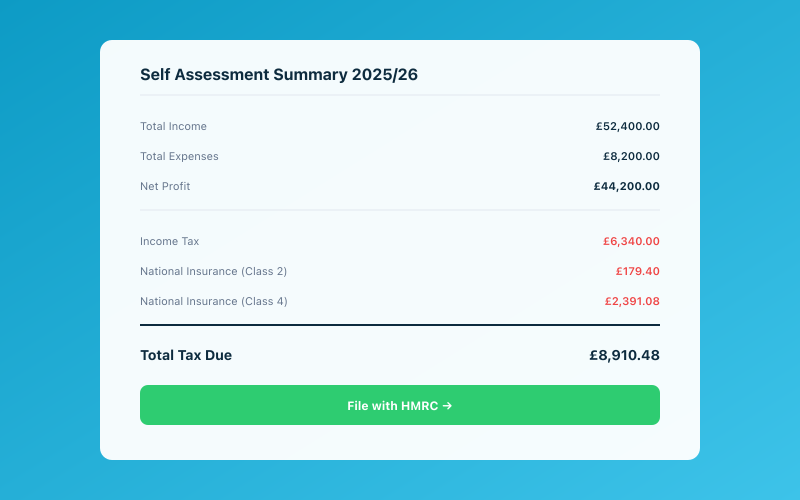 Your Accounted dashboard shows your real-time tax position
The flat rate percentage varies by business sector, ranging from 4% for retailing of food and children's clothing to 14.5% for computer and IT consultancy. The idea is that the flat rate is set lower than 20% to account for the input tax you cannot reclaim. If your actual input tax is lower than the difference between 20% and your flat rate, you keep the surplus.
First-Year Discount
In your first year of VAT registration, you receive a 1% discount on your flat rate percentage. So if your sector rate is 11%, you pay 10% in your first year. This makes the scheme particularly attractive for newly registered businesses.
What Is a Limited Cost Trader?
A limited cost trader is a business whose expenditure on relevant goods (broadly, physical goods used in the business) is either less than 2% of its VAT-inclusive turnover, or less than £1,000 per year (if spending on goods exceeds 2% of turnover but is below £1,000, you are still a limited cost trader).
If you are classified as a limited cost trader, your flat rate percentage is fixed at 16.5%, regardless of your business sector. For most businesses, this makes the flat rate scheme significantly less attractive.
What Counts as "Relevant Goods"?
Relevant goods include physical items purchased for use in the business, such as stock, raw materials, stationery, and office supplies. However, the following are specifically excluded from the definition: capital expenditure (items costing £2,000 or more), food and drink consumed by the business owner or employees, vehicles, vehicle parts, and fuel (unless the business is in the transport sector), and services of any kind.
This exclusion list is critical. Many service-based businesses spend most of their money on services (such as software subscriptions, subcontractors, and professional fees), food and drink, and travel. None of these count towards the 2% threshold.
The 2% Test in Practice
To apply the limited cost trader test, you calculate 2% of your gross (VAT-inclusive) turnover for the VAT period and compare it with your expenditure on relevant goods (excluding the items listed above).
Example 1: IT Consultant
An IT consultant has gross turnover of £30,000 per quarter. Their expenditure on relevant goods (stationery, printer cartridges, a new monitor costing £300) is £450 per quarter.
2% of £30,000 is £600. Since £450 is less than £600, the consultant is a limited cost trader and must use the 16.5% rate.
Under the standard flat rate for IT consultancy (14.5%), the VAT payable would be £4,350 per quarter. As a limited cost trader at 16.5%, the VAT payable is £4,950. Under standard VAT accounting, the consultant would charge £5,000 in output tax (20% of £25,000 net turnover) and reclaim input tax of, say, £200 on their goods, paying £4,800 to HMRC.
In this case, the limited cost trader rate of 16.5% means paying £4,950, which is more than the £4,800 they would pay under standard VAT accounting. The flat rate scheme is not beneficial.
Example 2: Retailer
A small retailer has gross turnover of £24,000 per quarter and spends £10,000 per quarter on stock (relevant goods).
2% of £24,000 is £480. Since £10,000 far exceeds £480, the retailer is not a limited cost trader and can use their sector rate. For general retailing, the flat rate is 7.5%.
VAT payable under the flat rate scheme would be £1,800 per quarter (7.5% of £24,000). Under standard VAT accounting, the retailer would charge £4,000 in output tax (20% of £20,000 net turnover) and reclaim approximately £1,667 in input tax on stock (assuming all stock is standard-rated), paying £2,333 to HMRC.
The flat rate scheme saves £533 per quarter, or £2,132 per year. For retailers and other businesses with significant goods expenditure, the flat rate scheme remains very attractive.
Example 3: Personal Trainer
A personal trainer has gross turnover of £15,000 per quarter. Their only expenditure on relevant goods is £50 per quarter on resistance bands and small equipment.
2% of £15,000 is £300. Since £50 is less than £300, the trainer is a limited cost trader at 16.5%.
VAT payable under the flat rate scheme: £2,475 per quarter. Under standard VAT accounting, the trainer would charge £2,500 in output tax and reclaim approximately £150 in input tax (on equipment, phone, and other business expenses), paying £2,350 to HMRC.
The flat rate scheme costs £125 more per quarter than standard VAT accounting. However, the simplification benefit may still be worthwhile if the trainer values the time saving of not tracking input tax on every purchase.
Which Sectors Still Benefit?
The flat rate scheme generally remains beneficial for businesses that purchase significant amounts of physical goods relative to their turnover. Sectors that tend to benefit include retail, catering and food service, manufacturing, wholesale, and construction (where materials are a large proportion of costs).
Sectors that typically do not benefit (and are likely to be limited cost traders) include consultancy and professional services, IT and software development, personal services (beauty, fitness, tutoring), marketing and creative services, and management and business services.
The Simplification Argument
Even if the flat rate scheme does not save you money, there is a simplification argument. Under the flat rate scheme, you do not need to track and reclaim input tax on every purchase. You simply apply the flat rate to your turnover and pay that amount. For very small businesses with limited accounting resources, this time saving may outweigh a small financial cost.
However, with modern accounting software that automatically categorises transactions and calculates VAT, the simplification benefit is less compelling than it once was. The time difference between flat rate and standard VAT accounting is minimal when software does the heavy lifting.
Joining and Leaving the Scheme
You can join the Flat Rate Scheme if your estimated VAT taxable turnover in the next 12 months is £150,000 or less (excluding VAT). You must leave the scheme if your total business income (including VAT and non-taxable income) exceeds £230,000 in any 12-month period.
You can also leave voluntarily at any time by writing to HMRC. If you determine that the limited cost trader rules make the scheme uneconomical, you are free to switch to standard VAT accounting. It is worth reviewing your position annually to ensure the scheme is still working in your favour.
When you leave, you may need to account for VAT on stock and capital assets held at the date of deregistration or change of scheme, so take professional advice to ensure the transition is handled correctly.
How to Decide
To determine whether the flat rate scheme is right for your business, follow these steps. Calculate your expected gross turnover for the year. Calculate your expected expenditure on relevant goods (excluding the items that do not count). If your goods expenditure is less than 2% of your gross turnover, you are a limited cost trader at 16.5%. Compare the flat rate scheme cost with what you would pay under standard VAT accounting.
If the flat rate scheme costs more, leave and use standard VAT accounting. If it costs less (or roughly the same with the added benefit of simplicity), stay on the scheme.
Review this calculation at least once a year, as changes in your turnover or spending patterns can tip the balance.
Let Accounted and Penny Help
Whether you are on the Flat Rate Scheme or standard VAT accounting, Accounted makes VAT compliance straightforward. The software automatically tracks your turnover and goods expenditure, so you can see at a glance whether you meet the limited cost trader threshold. Penny, your AI bookkeeper, categorises every purchase and flags whether it counts as relevant goods, taking the guesswork out of the 2% test. Start your free trial today and make confident, informed decisions about your VAT scheme.
Further Reading
- View the current income tax rates on GOV.UK.
- HMRC lists all allowable expenses for self-employed individuals.
Related Reading
Start your free trial and let Penny handle your bookkeeping automatically.
Penny, your AI bookkeeper, tracks your tax position in real time and flags opportunities to reduce your bill. Meet Penny →
Tax & Compliance Specialists
Our tax specialists have decades of combined experience in UK sole trader and small business taxation, MTD compliance, and HMRC submissions. All content is reviewed against current HMRC guidance before publication and updated quarterly to reflect legislative changes.
Ready to try Accounted?
Join UK sole traders who are simplifying their bookkeeping and tax.
Start your 14-day free trial