Flat Rate VAT for Limited Companies — Is It Still Worth It?
The Flat Rate VAT scheme has been a popular choice for small businesses since it was introduced back in 2002. The appeal is obvious: simpler VAT accounting, less paperwork, and — for many businesses — the chance to pocket the difference between the flat rate percentage and the standard VAT rate. But since the limited cost trader rules shook things up in 2017, a lot of company directors have been left wondering whether the scheme is still worth the effort.
If you're running a limited company and trying to decide whether the Flat Rate VAT scheme makes sense for your business, this guide will help you weigh it up properly.
How the Flat Rate VAT Scheme Works
Under the standard VAT scheme, you charge VAT on your sales, reclaim VAT on your purchases, and pay HMRC the difference. It works well enough, but it means tracking every bit of input VAT on every purchase — which can be time-consuming, especially if you have a lot of small transactions.
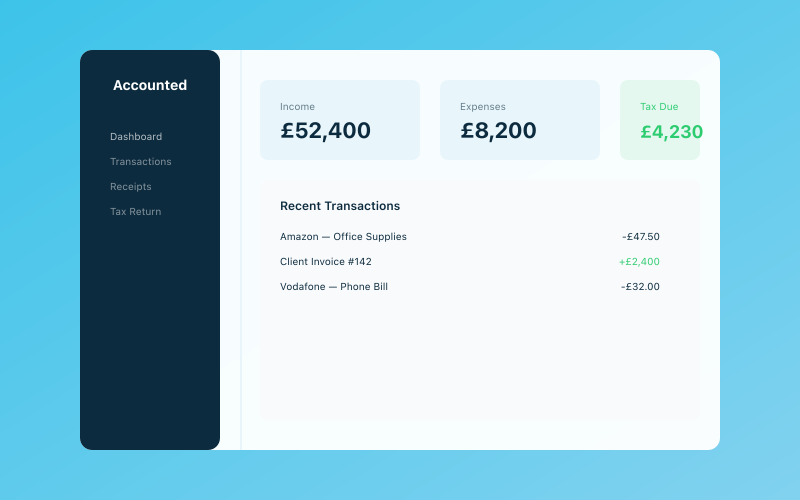 Your Accounted dashboard — income, expenses, and tax at a glance
The Flat Rate Scheme (FRS) simplifies this. Instead of calculating the exact difference between output and input VAT, you simply apply a fixed percentage to your gross (VAT-inclusive) turnover and pay that amount to HMRC. You don't reclaim VAT on most purchases — the reduced flat rate percentage is supposed to account for that.
For example, if your flat rate percentage is 14.5% and your gross turnover for the quarter is £30,000, you'd pay HMRC £4,350. If you'd charged your clients 20% VAT on net sales of £25,000 (collecting £5,000 in VAT), you'd be keeping £650 — that's the difference between the £5,000 you collected and the £4,350 you're paying over.
The specific flat rate percentage depends on your trade sector. HMRC publishes a full list, and rates range from 2% for certain food retailers up to 14.5% for computer and IT consultants. In your first year of VAT registration, you get an extra 1% discount off your applicable rate.
For a broader overview of how the scheme works, take a look at our VAT Flat Rate Scheme guide.
The Limited Cost Trader Rule — The Game Changer
Here's where things get complicated. In April 2017, HMRC introduced the "limited cost trader" test, and it dramatically changed the maths for a huge number of businesses using the Flat Rate Scheme.
A limited cost trader is a business whose VAT-inclusive expenditure on relevant goods is either less than 2% of its gross turnover, or less than £1,000 per year (whichever is greater). "Relevant goods" means physical goods used in the business — but it specifically excludes capital expenditure over £2,000, food and drink, and vehicle costs (including fuel, unless you operate a vehicle-related business).
If you're classified as a limited cost trader, your flat rate percentage jumps to 16.5%, regardless of your trade sector. And at 16.5% of gross turnover, the scheme almost never saves you money. In fact, for most limited cost traders, the amount paid to HMRC under the FRS is very close to — or even slightly more than — what you'd pay under standard VAT accounting.
The rule was introduced precisely because HMRC recognised that many service-based businesses with very low goods costs were making tidy profits from the scheme. Consultants, IT contractors, and professional service firms were the prime targets.
We've covered the limited cost trader rules in detail here if you want to dig into the specifics.
Who Still Benefits from the Flat Rate Scheme?
Despite the limited cost trader rule, the Flat Rate Scheme can still be worthwhile for certain types of limited companies. The key question is whether your business spends enough on relevant goods to avoid being caught by the 16.5% rate.
Businesses that buy and sell physical goods. If your limited company regularly purchases stock, raw materials, or other physical goods that count towards the test, you're more likely to exceed the 2% threshold and qualify for the lower, sector-specific rate. Retailers, manufacturers, and trades businesses often fall into this category.
Businesses with high material costs relative to turnover. Construction companies buying materials, catering firms purchasing ingredients, or businesses that regularly buy equipment and supplies may well find the FRS still saves money.
Newly VAT-registered businesses. Remember that first-year discount of 1%? For a new limited company in its first year of VAT registration, the lower rate can tip the balance in favour of the FRS, even for service-based businesses.
Businesses that value simplicity. Even if the FRS doesn't save you money, it might save you time. If you process dozens of purchase invoices each month, not having to track and reclaim input VAT on each one can be a genuine benefit. Time has a cost too.
Running the Numbers — A Practical Comparison
Let's look at a worked example to see how the two approaches compare for a typical limited company.
Scenario: An IT consulting company
- Quarterly net sales: £25,000
- VAT charged to clients (20%): £5,000
- Gross turnover: £30,000
- Quarterly purchases (with VAT): £1,200 (of which £800 is relevant goods)
- Flat rate percentage: 14.5% (IT consultants)
Under the Flat Rate Scheme:
First, the limited cost trader test. Relevant goods expenditure is £800 per quarter, or £3,200 per year. That's 2.67% of gross turnover (£30,000 x 4 = £120,000). Since 2.67% exceeds 2%, this company is not a limited cost trader — good news.
VAT payable: 14.5% x £30,000 = £4,350 VAT collected: £5,000 Effective saving: £650 per quarter, or £2,600 per year.
Under standard VAT:
VAT payable: £5,000 (output VAT) minus £200 (input VAT on £1,200 purchases) = £4,800
So under standard VAT, the company pays £4,800, versus £4,350 under FRS. The Flat Rate Scheme saves £450 per quarter, or £1,800 per year.
Now let's change the scenario. If that same company only spent £200 per quarter on relevant goods (£800 per year), that's just 0.67% of gross turnover. They'd be a limited cost trader, and the flat rate would jump to 16.5%.
VAT payable under FRS: 16.5% x £30,000 = £4,950 VAT payable under standard: £5,000 - £33 (input VAT) = £4,967
At 16.5%, the FRS is almost identical to standard VAT — there's barely £17 in it. And that's before considering that you can't reclaim VAT on capital purchases over £2,000 under the FRS (though you can on items over £2,000 including VAT).
Things to Watch Out For
If you're considering the Flat Rate Scheme for your limited company, keep these points in mind:
You can't reclaim input VAT on most purchases. This is fine when your flat rate percentage is low enough to compensate, but if you ever make a large purchase — say, a new computer system costing £3,000 plus VAT — you'd lose the ability to reclaim that VAT under the FRS. The exception is capital expenditure items costing £2,000 or more including VAT, which can still be reclaimed.
The limited cost trader test is applied each quarter. You might be a limited cost trader in one quarter but not in another. If your goods expenditure fluctuates, you could end up switching between the sector rate and 16.5% throughout the year.
Turnover limits. You can only join the FRS if your VAT-taxable turnover is £150,000 or less (excluding VAT). You must leave the scheme if your total business income exceeds £230,000 (including VAT) in any 12-month period. For growing limited companies, this ceiling can arrive sooner than expected.
It's not always straightforward to leave. If you decide the FRS isn't working for you, you can leave voluntarily by writing to HMRC. But you'll need to account for VAT under the standard method from the date you leave, so make sure your systems are set up to handle the switch.
Using Accounted with Penny can help you keep a clear picture of your VAT position throughout the quarter — so you'll know well in advance whether the Flat Rate Scheme is working for your limited company or whether it's time to switch.
How to Decide — A Simple Framework
Here's a quick decision framework for limited company directors:
-
Calculate your relevant goods expenditure. Look at the last four quarters. Exclude capital items over £2,000, food and drink for personal consumption, and vehicle costs. Is the total more than 2% of your gross turnover (or more than £1,000)?
-
If yes — you're not a limited cost trader. Compare your sector flat rate percentage against what you'd pay under standard VAT. If the FRS saves you money, it's worth considering.
-
If no — you are a limited cost trader. Your rate will be 16.5%. Run the numbers against standard VAT. In most cases, the saving will be negligible, and you might be better off on standard VAT where you can reclaim input tax properly.
-
Factor in the time saving. If you process a lot of purchase invoices, the simplicity of the FRS has real value. But if you're using good accounting software, the admin difference may be smaller than you think.
-
Review regularly. Your situation may change as your business grows or your cost base shifts. What works this year might not work next year.
The Bottom Line
The Flat Rate VAT Scheme can still offer genuine savings for limited companies that purchase enough relevant goods to avoid the limited cost trader trap. But for service-based businesses with minimal goods costs — which includes a large proportion of contractor-style limited companies — the scheme has lost most of its financial advantage since the 2017 rule change.
That doesn't mean it's worthless. The simplicity benefit is real, and in certain circumstances (particularly in the first year of VAT registration), it can still tip in your favour. The key is running the numbers for your specific business rather than relying on assumptions.
Related Reading
See how Accounted handles MTD and start your free trial.
Accounted helps UK sole traders stay on top of their bookkeeping and tax. Start your free 30-day trial at getaccounted.co.uk.
Accounted handles VAT returns and MTD for VAT with direct HMRC filing built in. See VAT features →
Tax & Compliance Specialists
Our tax specialists have decades of combined experience in UK sole trader and small business taxation, MTD compliance, and HMRC submissions. All content is reviewed against current HMRC guidance before publication and updated quarterly to reflect legislative changes.
Ready to try Accounted?
Join UK sole traders who are simplifying their bookkeeping and tax.
Start your 14-day free trial