Annual Accounting Scheme for VAT — Is It Right for You?
Filing a VAT return every quarter can feel like a lot — especially when you're a small business juggling everything from invoicing to marketing to actually doing the work. The Annual Accounting Scheme offers an alternative: one VAT return a year instead of four, with fixed monthly or quarterly payments throughout the year to spread the cost.
It's not as well known as the Flat Rate Scheme or Cash Accounting, but for the right businesses, annual accounting can simplify VAT considerably and make cash flow much more predictable. Let's see whether it could work for you.
How the Annual Accounting Scheme Works
Under the Annual Accounting Scheme, you:
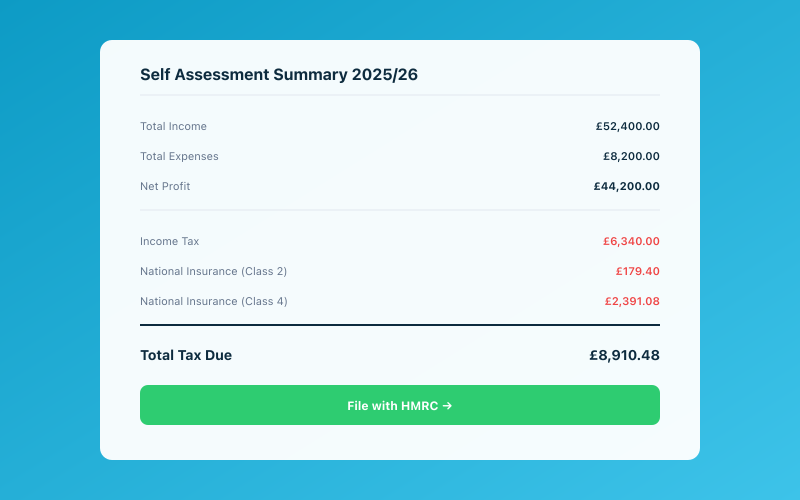 Your Accounted dashboard shows your real-time tax position
- Make regular payments towards your estimated VAT bill throughout the year — either nine monthly payments or three quarterly payments
- Submit one VAT return at the end of the year, covering the full 12-month period
- Pay any balance due (or receive a refund) when you submit your annual return
The regular payments are based on your estimated VAT liability for the year. HMRC calculates this by looking at your previous year's VAT liability, though you can request an adjustment if your circumstances have changed significantly.
Monthly Payments
If you choose monthly payments, you make nine payments during the year, each due at the end of months 4 through 12 of your VAT year. Each payment is 10% of your estimated annual VAT liability (so nine payments total 90%). The remaining balance is paid when you submit your annual return, which is due two months after the end of your VAT year.
Quarterly Payments
If you choose quarterly payments, you make three payments during the year, each at the end of months 4, 7, and 10 of your VAT year. Each payment is 25% of your estimated annual VAT liability (so three payments total 75%). Again, the balance is settled with the annual return.
Example
Let's say your estimated annual VAT liability is £12,000 and your VAT year ends on 31 March.
Monthly payments option:
- Nine payments of £1,200 each (10% × £12,000) due at the end of July through March
- Annual return due by 31 May, with any balance payable
Quarterly payments option:
- Three payments of £3,000 each (25% × £12,000) due at the end of July, October, and January
- Annual return due by 31 May, with any balance payable
If your actual VAT liability for the year turns out to be £13,500, you'd pay an additional £1,500 with your annual return (monthly option) or £4,500 (quarterly option). If it's less than £12,000, you'd get a refund.
Who Can Use the Annual Accounting Scheme?
Eligibility
You can join the scheme if:
- Your estimated taxable turnover for the next 12 months is £1.35 million or less
- You're up to date with your VAT returns and payments
- You haven't left the scheme in the last 12 months
You cannot join if:
- You're part of a VAT group
- You're registered for VAT in another EU country (or were when the UK was in the EU)
- You're an overseas business not established in the UK
- You're in the process of a voluntary liquidation
Leaving the Scheme
You must leave the scheme if your estimated taxable turnover exceeds £1.6 million. You can also leave voluntarily at the end of any VAT year by writing to HMRC.
There's a deliberate gap between the entry threshold (£1.35 million) and the exit threshold (£1.6 million), so you won't be forced off the scheme just because your turnover fluctuates slightly above the entry limit.
Benefits of Annual Accounting
Simplified Compliance
The most obvious benefit is fewer returns. Instead of preparing and filing four VAT returns a year, you file just one. That's three fewer deadlines to worry about, three fewer occasions where you need to gather all your records and run the numbers.
For small businesses where the owner does their own VAT, this frees up real time. Even if you have an accountant, it can reduce fees.
Predictable Cash Flow
With fixed regular payments, you always know how much VAT you need to set aside each month or quarter. There are no surprises — no unexpectedly large VAT bill because you had a good quarter. This makes budgeting much easier.
If you've ever been caught out by a larger-than-expected quarterly VAT bill, you'll appreciate the predictability that annual accounting offers.
More Time to Pay
Under standard quarterly accounting, your VAT return and payment are due one month and seven days after the end of each quarter. Under annual accounting, your balance payment isn't due until two months after the end of your annual period. That's an extra few weeks of breathing room.
Better for Seasonal Businesses
If your business is heavily seasonal — busy summers and quiet winters, for instance — quarterly returns can be frustrating. You might owe a lot of VAT in one quarter and very little in another. Annual accounting smooths this out, with fixed payments throughout the year regardless of seasonal fluctuations.
Drawbacks of Annual Accounting
No Regular Refunds
If you're regularly in a VAT repayment position (meaning HMRC owes you money), annual accounting isn't ideal. Under quarterly returns, you'd get a refund every quarter. Under annual accounting, you'd have to wait until you file your annual return to get your money back — potentially up to 14 months.
This is particularly relevant for businesses that make mainly zero-rated supplies (like food manufacturers or exporters) or businesses that are investing heavily and reclaiming significant input tax. If HMRC regularly owes you VAT, stick with quarterly (or even monthly) returns.
Fixed Payments May Not Match Your Cash Flow
While the fixed payments bring predictability, they're based on last year's liability. If your business is growing rapidly, the payments might be too low — leaving you with a large balance to pay at year-end. Conversely, if business has slowed down, the payments might be too high relative to your actual liability.
You can ask HMRC to adjust the payments if your circumstances have changed significantly, but this isn't automatic — you need to proactively request it.
Less Frequent Reconciliation
Filing quarterly returns forces you to review your VAT records every three months. This regular discipline helps you catch errors early. With annual accounting, there's a risk that you don't look at your VAT figures for months, potentially allowing errors to build up.
Good bookkeeping habits help here. Even if you're only filing annually, reviewing your VAT position quarterly (even informally) is sensible. If you're using Penny in Accounted to track your transactions, you can check your running VAT position at any time without needing to prepare a formal return.
Can't Combine with the Flat Rate Scheme
You can use the Annual Accounting Scheme alongside the Cash Accounting Scheme, but you cannot use it alongside the Flat Rate Scheme. If you're on the Flat Rate Scheme and want to switch to annual accounting, you'd need to leave the Flat Rate Scheme first.
How to Join the Annual Accounting Scheme
Applying
You apply to join the scheme using HMRC form VAT600AA. You can submit this online through the Government Gateway or by post.
You'll need to provide:
- Your VAT registration number
- Your estimated taxable turnover for the next 12 months
- Whether you want monthly or quarterly payments
- Your preferred VAT year-end date
HMRC will review your application and confirm your acceptance, along with the payment schedule and amounts.
Choosing Your VAT Year-End
You can choose any month-end as your VAT year-end. It doesn't have to align with your financial year-end, though aligning them can simplify your record-keeping. Common choices include 31 March (aligning with the tax year) or your company's financial year-end.
When Does It Start?
You can join the scheme from the beginning of any VAT period. HMRC will confirm the start date when they accept your application.
Annual Accounting and Making Tax Digital
The Annual Accounting Scheme works alongside Making Tax Digital (MTD) for VAT. You still need to keep digital records and file your annual return using MTD-compatible software. The only difference is that you file one return a year instead of four.
Your regular payments (monthly or quarterly) are simply payments — you don't need to submit a return with each one. The single annual return captures all the figures for the full year.
Is It Right for You?
Annual accounting tends to work best for businesses that:
- Have a relatively stable and predictable turnover
- Are usually in a VAT payment position (owing VAT to HMRC)
- Want to minimise the time spent on VAT administration
- Prefer predictable, fixed payments for budgeting purposes
- Are seasonal businesses that want to smooth their VAT cash flow
It tends to be less suitable for businesses that:
- Are regularly in a VAT repayment position
- Are growing rapidly (payments based on last year might be too low)
- Want to keep tight control of their VAT position with frequent returns
- Are on or want to be on the Flat Rate Scheme
A Quick Test
Ask yourself: at the end of each quarter, do you generally owe HMRC money or does HMRC owe you? If you generally owe money, annual accounting could work well. If HMRC generally owes you, quarterly returns are probably better — you'll get your refunds faster.
Also consider your appetite for admin. If quarterly returns feel like a burden and you'd rather deal with VAT once a year, annual accounting removes three of those four deadlines. If you actually find quarterly returns useful as a discipline for keeping your records in order, the annual scheme might remove a helpful constraint.
Combining with Cash Accounting
One popular combination is using the Annual Accounting Scheme alongside the Cash Accounting Scheme. Cash accounting means you only account for VAT when money actually changes hands (rather than when invoices are issued), which is great for cash flow. Combined with annual accounting's fixed payments and single annual return, you get a very streamlined VAT process.
This combination is particularly popular with small service businesses and tradespeople who want the simplest possible VAT setup.
Making Your Decision
The Annual Accounting Scheme won't save you any VAT — you'll pay the same amount regardless of which scheme you use. What it offers is simplicity and predictability. One return a year, fixed payments, less admin.
For many small businesses below the £1.35 million turnover threshold, it's a straightforward improvement over quarterly returns. The main exception is if you're regularly owed refunds by HMRC — in that case, waiting up to 14 months for your money back isn't ideal.
If you're currently struggling with quarterly deadlines or finding the admin burdensome, annual accounting is well worth considering. And if you're already on the Cash Accounting Scheme, adding annual accounting on top creates one of the most streamlined VAT setups available.
Accounted helps UK sole traders stay on top of their bookkeeping and tax. Start your free 30-day trial at getaccounted.co.uk
Related reading:
Related Reading
- Flat Rate VAT for Limited Companies — Is It Still Worth It?
- VAT on Food and Drink — Zero-Rated vs Standard Rated
- Voluntary VAT Registration — When It Makes Sense
You may also find our Reverse Charge VAT: Construction Businesses Guide helpful.
Related reading: Setting Up Your First VAT Scheme: Which One Is Right.
You may also find our VAT Cash Accounting Scheme Explained helpful.
For step-by-step guidance, see our article on How to Deregister for VAT: When and How.
Related reading: VAT on Digital Services: Rules for Online Businesses.
You may also find our VAT Margin Scheme Explained: Second-Hand Goods helpful.
See how Accounted handles MTD and start your free trial.
Accounted handles VAT returns and MTD for VAT with direct HMRC filing built in. See VAT features →
Tax & Compliance Specialists
Our tax specialists have decades of combined experience in UK sole trader and small business taxation, MTD compliance, and HMRC submissions. All content is reviewed against current HMRC guidance before publication and updated quarterly to reflect legislative changes.
Ready to try Accounted?
Join UK sole traders who are simplifying their bookkeeping and tax.
Start your 14-day free trial