Sole Trader vs Partnership — Which Structure Is Right for You?
When you're starting a business with someone else — or even just thinking about bringing another person on board — one of the first questions you'll face is whether to stay as a sole trader or form a partnership. It's a question that sounds straightforward, but the answer depends on your circumstances, your plans, and how comfortable you are with shared responsibility.
In this guide, we'll break down the key differences between operating as a sole trader and forming a partnership, covering everything from tax and liability to the practicalities of running each type of business. No jargon, no waffle — just the information you need to make a good decision.
What Exactly Is a Sole Trader?
A sole trader is the simplest business structure in the UK. You are the business. There's no legal distinction between you and the work you do, which means you're personally responsible for everything — the profits, the debts, the decisions, and the tax.
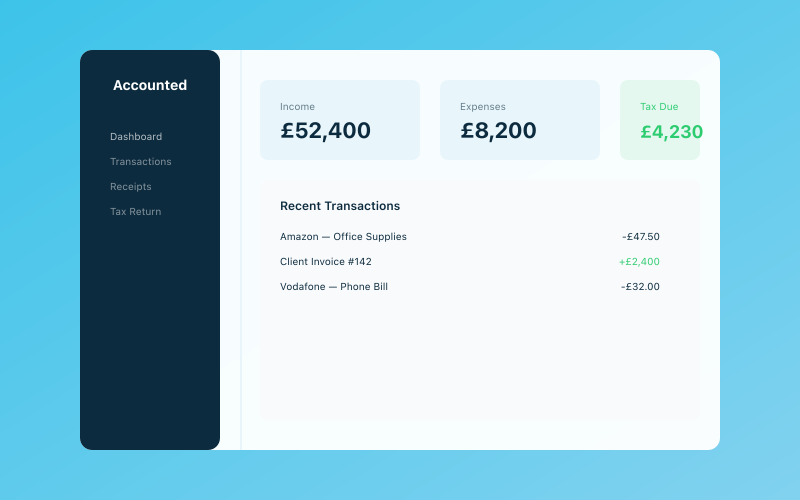 Your Accounted dashboard — income, expenses, and tax at a glance
Setting up as a sole trader is quick and free. You register with HMRC as self-employed, and you're away. You file a Self Assessment tax return each year, pay Income Tax on your profits, and pay National Insurance contributions. That's about it in terms of formal obligations.
The simplicity is the main attraction. There's minimal paperwork, you have complete control over your business, and you keep all the profits (after tax, of course). If you're working on your own and don't anticipate bringing anyone else into the business, being a sole trader is often the most practical choice.
You can find out more about how to get started in our guide on how to register as self-employed with HMRC.
What Is a Partnership?
A partnership is a business structure where two or more people share the responsibility — and the profits — of running a business together. Like sole traders, partners are personally liable for the debts of the business, but the workload (and the income) is split between them.
There are different types of partnership in the UK:
- Ordinary (general) partnership — the most common type. Each partner shares the profits, the losses, and the liability. There's no limit to how much each partner could owe if things go wrong.
- Limited partnership (LP) — has at least one general partner with unlimited liability and one or more limited partners whose liability is capped at their investment. These are less common for small businesses.
- Limited liability partnership (LLP) — a hybrid structure that gives partners the protection of limited liability, similar to a limited company. LLPs have their own legal identity and must file accounts with Companies House. They're more common in professional services like law and accountancy.
For most small businesses, it's the ordinary partnership that's relevant, so that's what we'll focus on here.
Tax: How Do They Compare?
This is usually the first thing people want to know, and rightly so.
Sole traders pay Income Tax on all their business profits, plus Class 2 and Class 4 National Insurance. You get a tax-free Personal Allowance (£12,570 for the 2025/26 tax year), and anything above that is taxed at the usual Income Tax rates — 20%, 40%, or 45% depending on how much you earn.
Partners are taxed in essentially the same way, but each partner only pays tax on their share of the partnership's profits. The partnership itself doesn't pay tax — it's what HMRC calls "tax transparent." Instead, each partner reports their share of the profit on their own Self Assessment tax return and pays Income Tax and National Insurance accordingly.
This can be an advantage. If two people are splitting profits equally, each person is taxed individually on a smaller amount, which could keep them in a lower tax bracket. For example, if your business makes £80,000 in profit:
- As a sole trader, you'd pay tax on the full £80,000
- In a 50/50 partnership, each partner pays tax on £40,000
That difference in tax brackets can mean real savings, particularly if it keeps one or both partners below the higher-rate threshold.
However, the split doesn't have to be equal. Partners can agree to divide profits in whatever ratio makes sense for the business, provided it's set out in a partnership agreement. More on that in a moment.
If you're still weighing up structures, you might also want to read our comparison of sole trader vs limited company to see whether incorporation might be worth considering.
Liability: Who's on the Hook?
This is where things get serious.
As a sole trader, you have unlimited personal liability. If your business runs up debts it can't pay, creditors can come after your personal assets — your savings, your car, even your home in extreme cases.
In an ordinary partnership, every partner has unlimited personal liability — not just for their own actions, but for the actions of their partners too. If your business partner takes on a debt or makes a mistake, you could be held jointly responsible. This is often referred to as "joint and several liability," which means a creditor could pursue any one partner for the full amount owed, regardless of the profit-sharing arrangement.
This is one of the biggest risks of a partnership, and it's why choosing the right partner is so important. You need to trust them — not just to do good work, but to make sound financial decisions that won't land you in trouble.
For this reason, some people opt for a limited liability partnership (LLP) instead, which limits each partner's liability to the amount they've invested. But LLPs come with more admin and reporting requirements, so they're not always the best fit for small businesses.
The Partnership Agreement: Don't Skip This
If you're going into business with someone, you need a partnership agreement. It's not legally required — technically, you can form a partnership with nothing more than a handshake — but operating without one is asking for trouble.
A good partnership agreement should cover:
- How profits and losses are shared — is it 50/50, or based on each partner's contribution?
- What each partner is responsible for — roles, decision-making authority, and who does what
- How much each partner is investing — in terms of money, equipment, or time
- What happens if a partner wants to leave — notice periods, buyout terms, and how assets are divided
- What happens if you disagree — a dispute resolution process, so disagreements don't blow up the business
- What happens if a partner dies or becomes incapacitated — this isn't a cheerful thought, but it's essential to plan for
Without an agreement, the Partnership Act 1890 kicks in by default. Under that Act, profits are split equally regardless of effort or investment, and any partner can dissolve the partnership at any time. These default rules rarely reflect what partners actually intended, which is why a written agreement is so important.
You can draft a basic agreement yourselves, but it's worth getting a solicitor to review it. A few hundred pounds now can save you thousands in disputes later.
Admin and Record Keeping
Sole traders have it relatively easy on the admin front. You keep records of your income and expenses, file one Self Assessment return a year, and that's broadly it. Tools like Accounted make this even simpler by automatically tracking your transactions and categorising your expenses, so you're not scrambling at year-end.
Partnerships have a bit more to deal with. The partnership itself must file a partnership tax return (form SA800) each year, in addition to each partner filing their own individual Self Assessment return. Someone needs to be nominated as the "nominated partner" to take responsibility for the partnership return.
You'll also need to keep records at the partnership level — tracking income, expenses, and how profits are allocated between partners. This isn't hugely complex, but it's more work than being a sole trader.
With Making Tax Digital for Income Tax coming in, partnerships above certain income thresholds will eventually need to submit quarterly updates to HMRC digitally. It's worth keeping on top of your digital record keeping now to avoid a scramble later.
Decision Making and Control
As a sole trader, you have total control. Every decision is yours — from pricing and marketing to whether you take a day off. There's no one to consult, no one to compromise with, and no one to blame if things go wrong.
In a partnership, decisions are shared. That can be brilliant — two heads are often better than one, and having a partner means you can bounce ideas off someone, share the workload, and cover for each other during holidays or illness.
But it can also be challenging. Disagreements about the direction of the business, how much to invest, or even day-to-day decisions can cause real friction. The strength of your working relationship matters enormously.
If you're considering a partnership, have honest conversations upfront about your working styles, your long-term goals, and how you'll handle conflict. It's far better to discover incompatibilities before you go into business together than after.
Bringing Someone Into an Existing Business
If you're currently a sole trader and thinking about bringing someone on board, you've got a few options:
- Form a partnership — you and the new person become partners, sharing profits, responsibilities, and liability as described above.
- Hire them as an employee — they work for you, and you remain the sole owner. This means taking on employer responsibilities like PAYE, pensions, and employment law compliance.
- Use them as a subcontractor or freelancer — they do work for you on a contract basis, but they're not part of your business structure. This is the simplest option if you just need help with specific tasks.
Each option has different implications for tax, control, and liability. If you're thinking about hiring, our guide on when to hire help for your business covers the financial side of that decision.
So Which Should You Choose?
Here's a quick summary to help you decide:
Stay as a sole trader if:
- You're working on your own and want complete control
- You prefer simplicity and minimal admin
- You don't need to share capital or resources with anyone
- You're comfortable with personal liability for your own decisions
Consider a partnership if:
- You're going into business with someone you trust
- You want to combine skills, resources, or contacts
- You'd benefit from shared workload and decision making
- The tax advantages of splitting profits are significant
- You're prepared to put a solid partnership agreement in place
There's no universally right answer. The best structure is the one that fits your specific situation, your risk tolerance, and your plans for the future.
And whatever you choose, keep your finances organised from day one. Keeping clear, accurate records isn't just good practice — it's a legal requirement. Penny, the AI bookkeeping assistant in Accounted, can help you stay on top of your income, expenses, and tax obligations without spending hours on admin.
Related Reading
Start your free trial and see how Accounted simplifies your bookkeeping.
Accounted helps UK sole traders stay on top of their bookkeeping and tax. Start your free 30-day trial at getaccounted.co.uk
Accounted keeps your books sorted automatically so you can focus on running your business. See Accounted →
Business & Operations Advisors
Our business advisors cover the practical side of running a UK sole trader business — from HMRC registration to managing growth. Content is written for real business owners in plain English, not accountants.
Ready to try Accounted?
Join UK sole traders who are simplifying their bookkeeping and tax.
Start your 14-day free trial