Building Multiple Income Streams as a Sole Trader
Why One Income Stream Is a Risk
Relying on a single source of income as a sole trader is like sitting on a one-legged stool. It works fine until it doesn't. A key client leaves, a market shifts, or an illness takes you out of action for a few weeks, and suddenly your entire income disappears.
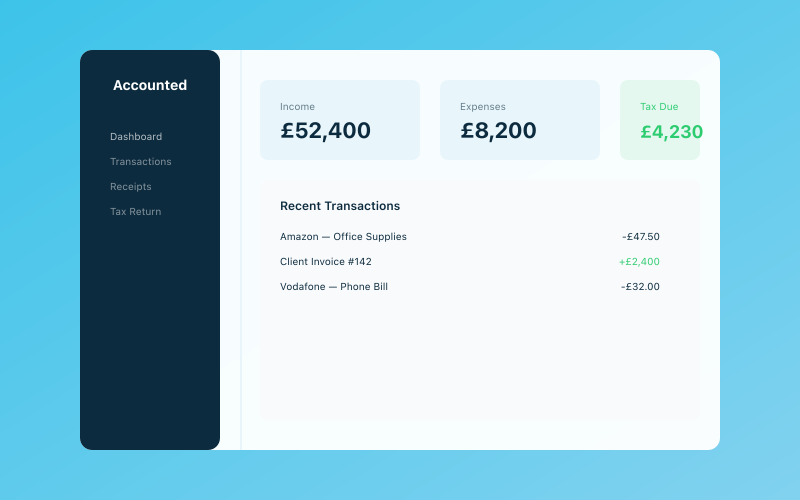 Your Accounted dashboard — income, expenses, and tax at a glance
Building multiple income streams is not about working more hours — it is about working smarter and creating financial resilience. The goal is to have money coming in from different directions, so that if one stream slows down, the others keep you afloat.
Active Income vs Passive Income
Before diving into ideas, it is worth understanding the two fundamental types of income:
Active Income
Active income requires your direct involvement. You trade time for money. This includes client work, consulting, teaching, and any service where you need to show up to get paid. Most sole traders start here, and there is nothing wrong with that — but it has a ceiling. There are only so many hours in a day.
Passive Income
Passive income generates revenue without requiring your constant presence. It usually requires significant upfront effort but then continues to earn with minimal ongoing input. Examples include digital products, royalties, rental income, and affiliate commissions.
The honest truth? Truly passive income is rare. Most "passive" income streams need occasional maintenance, marketing, or updates. But they are still far less demanding than active client work once they are established.
Income Stream Ideas for Sole Traders
Digital Products
If you have expertise in your field — and as a sole trader, you almost certainly do — you can package that knowledge into digital products:
- Online courses — Platforms like Teachable and Udemy let you create courses with minimal technical knowledge
- E-books and guides — A comprehensive guide to your specialism can sell for years
- Templates and tools — Spreadsheets, checklists, contracts, design templates
- Printables — Particularly popular on Etsy for planners, wall art, and educational materials
The beauty of digital products is that they have virtually zero marginal cost. Whether you sell one copy or one thousand, the production cost stays the same.
Consulting + Products
Many sole traders find that combining hands-on consulting with productised offerings creates a powerful mix. For example:
- A web developer who sells website maintenance retainer packages alongside project-based work
- A personal trainer who offers online workout plans alongside one-to-one sessions
- A copywriter who sells a "brand voice guide" template alongside bespoke writing services
The consulting work builds your credibility and generates ideas for products. The products provide income that does not require your physical presence.
Affiliate and Referral Income
If you regularly recommend tools, products, or services to your clients, affiliate partnerships can generate a secondary income stream. Many software companies, suppliers, and service providers offer commissions for referrals. Just be transparent with your clients about any affiliate relationships.
Teaching and Training
Whether it is running workshops, delivering webinars, or teaching at a local college, sharing your knowledge can be both rewarding and profitable. Teaching also reinforces your expert positioning, which often feeds back into your primary business.
Rental Income
If you own property, rental income alongside your trade is a common combination for sole traders. This is where things get interesting from a tax perspective, which we will cover in detail below.
Licensing and Intellectual Property
Photographers, designers, writers, and musicians can license their work for ongoing royalties. A single photograph, design, or piece of music can generate income for years through licensing platforms.
How Multiple Income Streams Affect Your Tax Return
This is the bit that catches many sole traders off guard. Different types of income are reported differently on your Self Assessment tax return, and getting it wrong can cause problems.
Multiple Trades
If you run genuinely separate business activities — say you are a plumber who also sells online courses — HMRC may consider these as separate trades. Each trade gets its own section on the tax return, with its own income and expenses.
The advantage? Losses in one trade can potentially be set against profits in another. The disadvantage? More record-keeping and more complexity on your return.
Trading Income and Property Income
Your trading income (from your main business) and any property income are reported in different sections of the Self Assessment tax return. Property income goes in the UK Property pages (SA105), while your trading income goes in the Self Employment pages (SA103).
They are both included in your total taxable income, so they combine for the purposes of determining your tax band. If your trading profits are £30,000 and your rental profits are £15,000, your total taxable income is £45,000. After the personal allowance of £12,570, you would pay basic rate tax at 20% on the remainder — as this falls within the basic rate band that runs up to £50,270.
Investment Income
Dividends, savings interest, and other investment income have their own allowances and reporting requirements. The dividend allowance is currently £500, and the personal savings allowance is £1,000 for basic rate taxpayers or £500 for higher rate taxpayers.
National Insurance Across Income Streams
Class 4 National Insurance at 6% applies to your combined self-employment profits between £12,570 and £50,270, then 2% on profits above that. However, NI is only charged on trading income — rental income and investment income are not subject to Class 4 NI.
You will also pay Class 2 NI at £3.45 per week if your trading profits exceed the small profits threshold.
Separate Record-Keeping
Here is where good habits pay off enormously. When you have multiple income streams, keeping your records separate and organised is essential.
Why Separation Matters
- HMRC may ask for records relating to a specific income stream
- You need to know which activities are profitable and which are not
- Different income types may have different allowable expenses
- If you ever need to cease one activity, clean records make the process straightforward
How to Keep Things Organised
The simplest approach is to use separate categories or tags for each income stream within your accounting software. Penny, the AI bookkeeper within Accounted, can help categorise transactions automatically, which is particularly useful when you have multiple income sources flowing through the same bank account.
Ideally, you would use separate bank accounts or at least separate sub-accounts for each significant income stream. This makes reconciliation dramatically easier and gives you a clear view of each stream's performance.
When to Register Separate Businesses vs One Umbrella
This is a common question, and the answer depends on your situation.
Staying as One Sole Trader Business
If your income streams are related — for example, a graphic designer who does client work, sells templates, and runs workshops — there is usually no need to separate them formally. Report everything as one self-employment business on your tax return, with clear categorisation in your records.
Running Multiple Sole Trader Trades
If your income streams are genuinely distinct and unrelated, HMRC may expect you to report them as separate trades. This does not mean registering separately — you are still one person filing one Self Assessment return. But you will complete separate self-employment pages for each trade.
When a Limited Company Makes Sense
If one or more of your income streams is generating significant profit — particularly above the higher rate threshold of £50,270 — it may become tax-efficient to operate that stream through a limited company. This is not a decision to take lightly, but it is worth reviewing as your income grows.
Building Your Second Stream — A Practical Approach
Start Small and Validate
Do not invest heavily in a new income stream before testing demand. Create a minimum viable product, offer a pilot service, or run a small experiment to see whether people will actually pay for what you are offering.
Use Your Existing Audience
Your current clients and contacts are the easiest people to sell to. They already trust you. Ask them what else they need, and look for ways to serve them beyond your primary offering.
Automate Where Possible
The whole point of multiple income streams is to avoid multiplying your workload proportionally. Use automation for digital product delivery, email sequences, booking systems, and payment collection.
Track Performance Religiously
Not every income stream will work. Some will generate meaningful revenue, and others will turn out to be distractions. Review each stream quarterly and be willing to cut the ones that are not pulling their weight.
Be Patient
Most secondary income streams take six to twelve months to become meaningful. The early period involves building, testing, and marketing. Do not abandon a stream too early, but do set clear milestones for what "success" looks like.
The Tax Planning Angle
Multiple income streams open up tax planning opportunities that a single income source does not:
- Pension contributions can be used to reduce your overall taxable income across all streams
- Timing of invoices across streams can help manage which tax year income falls into
- Capital allowances on equipment shared between streams need careful allocation
- VAT registration becomes relevant if your combined taxable turnover exceeds £90,000 — even if no single stream reaches that threshold alone
Building Resilience, Not Just Revenue
The real value of multiple income streams is not just the extra money — it is the security. When you know that losing one client or one contract will not sink your business, you make better decisions. You negotiate from a position of strength. You can afford to say no to work that is not right for you.
Accounted helps you see all your income streams in one place, with clear categorisation and real-time visibility of your total position. Because when you are juggling multiple sources of income, clarity is not a luxury — it is a necessity.
Related reading
- Self Assessment Tax Return — Your Complete Guide
- Tax Deductions Every Sole Trader Should Know About
- Sole Trader vs Limited Company in 2026
Related Reading
- DIY Bookkeeping vs Hiring a Bookkeeper — The Real Costs
- What to Include on a UK Invoice — Legal Requirements
Start your free trial and see how Accounted simplifies your bookkeeping.
Accounted keeps your books sorted automatically so you can focus on running your business. See Accounted →
Business & Operations Advisors
Our business advisors cover the practical side of running a UK sole trader business — from HMRC registration to managing growth. Content is written for real business owners in plain English, not accountants.
Ready to try Accounted?
Join UK sole traders who are simplifying their bookkeeping and tax.
Start your 14-day free trial