DIY Bookkeeping vs Hiring a Bookkeeper — The Real Costs
It's one of the most common questions sole traders ask: should I do my own bookkeeping or pay someone else to do it? And like most good questions, the honest answer is "it depends."
What it depends on is more nuanced than most people realise. It's not just about the price tag. The real cost of bookkeeping includes your time, your stress levels, the accuracy of your records, and the tax you might be overpaying because you missed legitimate deductions. When you factor all of that in, the calculation looks quite different from a simple comparison of monthly fees.
Let's break it down properly.
The True Cost of DIY Bookkeeping
When people think about doing their own bookkeeping, they tend to focus on the software cost. A spreadsheet is free. Basic accounting software might run you £10-£30 a month. Sorted, right?
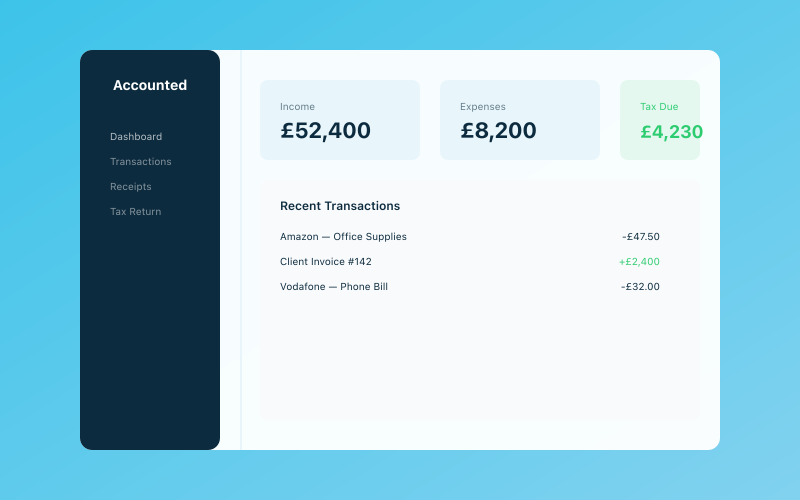 Your Accounted dashboard — income, expenses, and tax at a glance
Not quite. The biggest cost of DIY bookkeeping isn't the tools — it's your time. And your time has a value, even if you don't always think of it that way.
Let's do some rough maths. A typical sole trader with moderate transaction volumes might spend 3-5 hours per month on bookkeeping tasks: categorising transactions, reconciling bank statements, filing receipts, chasing invoices, and generating reports. At an average sole trader hourly rate of £30-£50, that's £90-£250 per month in time alone.
Over a year, you're looking at £1,080-£3,000 worth of your time spent on bookkeeping. That's time you could have spent doing billable work, finding new clients, or — let's be honest — having a life outside of work.
Then there's the hidden cost of mistakes. If you're not trained in bookkeeping, you're more likely to miscategorise expenses, miss allowable deductions, or make errors that could trigger questions from HMRC. A single missed expense category could mean paying hundreds of pounds more in tax than you need to. And if HMRC opens an enquiry because your records don't add up, the cost in stress and professional fees to respond can run into thousands.
There's also the compliance cost. With Making Tax Digital for Income Tax coming into effect, your records need to meet specific digital standards. If you're using a basic spreadsheet, you may need to invest in compatible software anyway — and learn how to use it properly.
The True Cost of Hiring a Bookkeeper
Professional bookkeepers in the UK typically charge between £20 and £45 per hour, or offer monthly packages ranging from about £75 to £300+ depending on the complexity of your business.
For a straightforward sole trader setup, you might expect to pay somewhere in the range of £100-£200 per month for a bookkeeper who handles your transaction categorisation, bank reconciliation, VAT returns (if applicable), and provides management accounts.
That sounds like more than doing it yourself, but remember what you're getting:
- Accuracy — A trained bookkeeper is far less likely to make categorisation errors or miss deductions
- Time back — Those 3-5 hours per month are yours again
- Peace of mind — Someone who knows what they're doing is looking after your compliance
- Better information — Professional bookkeeping means better financial data, which means better business decisions
- HMRC readiness — Your records will be in the format HMRC expects
The cost-benefit analysis often tips in favour of hiring when you consider these factors. If a bookkeeper saves you even £500 a year in correctly claimed expenses you would have missed, and frees up 4 hours a month that you can spend on billable work, the net cost might actually be negative — meaning they're saving you money overall.
The Third Option: Smart Software
Here's where things get interesting. The traditional choice between "do it yourself" and "hire someone" now has a middle ground that didn't exist a few years ago: AI-powered bookkeeping tools that do much of the heavy lifting for you.
This is exactly the space Accounted operates in. Rather than spending hours categorising transactions manually or paying someone else to do it, Penny — Accounted's AI bookkeeper — handles the categorisation automatically. She learns your spending patterns, matches transactions to the right categories, and flags anything she's not confident about for your review.
The result is that you get the accuracy benefits of professional bookkeeping at a fraction of the cost, while keeping full control and visibility of your finances. The time commitment drops from hours per month to minutes, because you're only dealing with exceptions rather than processing every single transaction.
For many sole traders, this represents genuinely the best of both worlds. Your records are kept to a professional standard, you're not spending your evenings wrestling with spreadsheets, and the cost is significantly lower than hiring a human bookkeeper.
It's worth noting that this isn't an either/or situation with having an accountant, either. Many Accounted users have an accountant who handles their year-end tax return and provides strategic advice, while Accounted and Penny manage the day-to-day bookkeeping. The accountant benefits because they receive clean, well-organised records, and the client benefits because their accountancy fees are lower since there's less work for the accountant to do.
When DIY Makes Sense
Despite everything above, there are situations where doing your own bookkeeping is the right call.
You're just starting out and money is genuinely tight. In the early days of a business, every pound matters. If you have more time than money and your transaction volumes are low, doing your own bookkeeping with affordable software is perfectly reasonable.
Your business is very simple. If you have one income stream, a handful of expense categories, and no employees or VAT to worry about, your bookkeeping needs are minimal. You might genuinely only need 30 minutes a month.
You actually enjoy it. Some people find a certain satisfaction in keeping their books tidy. If that's you, and you're doing it accurately, there's no reason to outsource something you find rewarding.
You want to understand your finances. There's genuine value in doing your own bookkeeping early on because it forces you to understand where your money comes from and where it goes. That financial literacy serves you well as your business grows. You can always outsource later once you've built that foundation.
When Hiring Makes Sense
Conversely, there are clear indicators that it's time to get professional help.
Your time is worth more spent elsewhere. If you can earn £50 an hour doing client work, spending 5 hours a month on bookkeeping that a professional could do for £150 is a false economy. You're effectively paying yourself £30 an hour to do something someone else could do better.
You're making mistakes. If your bank reconciliations never quite balance, you're not sure whether something is an expense or not, or you've had queries from HMRC about your records, it's time to get help. The cost of errors always exceeds the cost of prevention.
Your business is growing. More clients, more transactions, more complexity. What took 2 hours a month when you started might now take 8. Growth is wonderful, but it demands better systems and often professional support.
You're dreading it. Life's too short to spend it doing things you hate, especially when there are cost-effective alternatives. If bookkeeping fills you with dread, outsource it and move on with your life.
You need to be MTD-compliant. The Making Tax Digital deadline is approaching, and compliance requires digital records kept in a specific way. If you're not confident about meeting these requirements yourself, professional help is a sensible investment.
A Practical Comparison
Let's put some real numbers side by side for a typical sole trader with about 50 transactions per month:
DIY with spreadsheets:
- Software cost: £0
- Time cost: ~5 hours/month at £35/hour = £175/month
- Risk of errors: Higher
- MTD compliance: May need additional tools
- Annual effective cost: ~£2,100 + potential missed deductions
DIY with smart software (e.g., Accounted):
- Software cost: From around £15-£30/month
- Time cost: ~30 minutes/month at £35/hour = £17.50/month
- Risk of errors: Low (AI categorisation + confidence scoring)
- MTD compliance: Built in
- Annual effective cost: ~£400-£570
Hiring a bookkeeper:
- Service cost: ~£150-£250/month
- Time cost: ~30 minutes/month for review = £17.50/month
- Risk of errors: Low
- MTD compliance: Handled by bookkeeper
- Annual effective cost: ~£2,000-£3,200
The numbers speak for themselves. Smart software has changed the equation dramatically, particularly for sole traders and small businesses where the bookkeeping requirements are relatively straightforward.
Making Your Decision
There's no universally right answer here — it genuinely depends on your circumstances, your budget, your skills, and how you want to spend your time.
What we'd encourage you to avoid is the default option, which for most people is "muddle through with a spreadsheet and hope for the best." That tends to produce the worst outcomes: inaccurate records, missed deductions, compliance risks, and wasted time.
Whatever you decide, the most important thing is that your bookkeeping actually gets done, gets done accurately, and gets done regularly. Whether that's you, a professional, or a very clever AI assistant called Penny — the end result should be clean, organised records that give you a clear picture of your business finances and keep HMRC happy.
Related reading:
- Accountant vs Bookkeeper — What's the Difference?
- How AI Is Changing Bookkeeping
- Do You Need an Accountant as a Sole Trader?
Accounted helps UK sole traders stay on top of their bookkeeping and tax. Start your free 30-day trial at getaccounted.co.uk.
Related Reading
- Running a Business in Rural Areas — Challenges and Tax Benefits
- Subscription Business Models — Accounting and Tax
Start your free trial and see how Accounted simplifies your bookkeeping.
Accounted keeps your books sorted automatically so you can focus on running your business. See Accounted →
Business & Operations Advisors
Our business advisors cover the practical side of running a UK sole trader business — from HMRC registration to managing growth. Content is written for real business owners in plain English, not accountants.
Ready to try Accounted?
Join UK sole traders who are simplifying their bookkeeping and tax.
Start your 14-day free trial