How AI Is Changing Bookkeeping for Small Businesses
The State of AI in Bookkeeping
AI in bookkeeping isn't a future promise — it's here, and it's changing how small business owners manage their finances. But there's a gap between marketing claims and what the technology actually delivers.
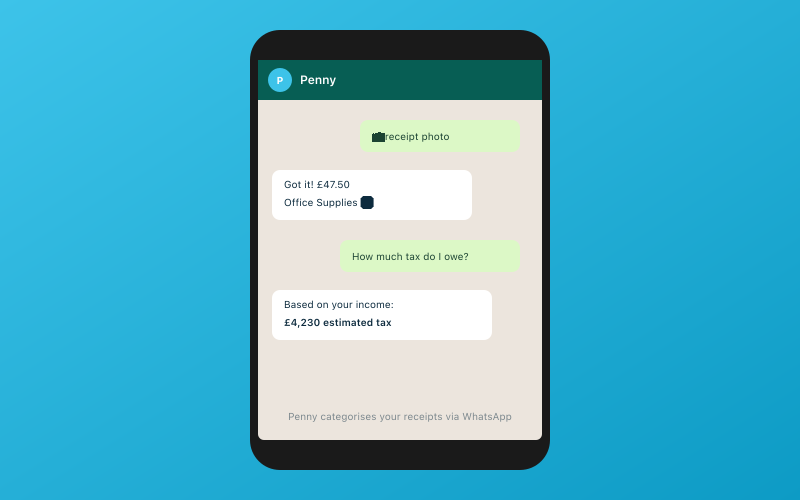 Chat with Penny on WhatsApp — your AI bookkeeper
Some tools slap an "AI-powered" label on basic rules engines. Others use genuine machine learning but lack guardrails for something as important as financial records. Let's be honest about what works and what doesn't.
What AI Can Do Right Now
Transaction Categorisation
The biggest practical impact. Instead of manually sorting every transaction, AI analyses the description, amount, timing, and your history to categorise automatically. Good AI goes beyond keyword matching — a payment to "Amazon" could be office supplies, stock, or personal. AI considers amount, history, and context to get it right.
Receipt OCR and Data Extraction
Modern vision models read photographs of receipts and extract merchant names, dates, totals, and VAT amounts. They handle crumpled receipts and faded thermal paper far better than traditional OCR. Combined with transaction matching, receipts link to the right bank transaction automatically.
Pattern Recognition
AI spots unusual spending spikes, duplicate payments, and transactions that don't match normal patterns. For sole traders, this often catches mistakes like double subscription charges or forgotten direct debits.
Tax Estimation
By understanding your income, expenses, and tax situation, AI maintains a running estimate of your liability. No more January surprises.
What AI Can't Do (Yet)
Tax Advice
AI can calculate your tax. It cannot advise on tax strategy. There's a crucial difference between "your estimated tax bill is £8,500" and "you should incorporate as a limited company to reduce your tax bill." The first is arithmetic. The second requires understanding your personal circumstances, future plans, risk tolerance, and a hundred other variables. Tax advice is regulated in the UK for good reason, and an AI model shouldn't be making recommendations that could cost you thousands if wrong.
Complex Judgements
Is this expense capital or revenue? Should this transaction be split? Will HMRC challenge this claim? These require nuance and professional understanding that AI handles poorly. Good AI knows its limits and asks for clarification rather than guessing.
Understanding Business Context
AI learns transaction patterns but doesn't truly understand your business. It doesn't know that payment to your sister was a legitimate subcontractor cost, or that your business model is changing next quarter. Human oversight remains essential.
How Penny Approaches AI Bookkeeping
When we built Penny, our AI bookkeeper, we made deliberate choices about balancing automation with accountability.
Tier 1: Rules-Based Matching (~95% of Transactions)
Your monthly Vodafone bill, office rent, regular suppliers — these follow clear patterns. Tier 1 handles them with deterministic rules derived from your history. Fast, predictable, and explainable.
Tier 2: RAG-Enhanced Matching (~4%)
For transactions that don't match simple rules, Penny uses Retrieval Augmented Generation — pulling from categorisation patterns across similar businesses, HMRC guidance, and your specific context.
Tier 3: LLM Reasoning (~1%)
For genuinely ambiguous transactions, Penny uses large language model reasoning. Critically, Tier 3 never auto-applies — these are always flagged for your review, with reasoning explained.
Confidence Scoring
Every categorisation comes with a confidence score:
- 95%+: Auto-applied
- 80–94%: Suggested for confirmation
- 50–79%: Options presented for you to choose
- Below 50%: Escalated to your accountant
This transparency is intentional. You should always see why Penny made a decision and how confident she was.
The Future of AI Bookkeeping
We're at an interesting inflection point. The technology is good enough to handle routine bookkeeping for most small businesses, but not good enough to replace professional judgement for complex situations.
Over the next few years, expect:
- Better receipt understanding — extracting line items, correctly splitting a Tesco receipt between business supplies and personal groceries
- Proactive insights — flagging upcoming tax thresholds, suggesting expense timing, identifying cash flow risks
- Smarter anomaly detection — better at distinguishing genuine errors from legitimate unusual transactions
- Natural language interaction — asking "What did I spend on travel last quarter?" and getting an instant answer
What we don't expect is AI replacing human oversight entirely. The stakes are too high, the edge cases too varied, and the regulatory environment too complex. The future is AI handling the 95% that's routine, so humans can focus on the 5% that actually requires thought.
Get Started with Accounted
Penny brings genuine AI intelligence to your bookkeeping — transparent, explainable, and always clear about what she's confident about. Start your free trial today — no credit card required.
Further Reading
- Accounted is built to comply with Making Tax Digital requirements.
- Good bookkeeping software helps you meet HMRC record-keeping requirements.
Related Reading
Editorial & Research
The Accounted editorial team covers software comparisons, technology, and the tools UK sole traders need to run their businesses efficiently. All software comparisons are based on independent research and publicly available pricing.
Ready to try Accounted?
Join UK sole traders who are simplifying their bookkeeping and tax.
Start your 14-day free trial