What Is Confidence Scoring and Why Your Bookkeeping App Needs It
The Problem Nobody Talks About
Here's something that should worry you about most bookkeeping apps: they auto-categorise your transactions, and you have no idea whether they got it right.
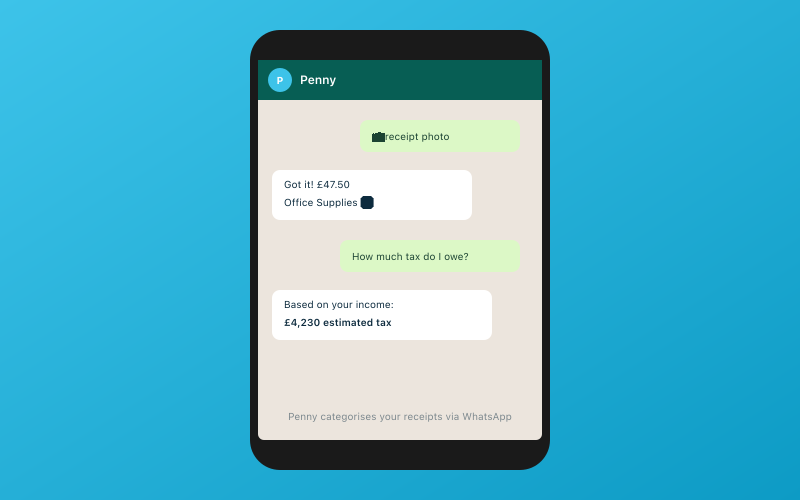 Chat with Penny on WhatsApp — your AI bookkeeper
Your bank feed comes in. The software assigns categories based on rules -- merchant name matching, keyword detection, whatever algorithm it uses. "TESCO STORES" becomes "Stock and materials." "SHELL FORECOURT" becomes "Travel costs." "AMAZON.CO.UK" becomes... well, what? Office supplies? Stock? Personal?
The software picks something. It doesn't tell you how confident it is. It doesn't flag the uncertain ones. It categorises everything with the same silent certainty, whether it's 99% sure or 50% sure.
This is the dirty secret of bookkeeping automation: silent categorisation is a gamble. And when HMRC expects accurate records for your Making Tax Digital submissions, gambling isn't a great strategy.
How Most Apps Handle It: Hope for the Best
Xero and QuickBooks are good products. Their bank rules work well for straightforward, recurring transactions. If you always buy from the same suppliers and your expenses follow predictable patterns, the rules catch most things.
But "most things" isn't all things. Consider these common scenarios:
- A payment to "Amazon" -- office supplies, stock for resale, or a birthday present?
- A supermarket transaction -- business supplies, client entertainment, or your weekly shop?
- A payment to a person's name -- subcontractor, professional services, or personal?
- A cafe purchase -- business meeting or just a coffee?
Rules-based systems handle these badly because the merchant name alone doesn't contain enough information. Most apps just pick the most common category and move on. If you notice the mistake, you fix it. If you don't, your records are wrong -- and you might not find out until your accountant reviews or HMRC asks questions.
What Confidence Scoring Actually Is
Confidence scoring is a fundamentally different approach. Instead of silently categorising everything, Penny assigns a percentage certainty to every categorisation she makes, based on:
- Merchant recognition -- is this a well-known business with a clear category?
- Your history -- how have you categorised similar transactions before?
- Amount patterns -- does the amount fit the expected range for this category?
- Timing context -- does the day and time suggest business or personal?
- Industry norms -- what do other sole traders in your industry typically categorise this as?
What happens next depends on that score.
High Confidence (95%+): Handled Automatically
When Penny is 95% or more confident, she categorises without bothering you. These are clear-cut cases: your monthly phone bill, regular fuel purchases, subscription payments on the same day every month.
For most sole traders, around 80-85% of transactions fall here. Categorised instantly, accurately, and silently. You can review them any time, but no action is needed.
This is where the time saving comes from. The bulk of your bookkeeping is handled without you lifting a finger.
Medium Confidence (70-94%): Flagged for Quick Review
When Penny is fairly sure but not certain, she flags it via WhatsApp:
Penny: I've categorised a £34.50 payment to Tesco as "Stock and materials" (confidence: 78%). Does that look right, or was this personal?
One tap to confirm. One tap to correct. Three seconds.
These are typically 10-15% of transactions -- cases where you shop at a merchant for both business and personal, or you've used a new supplier for the first time. The key: Penny tells you she's not fully sure. She suggests her best answer and lets you make the final call.
Low Confidence (Below 70%): Penny Asks Directly
When Penny genuinely doesn't know, she doesn't guess:
Penny: I saw a payment of £125.00 to "R. Davies" on 15 March. I'm not confident about this one. Could you tell me what it was for?
- Subcontractor payment
- Professional services
- Stock and materials
- Something else
No silent miscategorisation. No wrong category sitting unnoticed in your records. These are typically just 3-5% of transactions -- the genuinely ambiguous ones that are exactly where getting it wrong would cause problems.
Why This Matters for MTD Compliance
Making Tax Digital requires quarterly updates to HMRC with accurate records. HMRC's digital record-keeping requirements are clear: your records must be accurate and complete.
If your app silently miscategorises transactions, your quarterly submissions contain errors. Those errors compound over time. Expenses in the wrong category. Personal costs counted as business. Business expenses missed entirely.
The consequences range from overpaying tax (frustrating) to underpaying (which HMRC takes rather seriously). And if you're ever investigated, records full of miscategorised transactions don't look great.
Confidence scoring prevents this by ensuring uncertain categorisations are always checked by a human. Your records are accurate not because the AI is perfect, but because it's honest about what it doesn't know.
The Learning Loop: Penny Gets Smarter
Every time you confirm or correct a categorisation, Penny learns. Tell her that payments to "R. Davies" are subcontractor costs, and she'll remember next time. Her confidence for similar transactions increases.
In the first month, you might review 20% of transactions. By month three, closer to 10%. By month six, Penny knows your patterns well enough that 90%+ is automatic.
You're training a bookkeeper who never forgets, never leaves, and gets better every month.
No Other Bookkeeping App Does This
We've looked. Xero, QuickBooks, FreeAgent, Sage -- none offer transaction-level confidence scoring. They all use auto-categorisation, but none tell you how confident the system is about each decision.
This isn't a small difference. It's the difference between trusting your records and hoping they're right. Between knowing which transactions need attention and checking everything manually (or checking nothing and crossing your fingers).
Confidence scoring is a core reason we built Penny. It makes your bookkeeping genuinely trustworthy -- and trustworthy books mean stress-free tax deadlines, smooth accountant reviews, and peace of mind that your numbers are right.
See It in Action
The best way to understand confidence scoring is to experience it. Sign up, connect your bank, and watch Penny categorise your first batch of transactions. You'll see the scores, see how she handles uncertainty, and understand immediately why this matters.
Ready to simplify your bookkeeping? Try Accounted free for 14 days -->
Further Reading
- Accounted is built to comply with Making Tax Digital requirements.
- Good bookkeeping software helps you meet HMRC record-keeping requirements.
Related Reading
- Best Accounting Software for Landlords in 2026
- How to Switch from FreeAgent to Accounted: Why and How
Related reading: 10 Things You Can Ask Penny on WhatsApp.
You may also find our AI Bookkeeping Explained: How and Why It Matters helpful.
Related reading: How Penny Works: A Day in the Life of AI.
See our detailed comparison: Penny vs Manual Bookkeeping: Time Savings.
Related reading: Penny's Weekly Summary: How Your AI Bookkeeper Reports Back.
Start your free trial and see how Accounted simplifies your bookkeeping.
Editorial & Research
The Accounted editorial team covers software comparisons, technology, and the tools UK sole traders need to run their businesses efficiently. All software comparisons are based on independent research and publicly available pricing.
Ready to try Accounted?
Join UK sole traders who are simplifying their bookkeeping and tax.
Start your 14-day free trial