Can AI Really Do Your Bookkeeping? We Built One to Find Out
The Problem with Traditional Bookkeeping
Here's a scene that plays out in hundreds of thousands of homes across the UK every month. It's Sunday evening. You've worked hard all week -- delivering, building, consulting, cleaning, whatever your business does. Now you're sitting at the kitchen table with a laptop, a carrier bag of receipts, and a growing sense of dread.
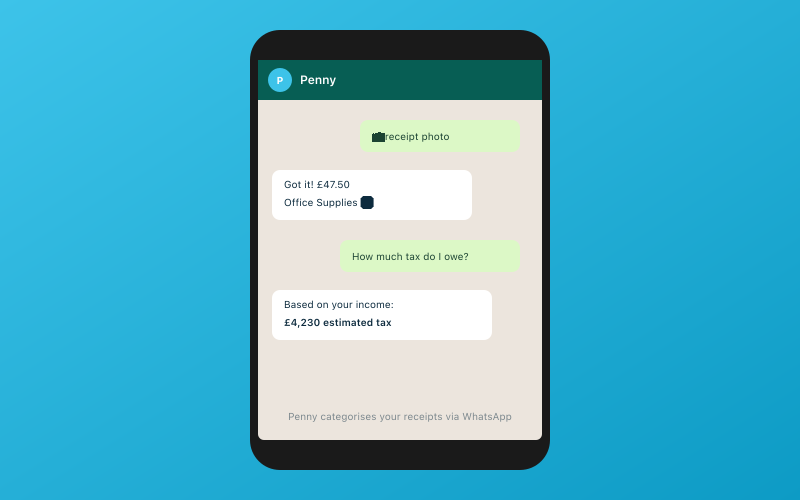 Chat with Penny on WhatsApp — your AI bookkeeper
You open your bookkeeping software. There are 47 uncategorised transactions. You can't remember what half of them were for. You spend 90 minutes clicking through drop-down menus, matching receipts, and second-guessing whether that Costa Coffee was a client meeting or just a coffee.
This is the reality for most UK sole traders. It's not complicated, exactly. It's tedious, repetitive, and relentless. And with Making Tax Digital now requiring quarterly submissions, you can't even leave it until year end.
So when people ask "Can AI do my bookkeeping?" -- what they're really asking is: "Can something please take this off my plate?"
Why Most Sole Traders Hate Admin
Administrative tasks are consistently the number one frustration for self-employed people in the UK. Not finding clients. Not the work itself. The paperwork.
You became a sole trader to do work you're good at. Bookkeeping is the opposite of that for most people -- something you endure so you can keep doing the thing you love.
The result? Procrastination. Missed deadlines. Inaccurate records. And penalties from HMRC that feel deeply unfair when you've been working 60-hour weeks.
What AI Is Genuinely Good At
Artificial intelligence isn't magic. It's pattern recognition at scale. And bookkeeping is almost entirely pattern recognition.
When you see "SCREWFIX DIRECT" on your bank statement, you know it's stock and materials. When you see "SHELL FORECOURT," you know it's travel costs. You're recognising patterns and mapping them to categories.
AI does the same thing, faster and more consistently. It doesn't get tired at 10pm or mix up categories because it's distracted. Here's what AI handles brilliantly:
- Categorising transactions against HMRC expense categories
- Extracting data from receipts (merchant, date, amount, VAT)
- Matching receipts to bank transactions
- Spotting patterns -- recurring expenses, unusual transactions, seasonal trends
- Calculating tax estimates based on current figures and HMRC rates
- Maintaining consistency -- the same type of expense gets the same category every time
What AI Isn't Good At (Yet)
Honesty matters here. AI is not a replacement for professional tax advice.
Judgment calls on ambiguous expenses. Was that laptop for business or personal use? What percentage of your phone bill counts as business? These require human judgment.
Complex tax planning. Should you register as a limited company? Is it worth voluntarily registering for VAT? These are strategic decisions that depend on your goals and circumstances.
Unusual situations. A one-off insurance settlement, a business asset sale, a change in structure -- these edge cases need a human who understands the nuances.
How We Built Penny
When we started building Penny, we didn't set out to replace human bookkeepers entirely. We set out to handle the 90% of bookkeeping work that is repetitive, pattern-based, and frankly beneath a human's time.
Penny uses a three-tier approach:
Tier 1: Rules Engine (~95% of transactions)
Most transactions follow clear patterns. "TESCO STORES" is almost always stock and materials for a food business, or personal for everyone else. Penny has thousands of rules that handle these categorisations instantly.
Tier 2: Contextual Analysis (~4%)
For less obvious transactions, Penny examines your history, industry, amount, and timing. A payment to "J. Morrison" could be anything -- but if you're a builder who's previously categorised Morrison payments as subcontractor costs, Penny connects the dots.
Tier 3: AI Reasoning (~1%)
For truly ambiguous cases, Penny uses large language models to reason about the transaction. Crucially, she uses confidence scoring to assess her certainty, and if she's not confident enough, she asks you.
Accuracy: AI vs Human Bookkeepers
We've tested Penny's categorisation accuracy against professional human bookkeepers:
- Penny's auto-categorisation accuracy: 95.2% on high-confidence transactions
- Average human bookkeeper accuracy: 91-94% (varies with fatigue and experience)
- Penny's overall accuracy (including user-confirmed): 99.1%
AI isn't just comparable to humans -- on routine categorisation, it's marginally better. Not because AI is smarter, but because it doesn't get tired, doesn't rush before deadlines, and doesn't accidentally click the wrong dropdown.
The real advantage isn't accuracy though. It's speed. What takes a human bookkeeper 2-3 hours per month takes Penny about 15 seconds.
The Human Safety Net
Here's where we differ from companies promising AI handles everything. We believe in AI-assisted bookkeeping, not AI-replaced bookkeeping.
Penny's confidence scoring is the key:
- 95% and above: Handled automatically. No action needed.
- 70-94%: Penny suggests a category and asks you to confirm via WhatsApp. One tap.
- Below 70%: Penny asks you directly. No guessing.
You're always in the loop on decisions that matter, but never buried in routine work.
If you work with an accountant, they can review Penny's work through the accountant portal. Low-confidence items get flagged for professional review. Your accountant spends less time on data entry and more on actual advice.
The Future Is AI-Assisted, Not AI-Replaced
The future of bookkeeping: AI handles the grunt work -- categorising, matching, calculating, filing. Humans handle the strategy -- tax planning, business decisions, complex situations.
That future is here now. Penny handles categorisation, receipt capture, tax estimates, and MTD submissions. She's available 24/7 on WhatsApp, never forgets a receipt, and keeps your books impeccably up to date.
Sole traders using Penny spend an average of 12 minutes per month on bookkeeping. Twelve minutes. Compare that to the Sunday evening dread, and you understand why AI-assisted bookkeeping is genuinely transformative for small businesses.
The question isn't "Can AI do your bookkeeping?" any more. It's "Why are you still doing it yourself?"
Ready to simplify your bookkeeping? Try Accounted free for 14 days -->
Further Reading
- Accounted is built to comply with Making Tax Digital requirements.
- Good bookkeeping software helps you meet HMRC record-keeping requirements.
Related Reading
- Best Accounting Software for Landlords in 2026
- Accounted vs TaxCalc: Year-Round Bookkeeping vs Annual Tax Filing
Related reading: 10 Things You Can Ask Penny on WhatsApp.
You may also find our AI Bookkeeping Explained: How and Why It Matters helpful.
Related reading: How Penny Works: A Day in the Life of AI.
See our detailed comparison: Penny vs Manual Bookkeeping: Time Savings.
Related reading: Penny's Weekly Summary: How Your AI Bookkeeper Reports Back.
Related reading: Accounted's IR35 Assessment Tool: How It Works.
Related reading: Why an AI Bookkeeper on WhatsApp Makes Sense.
Related reading: FreeAgent Alternatives: 5 Better Options for Freelancers.
Related reading: Open Banking in Accounted: How Bank Feeds Work.
For more on this topic, read Penny's Tax Knowledge: Trained on HMRC Guidance.
Start your free trial and see how Accounted simplifies your bookkeeping.
Editorial & Research
The Accounted editorial team covers software comparisons, technology, and the tools UK sole traders need to run their businesses efficiently. All software comparisons are based on independent research and publicly available pricing.
Ready to try Accounted?
Join UK sole traders who are simplifying their bookkeeping and tax.
Start your 14-day free trial