How to Reduce Your Tax Bill as a UK Sole Trader (Legally)
Yes, You Can Pay Less Tax. Legally.
This is not a guide to dodgy tax schemes. Everything here is perfectly legal, openly encouraged by HMRC, and available to every sole trader in the UK. The problem isn't that these strategies are secret — it's that most people simply don't know about them.
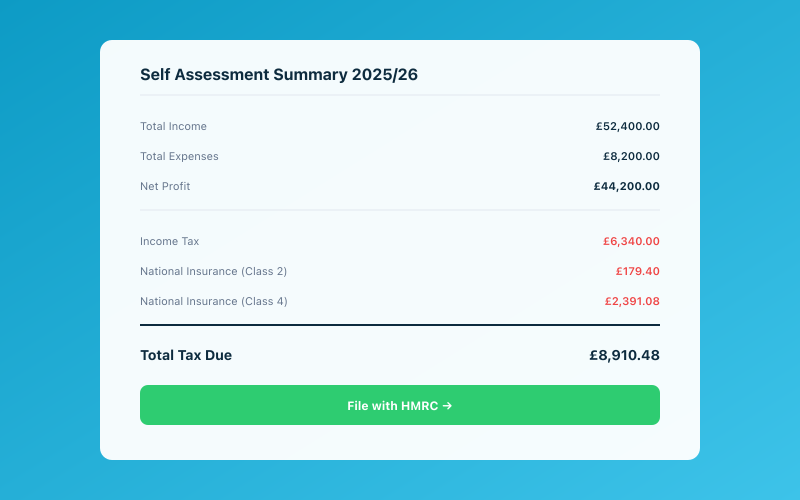 Your Accounted dashboard shows your real-time tax position
As a sole trader, you're taxed on your profits — income minus allowable expenses. The less profit you report (legitimately), the less tax you pay. Here's how to do that.
1. Claim Every Allowable Expense
This is the single biggest lever you have. Every pound of legitimate expense reduces your taxable profit by a pound — that's 20p saved at the basic rate, or 40p at the higher rate.
We've put together a complete list of sole trader expenses — most sole traders miss at least a few categories. Common ones people forget: working from home costs, professional subscriptions, and bank charges.
No receipt, no claim. That's why tools that categorise expenses automatically save you real money — not just time.
2. Use Your Personal Allowance (£12,570)
Every UK resident gets a tax-free personal allowance of £12,570. If you're employed part-time and self-employed on the side, your allowance gets split across both. Your tax code determines how it's allocated, so check it's set up correctly.
If your total income is close to £12,570, you might not owe any income tax at all (though National Insurance is a separate calculation).
3. Marriage Allowance Transfer
If you're married or in a civil partnership and one of you earns less than £12,570, you can transfer £1,260 of unused personal allowance to the higher earner — saving up to £252 per year. You can backdate it up to four years. That's potentially over £1,000 for filling in a short form.
This only works if the higher earner is a basic rate taxpayer (under £50,270).
4. Pension Contributions
This is the single most powerful tax reduction tool available to sole traders, and it's criminally underused.
When you contribute to a personal pension, the amount is added back to your basic rate band. In practice, this means:
- Basic rate taxpayers: Every £80 you put in becomes £100 in your pension (the government adds 20% tax relief automatically).
- Higher rate taxpayers: You can claim an additional 20% back through your Self Assessment, meaning every £60 you actually "spend" puts £100 in your pension.
You can contribute up to £60,000 per year (or your total earnings, whichever is lower). If you haven't used your full allowance in the last three tax years, you can carry it forward.
Yes, the money is locked away until you're 57. But if you're paying 40% tax, putting money into a pension gives you an effective 67% return before any investment growth. Nothing else comes close.
5. Capital Allowances on Equipment
When you buy equipment for your business — a laptop, a van, tools, office furniture — you don't just deduct it as a simple expense. Instead, you claim capital allowances.
The good news is that the Annual Investment Allowance (AIA) lets you deduct 100% of the cost of most equipment in the year you buy it, up to £1 million. For most sole traders, this means you can deduct the full cost immediately.
If you know you're going to have a high-profit year, buying necessary equipment before the tax year ends can meaningfully reduce your bill. A £2,000 laptop saves you £400 in tax at the basic rate, or £800 at the higher rate.
6. The Trading Allowance (£1,000)
If your self-employment income is small — a side hustle, some freelance work — the trading allowance gives you £1,000 tax-free. Earn less than £1,000 and you don't even need to register as a sole trader.
Earn more than £1,000? You can deduct either the flat £1,000 allowance or your actual expenses — whichever gives you the lower profit.
7. Loss Relief
Had a bad year? Made a loss? There's a silver lining: you can use that loss to reduce tax on other income.
You've got several options:
- Offset against other income in the same year — if you're employed and self-employed, your business loss can reduce the tax on your employment income
- Carry the loss forward — offset it against future profits from the same trade
- Carry the loss back — offset against the previous year's profits (useful if you had a good year last year and a bad one this year)
This is particularly valuable in your first few years of trading. Start-up costs can create a loss in year one, and that loss can reduce your tax bill in year two when (hopefully) the money starts coming in.
8. Timing Income and Expenses
Your tax year runs from 6 April to 5 April. What you earn and spend within that window determines your tax bill. This creates opportunities.
If you're approaching a higher tax band, consider:
- Delaying invoicing until after 5 April (pushing income into the next tax year)
- Bringing forward planned purchases into the current tax year (increasing expenses)
If you've had a low-income year, consider:
- Chasing outstanding invoices before 5 April
- Delaying large purchases until the next tax year when they'll save more tax
This isn't about faking anything — it's about sensible timing of real business decisions. The difference between invoicing on 4 April versus 7 April could be thousands of pounds in tax.
Be aware though: once Making Tax Digital quarterly submissions become mandatory, the scope for timing strategies may narrow slightly. Planning ahead is more important than ever.
9. Check Whether a Limited Company Makes Sense
Once your profits consistently exceed £30,000-£40,000, it's worth running the numbers on incorporating. A limited company pays Corporation Tax at 25% (or 19% on profits under £50,000), and you can extract money through salary and dividends — often more tax-efficient than paying income tax and National Insurance as a sole trader.
It's not right for everyone — more admin and more cost. But the savings can be significant. We've compared the two in our sole trader vs limited company guide.
Let Penny Find the Savings for You
Tax savings only work if you actually claim them. Most sole traders, being busy running their business, miss deductions and overpay as a result.
That's why we built Penny, our AI bookkeeper, to proactively flag tax-saving opportunities. She'll spot when you're approaching a threshold, remind you about unused allowances, and make sure every legitimate expense gets captured. You don't need to become a tax expert — you just need a system that doesn't let things slip through the cracks.
Ready to simplify your bookkeeping? Try Accounted free for 14 days →
Related Reading
Start your free trial and let Penny handle your bookkeeping automatically.
Penny, your AI bookkeeper, tracks your tax position in real time and flags opportunities to reduce your bill. Meet Penny →
Tax & Compliance Specialists
Our tax specialists have decades of combined experience in UK sole trader and small business taxation, MTD compliance, and HMRC submissions. All content is reviewed against current HMRC guidance before publication and updated quarterly to reflect legislative changes.
Ready to try Accounted?
Join UK sole traders who are simplifying their bookkeeping and tax.
Start your 14-day free trial