Understanding Your Tax Code: What 1257L Actually Means
That String of Letters and Numbers on Your Payslip
If you've ever glanced at your payslip and seen "1257L" without having the faintest idea what it means, you're in excellent company. Tax codes affect how much money you take home every month, yet almost nobody understands them.
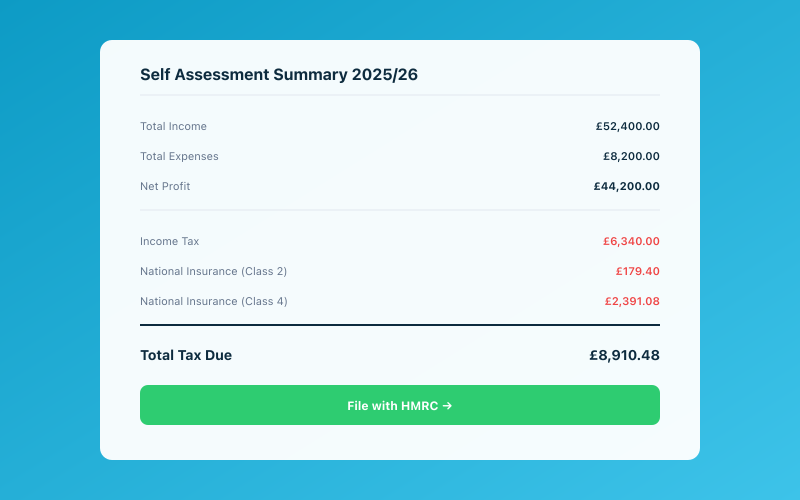 Your Accounted dashboard shows your real-time tax position
Good news: they're far simpler than they look.
How Tax Codes Work
A tax code tells your employer how much tax-free income you're entitled to. The formula is simple:
Multiply the number in your tax code by 10, and that's your tax-free allowance.
So 1257L means a tax-free allowance of £12,570. Your employer won't deduct income tax on the first £12,570 you earn. Everything above that gets taxed at the appropriate rate. The letter tells HMRC what type of allowance applies.
Common Tax Codes Explained
1257L — The Standard Code
The most common tax code in the UK. You're entitled to the full personal allowance of £12,570, with no adjustments. If your financial affairs are straightforward — one job, no benefits in kind, no outstanding tax — this is what you'll have.
BR — Basic Rate
All your income from this source is taxed at 20%, with no personal allowance. Typically used for a second job, because your allowance is already applied to your first. If you see BR on your only job, something's wrong — you're overpaying.
D0 and D1 — Higher and Additional Rate
D0 taxes everything at 40%; D1 at 45%. Used for secondary income sources when your other earnings already cover the lower bands.
K Codes
A K code means you owe more tax than your personal allowance covers. The number represents income added to your taxable pay. This happens with significant benefits in kind (company car, health insurance) or if HMRC is collecting underpaid tax from a previous year.
Example: K475 means £4,750 is added to your taxable income. Earn £30,000, get taxed as if you earned £34,750.
NT and 0T
NT means no tax is deducted — rare, usually diplomatic staff. 0T means no personal allowance, but normal graduated rates apply. Often used temporarily when HMRC lacks your information. If 0T persists beyond a couple of months, chase it up.
Scottish Tax Codes
If you live in Scotland, your tax code has an S prefix (e.g. S1257L). Your personal allowance stays the same, but Scottish income tax rates apply — which include six bands ranging from 19% (starter rate) up to 48% (top rate). If you've moved to or from Scotland, check your code has been updated.
Welsh taxpayers get a C prefix (for Cymru). Currently Welsh rates match England and Northern Ireland, so it doesn't change your tax amount.
Why Your Tax Code Might Change
Your tax code isn't set in stone. HMRC can change it if your circumstances change:
- Benefits in kind starting or ending (company car, health insurance)
- Underpaid tax from a previous year being collected
- Overpaid tax being refunded via increased allowance
- Starting a second job — your allowance shifts to one employer
- Marriage allowance being applied or removed
You'll get a letter from HMRC when your code changes, though the update may appear on your payslip first.
Emergency Tax Codes
If your employer doesn't have your previous tax details (no P45), they might use an emergency tax code like 1257L W1 or 1257L M1. The W1/M1 suffix means each pay period is treated independently, often resulting in overpaying initially.
Emergency codes should be temporary. If yours persists beyond a couple of months, contact HMRC — the refund could be significant.
How to Check Your Tax Code
Check your tax code via:
- Personal Tax Account on gov.uk — shows your code and lets you correct HMRC's information
- HMRC App — view your code and report changes
- Your payslip — printed near the top
- P2 Notice of Coding — sent annually, usually in January or February
If anything looks wrong, check your Personal Tax Account first. Correct any errors there, and HMRC will issue an updated code.
What to Do If Your Tax Code Is Wrong
- Check your Personal Tax Account and correct any wrong information
- Call HMRC on 0300 200 3300 if you can't resolve it online
- Tell your employer — they can only use what HMRC tells them, but it's worth flagging
- Claim a refund — HMRC should do this automatically when corrected, but it can take time
Overpaid tax from a wrong code can be reclaimed for up to four years.
Tax Codes and Self-Employment
If you're purely self-employed, tax codes don't directly apply to you — you pay through Self Assessment, and your personal allowance is applied when calculating your tax bill.
However, if you're employed and self-employed, your tax code matters. Your personal allowance usually applies to employment income, with self-employment profits taxed on top. Make sure your employer has the correct code and your Self Assessment return reflects your employment income accurately.
For a broader look at all the tax deadlines you need to hit, we've got you covered.
Ready to simplify your bookkeeping? Try Accounted free for 14 days →
Related Reading
Start your free trial and let Penny handle your bookkeeping automatically.
Penny, your AI bookkeeper, tracks your tax position in real time and flags opportunities to reduce your bill. Meet Penny →
Tax & Compliance Specialists
Our tax specialists have decades of combined experience in UK sole trader and small business taxation, MTD compliance, and HMRC submissions. All content is reviewed against current HMRC guidance before publication and updated quarterly to reflect legislative changes.
Ready to try Accounted?
Join UK sole traders who are simplifying their bookkeeping and tax.
Start your 14-day free trial