Self Assessment vs MTD: What's Actually Changing?
The System You Know
If you've been self-employed for any length of time, Self Assessment is a familiar routine. Keep your records throughout the year (or, let's be honest, stuff receipts in a drawer and deal with it later), then file your tax return by 31 January.
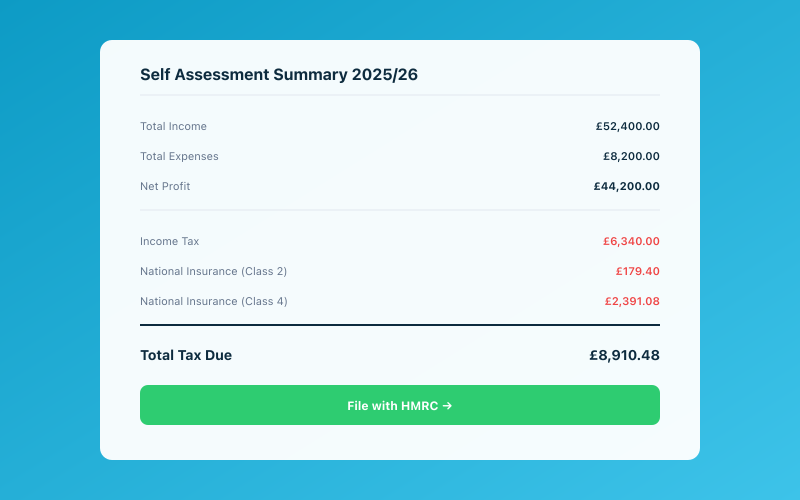 Your Accounted dashboard shows your real-time tax position
It's been this way since 1996. Now Making Tax Digital is changing the fundamentals. But the changes aren't quite as dramatic as the headlines suggest. Some things are genuinely different. Some things stay exactly the same. Understanding the distinction is the key to not getting overwhelmed.
What MTD Actually Replaces
The biggest change is moving from annual reporting to quarterly reporting. Instead of one tax return per year, you'll submit four quarterly updates to HMRC throughout the tax year, followed by an End of Period Statement and a Final Declaration.
Here's what that looks like in practice:
Under Self Assessment (Current System)
- Keep records throughout the tax year (6 April to 5 April)
- File your tax return by 31 January (online) or 31 October (paper)
- Pay your tax bill by 31 January (plus payments on account if applicable)
Under MTD (New System)
- Keep digital records throughout the tax year using compatible software
- Submit quarterly updates summarising income and expenses (deadlines: 5 Aug, 5 Nov, 5 Feb, 5 May)
- Submit an End of Period Statement confirming year-end adjustments
- Submit a Final Declaration (replaces the tax return) by 31 January
- Pay your tax bill by 31 January (payments on account still apply)
The quarterly updates are the new element. The Final Declaration is essentially a renamed, slimmed-down version of the Self Assessment return. And the payment deadlines haven't changed at all.
What Stays the Same
More stays the same than you might think:
The 31 January Deadline
Your Final Declaration and tax payment are still due by 31 January. That familiar deadline isn't going anywhere.
Payments on Account
If your tax bill is over £1,000, you'll still make payments on account — 50% by 31 January, 50% by 31 July. MTD hasn't changed the payment structure.
What You Can Claim
Your allowable expenses remain the same. If you could claim it before, you can claim it under MTD.
Capital Allowances and Adjustments
Year-end adjustments like capital allowances and loss relief are still handled at year end through the End of Period Statement — not in quarterly updates.
Tax Codes and Thresholds
Your personal allowance and tax code work exactly the same way. National Insurance is calculated on the same basis.
The Transition Period: Running Both Systems
Here's something that isn't widely publicised: during the transition period, Self Assessment doesn't disappear immediately. For the 2025/26 tax year (the last year before MTD kicks in for the first group), you'll file a normal Self Assessment return as usual.
From the 2026/27 tax year onwards (starting 6 April 2026), if you're in the first MTD group (gross income over £50,000), you'll switch to the new system. Your 2026/27 tax obligations will be met through quarterly updates and a Final Declaration rather than a Self Assessment return.
What If You're Below the Threshold?
If your income is between £30,000 and £50,000, you'll continue with Self Assessment until April 2027, when the threshold drops. If you're under £30,000, HMRC hasn't yet confirmed when (or if) you'll be required to join MTD. For now, Self Assessment continues as normal.
This means that for the next year or two, both systems will run in parallel across different groups of taxpayers. HMRC's Self Assessment system isn't being switched off — it's being gradually superseded.
Key Dates for the Changeover
Here's the timeline at a glance:
| Date | What Happens | |------|-------------| | 31 January 2026 | File 2024/25 Self Assessment return (normal deadline) | | 6 April 2026 | MTD begins for sole traders and landlords earning over £50,000 | | 5 August 2026 | First MTD quarterly update deadline (Q1: Apr-Jul 2026) | | 31 January 2027 | Final Declaration for 2025/26 (last Self Assessment year for first group) AND payments on account under MTD | | 6 April 2027 | MTD begins for those earning over £30,000 | | TBC | MTD for those earning under £30,000 (no confirmed date) |
If you're in the first group, be signed up and ready before 6 April 2026. Your first submission isn't until August, but record-keeping needs to be digital from day one.
Will Self Assessment Disappear Entirely?
In the long term, probably yes. HMRC's vision is a fully digital tax system. But "long term" in HMRC timescales can mean a decade or more.
Self Assessment will continue for taxpayers below the MTD thresholds, those with income types not yet covered (certain partnerships, trusts), and situations where MTD doesn't apply. The most likely scenario is a gradual phase-out as the income threshold keeps dropping. But HMRC has been known to delay — MTD for Income Tax was originally supposed to start in 2018 — so nothing is guaranteed.
What This Means for Your Bookkeeping Routine
Under Self Assessment, plenty of sole traders operated on a "deal with it in January" basis. Collect receipts, hand them to an accountant, file the return, forget about it for another year.
Under MTD, that approach doesn't work. You need your books in order every three months. That's the genuine behavioural change MTD demands.
But here's the thing: keeping your books up to date is actually better for your business. You'll know your tax position in real time, make informed decisions about spending, and never face a nasty surprise in January.
Making the Transition Painless
The best way to prepare is to start now — even if you won't be required to use MTD until 2027. Get into the habit of keeping digital records, categorising expenses as they happen, and reviewing your figures quarterly.
With Accounted, this happens naturally. Connect your bank account, let Penny categorise your transactions, and respond to the occasional question on WhatsApp. By the time MTD kicks in, you'll already be working in the way the system requires — and the quarterly submissions will feel like a formality rather than a burden.
The shift from Self Assessment to MTD isn't something to fear. It's just a different rhythm. And once you're in the groove, most sole traders find it's actually less stressful than the old annual scramble.
For a full walkthrough of the new system, including the penalty regime, quarterly submission details, and how to sign up, head to our complete MTD guide.
Ready to simplify your bookkeeping? Try Accounted free for 14 days →
Related Reading
Related reading: MTD for Landlords: Property Income Reporting.
For step-by-step guidance, see our article on How to Set Up Making Tax Digital for Business.
Related reading: What Happens If You Miss the MTD Deadline.
For more on this topic, read MTD Digital Record Keeping: HMRC Requirements.
Related reading: MTD Exemptions: Who Doesn't Need to Comply.
Related reading: MTD Digital Links: Connecting Your Records.
You may also find our MTD for Self-Employed: Step-by-Step Setup Guide helpful.
For more on this topic, read Making Tax Digital Timeline: Every Deadline.
See how Accounted handles MTD and start your free trial.
Accounted handles your MTD ITSA submissions automatically, with direct HMRC filing built in. See how MTD works in Accounted →
Tax & Compliance Specialists
Our tax specialists have decades of combined experience in UK sole trader and small business taxation, MTD compliance, and HMRC submissions. All content is reviewed against current HMRC guidance before publication and updated quarterly to reflect legislative changes.
Ready to try Accounted?
Join UK sole traders who are simplifying their bookkeeping and tax.
Start your 14-day free trial