Payments on Account: Why HMRC Wants Tax in Advance
Payments on Account: Why HMRC Wants Tax in Advance
There's a moment every new sole trader experiences. You've filed your first Self Assessment return, you know your tax bill, and then — wait, why is HMRC asking for more than you owe?
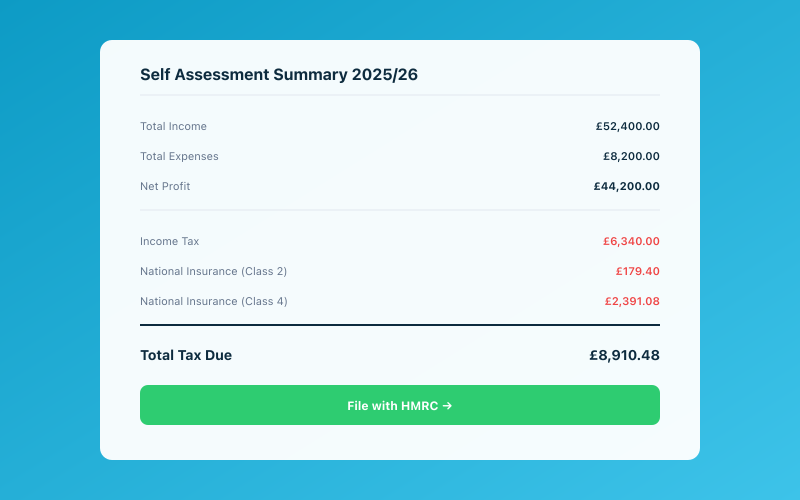 Your Accounted dashboard shows your real-time tax position
Welcome to payments on account. It's not a mistake. It's HMRC's way of collecting next year's tax in advance. And once you understand how it works, it's actually quite logical. Annoying, perhaps, but logical.
What Are Payments on Account?
Payments on account are advance payments towards your next year's tax bill. HMRC assumes your income will be roughly the same as last year, so they ask you to pay two instalments — each equal to 50% of your previous year's total tax and Class 4 National Insurance bill.
These payments are made on top of any balance owed for the current year.
A simple example
Let's say your 2024/25 tax bill (income tax plus Class 4 NI) comes to £4,000.
- 31 January 2026: You pay the £4,000 you owe for 2024/25, plus £2,000 as the first payment on account for 2025/26
- 31 July 2026: You pay another £2,000 as the second payment on account for 2025/26
- Total paid by July 2026: £8,000
When you file your 2025/26 return, HMRC calculates what you actually owe and deducts the £4,000 already paid on account. If your actual bill is £4,500, you pay a balancing payment of £500 on 31 January 2027. If it's less than £4,000, you get a refund.
The Payment Dates
There are three key dates in the payments on account cycle:
| Date | What's due | |------|-----------| | 31 January | Balancing payment for previous year + first payment on account for current year | | 31 July | Second payment on account for current year | | Following 31 January | Balancing payment (if your actual bill is higher than the payments on account) |
The January date is the big one. It's when you're potentially paying two amounts at once — the balance from last year and the first instalment for this year.
Mark these in your calendar. Set reminders. Tattoo them on your forearm if you must. Late payment means penalties and interest, and HMRC's interest rates are not friendly.
The First-Year Shock
Here's where it really stings. In your first year of Self Assessment, you've had no previous payments on account. So on 31 January, you're paying:
- 100% of your first year's tax bill
- Plus 50% on account for year two
That's effectively 150% of one year's tax in a single payment.
If your first year's bill is £6,000, you'll need to find £9,000 by 31 January. Then another £3,000 by 31 July.
This catches an enormous number of people out. If you're in your first year of self-employment, start setting aside money for tax now. A good rule of thumb is to save 25-30% of your profits into a separate savings account throughout the year. You'll thank yourself come January.
When Do Payments on Account Apply?
You'll need to make payments on account if your Self Assessment bill is more than £1,000 and less than 80% of your tax was collected at source (e.g., through PAYE).
If your bill is under £1,000, or if most of your tax is already collected through your employer, you won't need to make payments on account. This is why many employed people who do a tax return for rental income or side income may not face these payments — their PAYE already covers most of the liability.
Reducing Your Payments on Account
What if you know your income is going to be lower this year? Perhaps you've lost a big client, or you're taking time off. You don't have to pay based on last year's higher income.
You can apply to reduce your payments on account through your HMRC online account. You'll need to estimate what your actual bill will be, and HMRC will adjust your payments accordingly.
A word of caution: if you reduce your payments and it turns out your income wasn't lower, you'll owe the difference plus interest. Only reduce if you're genuinely confident your income has dropped. Being conservative here is wise.
You can do this through your HMRC online account under the Self Assessment section. Just keep records of why you made the reduction in case HMRC queries it.
If your income increases, your payments on account won't cover the full bill and you'll owe a larger balancing payment the following January — another reason to track your tax position throughout the year.
Cash Flow Planning for Tax
Payments on account are fundamentally a cash flow challenge. The tax itself isn't any higher — you're just paying it earlier than you might expect.
Here are some practical strategies:
1. Open a dedicated tax savings account
Transfer a percentage of every payment you receive into a separate account. For basic-rate taxpayers, 25% is a reasonable starting point. Higher-rate taxpayers should aim for 35-40%. Factor in National Insurance as well.
2. Know your key dates
31 January and 31 July. Non-negotiable. Build these into your cash flow management and make sure you have funds available at least a week before each deadline.
3. Invoice promptly
If you're waiting on client payments in January, chase them early. Outstanding invoices are the number one reason sole traders scramble for tax money. Our guide to invoicing as a sole trader covers best practices for getting paid on time.
4. Consider your timing
If you have control over when you invoice or recognise income, the tax year end becomes strategically important. Income received before 5 April falls into the current tax year; after that date, it's next year's problem (and next year's payments on account).
5. Don't forget about expenses
Claiming all your allowable expenses reduces your profit, which reduces your tax bill, which reduces your payments on account. It's a virtuous circle. Every legitimate expense you claim has a multiplier effect on your cash flow.
How Accounted Helps You Plan Ahead
The payments on account system is manageable once you understand it, but it requires you to think ahead. That's where Accounted's tax position dashboard comes in.
As you record income and expenses throughout the year, Accounted calculates your estimated tax bill in real time — including both income tax and Class 2 and Class 4 NI. It shows you:
- What you've already paid through payments on account
- What your estimated balancing payment will be
- What next year's payments on account are likely to be
- A month-by-month savings target to make sure you're putting enough aside
No spreadsheets. No guesswork. No January panic.
If your income changes significantly mid-year, you'll see the impact immediately and can decide whether to reduce your payments on account or adjust your savings rate.
The Bottom Line
Payments on account aren't an extra tax — they're an advance on tax you'll owe anyway. But they do create a cash flow challenge, especially in your first year when you're paying 150% of one year's tax in a short window.
The solution is simple: understand the system, plan ahead, and set money aside consistently. Do that, and January becomes just another month — not a financial crisis.
Ready to simplify your bookkeeping? Try Accounted free for 14 days →
Related Reading
Start your free trial and let Penny handle your bookkeeping automatically.
Penny, your AI bookkeeper, tracks your tax position in real time and flags opportunities to reduce your bill. Meet Penny →
Tax & Compliance Specialists
Our tax specialists have decades of combined experience in UK sole trader and small business taxation, MTD compliance, and HMRC submissions. All content is reviewed against current HMRC guidance before publication and updated quarterly to reflect legislative changes.
Ready to try Accounted?
Join UK sole traders who are simplifying their bookkeeping and tax.
Start your 14-day free trial