Year-End Tax Checklist for Sole Traders (2025/26)
Year-End Tax Checklist for Sole Traders (2025/26)
The 2025/26 tax year ends on 5 April 2026. That's your deadline for making sure everything is in order — expenses claimed, income recorded, and tax-saving opportunities seized before the window closes.
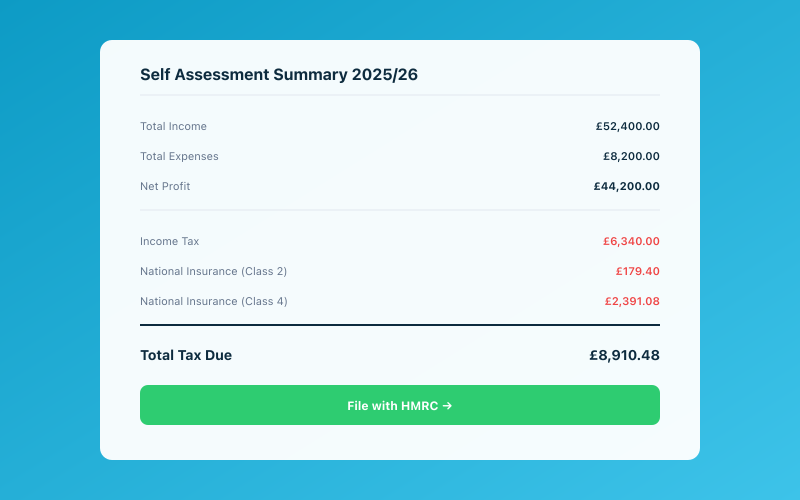 Your Accounted dashboard shows your real-time tax position
Whether you've been diligently tracking everything all year or you're only now thinking about it (no judgement), this checklist will walk you through everything you need to do before the year end.
1. Review All Your Income Sources
Start with the basics. Make sure you've recorded all income for the tax year — not just your main client or revenue stream.
Common sources people forget:
- One-off freelance gigs or side projects
- Cash payments (yes, these still count)
- Interest on business savings accounts
- Grants or business support payments
- Referral fees or affiliate income
- Income from selling assets or equipment
HMRC expects you to declare everything. Missing income sources is one of the most common triggers for an enquiry, so be thorough.
2. Chase Outstanding Invoices
If you use cash basis accounting (which most sole traders under £150,000 turnover do), you only declare income when it's actually received. An invoice issued in March but paid in April falls into the next tax year.
Whether you chase or wait depends on your situation. If your profits are lower this year, getting paid before 5 April uses more of your basic-rate band. If profits are higher, letting income fall into next year might be smarter. Check our invoicing guide for tips on getting paid promptly.
3. Claim All Allowable Expenses
This is the big one. Every legitimate business expense you haven't yet recorded is tax relief you're leaving on the table.
Go through your bank statements, receipts, and records for the full year. Common expenses sole traders miss:
- Working from home — simplified rate (up to £312/year) or actual costs (often much more)
- Professional subscriptions — trade bodies, professional memberships
- Software and tools — accounting software, design tools, cloud storage
- Training and courses — that update or maintain your existing skills
- Business insurance — public liability, professional indemnity
- Bank charges and interest — on your business account
- Marketing costs — website hosting, domain names, advertising
- Travel — fuel, train tickets, parking for business journeys (not commuting)
- Phone costs — the business proportion of your mobile bill
We have a comprehensive list of sole trader expenses if you want to make sure you haven't missed anything.
4. Do a Stock Take (If Applicable)
If you sell physical products, value your stock as at 5 April 2026 at the lower of cost or net realisable value. Write down damaged or unsellable stock to its realistic selling price.
5. Capital Allowances: Buy Before 5 April
If you've been thinking about buying equipment, a laptop, tools, or other business assets — do it before 5 April to claim the deduction in this tax year.
The Annual Investment Allowance (AIA) lets you deduct the full cost of qualifying equipment up to £1,000,000 in the year you buy it. For most sole traders, this means any equipment purchase is fully deductible immediately.
This includes:
- Computers and laptops
- Office furniture
- Tools and machinery
- Vehicles (with some restrictions for cars)
Buy that new laptop on 4 April and you claim it against 2025/26 profits. Wait until 6 April, and it's next year's deduction. But don't buy things you don't need just for the tax saving — a £1,000 purchase at 20% only saves £200.
6. Pension Contributions
Pension contributions are one of the most powerful tax-reduction tools available, and the deadline for 2025/26 relief is 5 April 2026.
As a sole trader, you can contribute up to £60,000 per year (or 100% of your earnings, whichever is lower) to a personal pension and receive full tax relief.
If you're a basic-rate taxpayer, your pension provider claims the 20% relief automatically. If you're a higher-rate taxpayer, you claim the additional 20% through your Self Assessment return.
Example: A £10,000 pension contribution for a higher-rate taxpayer saves £4,000 in tax (plus reduces your Class 4 NI liability). And the money is invested for your future.
If you haven't used your full allowance in previous years, you may be able to carry forward unused relief from the last three tax years. This is worth investigating if you've had a particularly profitable year.
7. Gift Aid Donations
If you've made charitable donations during the year, make sure they're recorded. Gift Aid donations extend your basic-rate band, which can reduce your higher-rate tax liability. A £2,000 Gift Aid donation on income of £55,000 could save you an extra £500. Make sure you have Gift Aid declarations from each charity.
8. Check Your Tax Code for Next Year
If you have employment income alongside your self-employment (or you have income collected through PAYE coding), check the tax code HMRC has assigned for 2026/27.
Incorrect tax codes are surprisingly common. Look out for old benefits still included after leaving employment, payments on account being collected through your code, and estimated untaxed income that's wildly inaccurate. Check via your Personal Tax Account on the HMRC website.
9. Prepare for Making Tax Digital
If this is your first year of Making Tax Digital for Income Tax, you'll need to start quarterly submissions from April 2026. Make sure you have HMRC-compatible software set up, your digital records in order, and you understand the new penalty regime. Don't leave setup until April.
10. Reconcile Your Bank Accounts
Before closing out the year, reconcile your business bank account. Every transaction should be categorised and matched. Look for:
- Uncategorised transactions
- Personal expenses accidentally paid from the business account (and vice versa)
- Standing orders or subscriptions you've forgotten about
- Bank charges you haven't claimed as expenses
A clean bank reconciliation makes your Self Assessment filing dramatically easier and reduces the risk of errors.
11. Back Up Your Records
HMRC requires you to keep records for at least 5 years after the filing deadline. For 2025/26, that means until at least 31 January 2032. Make sure everything is backed up securely — you'll need digital records for MTD anyway.
How Accounted Generates Your Year-End Summary
If you've been using Accounted throughout the year, much of this checklist is already done. Your income and expenses are tracked, your bank transactions are reconciled, and your tax position is calculated in real time.
At year end, Accounted generates a comprehensive summary that includes:
- Total income by source and category
- Complete expense breakdown with supporting receipts
- Working from home deduction (both methods calculated, so you can pick the best)
- Capital allowances claimed
- Estimated tax and National Insurance liability
- Comparison to previous year
Everything you need for your Self Assessment return — or to hand to your accountant — in one place. No year-end scramble, no missing receipts, no guesswork.
The Bottom Line
Year-end tax planning isn't about finding clever loopholes. It's about making sure you claim everything you're entitled to, time your purchases and contributions wisely, and go into the new tax year with clean, accurate records.
The best time to start this checklist was January. The second-best time is now. Work through it methodically, and you'll head into 2026/27 with confidence — and a lower tax bill.
Ready to simplify your bookkeeping? Try Accounted free for 14 days →
Related Reading
You may also find our Annual Investment Allowance Explained for Small Businesses helpful.
For step-by-step guidance, see our article on How to Handle an HMRC Tax Investigation.
Related reading: National Insurance Calculator for Self-Employed.
Related reading: Should I Register for VAT? Decision Framework.
For more on this topic, read Tax Implications of Closing Your Business.
For more on this topic, read Tax Relief on Charitable Donations for Business Owners.
Related reading: Am I Inside IR35? Self-Assessment Checklist.
For more on this topic, read Dividend Tax for Director-Shareholders: 2026.
For more on this topic, read How Much Should I Set Aside for Tax Each Month?.
You may also find our IR35 Explained: The Complete Guide for Contractors helpful.
Related reading: IR35 for Agencies: Responsibilities and Compliance.
Related reading: Marriage Allowance: Transfer £1,260 to Your Partner.
See our detailed comparison: Sole Trader vs Ltd Calculator: Which Saves Tax.
For step-by-step guidance, see our article on How to Spot HMRC Scam Emails, Texts, and Calls.
For more on this topic, read Year-End Tax Planning Tips for Sole Traders.
Related reading: Voluntary NI Contributions: When It's Worth It.
Start your free trial and let Penny handle your bookkeeping automatically.
Penny, your AI bookkeeper, tracks your tax position in real time and flags opportunities to reduce your bill. Meet Penny →
Tax & Compliance Specialists
Our tax specialists have decades of combined experience in UK sole trader and small business taxation, MTD compliance, and HMRC submissions. All content is reviewed against current HMRC guidance before publication and updated quarterly to reflect legislative changes.
Ready to try Accounted?
Join UK sole traders who are simplifying their bookkeeping and tax.
Start your 14-day free trial