MTD Penalties Explained: What Happens If You're Not Ready by April 2026
The Old Penalty System Is Gone
If you've been filing Self Assessment for a while, you'll know the old system: miss the 31 January deadline and you'd get an automatic £100 fine, followed by escalating penalties.
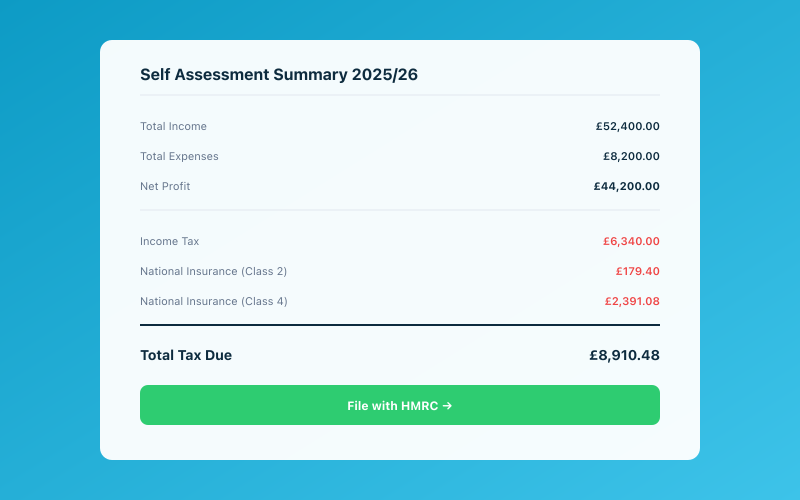 Your Accounted dashboard shows your real-time tax position
From April 2026, HMRC is introducing a new points-based penalty regime for anyone within Making Tax Digital for Income Tax. It's designed to be fairer — you won't get hammered for a single late submission — but it can add up quickly if you're not on top of things.
Late Submission Penalties: The Points System
Under MTD, you'll be submitting quarterly updates to HMRC, plus an End of Period Statement and a Final Declaration. That's six submissions per year for most sole traders.
Here's how the points system works:
How You Accumulate Points
- Every late submission earns you 1 penalty point. It doesn't matter whether you're a day late or a month late — it's one point per missed deadline.
- The penalty threshold for quarterly reporters is 4 points. Once you hit 4 points, you receive a £200 penalty.
- Every subsequent late submission after hitting the threshold is another £200. These stack up — there's no cap.
So in a worst-case scenario, if you missed every submission in your first year, you'd accumulate 6 points and pay £200 for the 4th, 5th, and 6th — that's £600 in penalties alone. And that's before we get to late payment charges.
How Points Expire
The good news: penalty points don't stay on your record forever. If you're a quarterly reporter, your points reset to zero after you achieve a 24-month period of compliance (all submissions on time). Points also can't be more than 24 months old when they count towards your threshold.
This means one bad year doesn't haunt you indefinitely. Get back on track, and the slate gets wiped clean.
Late Payment Penalties: Calculated Daily
Late submission and late payment are penalised separately. Even if your quarterly update is on time, you can still face penalties if you don't pay what you owe when it's due.
How Late Payment Charges Work
- Up to 15 days late: No penalty. HMRC gives you a short grace period.
- 16 to 30 days late: A penalty of 2% of the tax owed at day 15.
- 31+ days late: An additional 2% of the tax owed at day 30, plus a daily penalty calculated at an annualised rate of 4% on the outstanding balance.
Let's put some numbers on that. Say you owe £5,000 in tax and you're 45 days late:
- Day 15 penalty: 2% of £5,000 = £100
- Day 30 penalty: 2% of £5,000 = £100
- Daily penalty (days 31-45): £5,000 × 4% ÷ 365 × 15 = £8.22
- Total penalties: £208.22 (on top of the tax you still owe)
These charges may look modest on small amounts, but they scale linearly. Owe £20,000 and you're looking at over £800 in penalties for the same 45-day delay.
Interest on Late Payments
On top of penalties, HMRC charges interest on any tax paid late. The current rate is the Bank of England base rate plus 2.5%. As of February 2026, that puts the interest rate at around 7%.
Interest accrues daily from the date the payment was due until the date it's actually paid. Unlike penalties, there's no grace period for interest — it starts from day one.
And here's the bit that catches people out: you'll also pay interest on unpaid penalties. So if you don't pay a £200 late submission penalty promptly, that accrues interest too.
Reasonable Excuses HMRC Will Accept
Life happens, and HMRC acknowledges that. If you have a "reasonable excuse" for a late submission or payment, you can request that a penalty point or charge be removed.
HMRC will typically accept:
- Bereavement of a close family member around the deadline
- Serious illness (yours or a close relative's) that prevented you from meeting the deadline
- HMRC system outages or technical issues on their end
- Fire, flood, or other natural disaster affecting your records
- Postal delays (for paper-based elements, though MTD is mostly digital)
What HMRC Won't Accept
- "I didn't know about MTD" — ignorance isn't a reasonable excuse
- "My software wasn't working" — you're expected to have contingency plans
- "I was too busy" — unfortunately, that's not HMRC's problem
- "My accountant didn't do it" — you're ultimately responsible for your own tax affairs
The key test is whether you had a reasonable excuse that prevented compliance and you put things right without unreasonable delay once the excuse no longer applied.
How to Appeal a Penalty
If you believe a penalty was issued unfairly, you have the right to appeal. Here's the process:
Step 1: Review the Penalty Notice
HMRC will send you a penalty notice explaining what the penalty is for and how it was calculated. Check the details carefully — mistakes do happen.
Step 2: Appeal to HMRC Directly
Appeal online through your HMRC account or in writing, explaining your reasonable excuse with supporting evidence (medical certificates, insurance claims, screenshots of HMRC outages, etc.).
Step 3: Escalate if Necessary
If HMRC rejects your appeal, request an internal review by a different officer. If that fails, take your case to the First-tier Tribunal (Tax Chamber). Most appeals are resolved at the first stage.
Why Getting Set Up Early Eliminates the Risk
Here's the thing about MTD penalties: they're entirely avoidable. The whole points system is designed so that people who keep up with their submissions never face a fine. You get multiple chances before any money leaves your account.
The real risk isn't the penalty system being harsh — it's not being prepared when April 2026 arrives.
If you're scrambling to find software, set up digital records, and understand what HMRC expects, you're far more likely to miss that first quarterly deadline in August. And once you're behind, catching up gets harder with each quarter.
The Simplest Way to Stay Compliant
With Accounted, your digital records are maintained automatically as you go about your business. Bank transactions are categorised. Receipts are captured through WhatsApp. And when a quarterly deadline approaches, your submission is already prepared — you just review and send.
No last-minute panics. No penalty points. No daily interest charges ticking away in the background.
Set it up once, and let it handle the rest. Because sole traders have better things to worry about than HMRC compliance.
Ready to simplify your bookkeeping? Try Accounted free for 14 days →
Related Reading
See how Accounted handles MTD and start your free trial.
Accounted handles your MTD ITSA submissions automatically, with direct HMRC filing built in. See how MTD works in Accounted →
Tax & Compliance Specialists
Our tax specialists have decades of combined experience in UK sole trader and small business taxation, MTD compliance, and HMRC submissions. All content is reviewed against current HMRC guidance before publication and updated quarterly to reflect legislative changes.
Ready to try Accounted?
Join UK sole traders who are simplifying their bookkeeping and tax.
Start your 14-day free trial