IR35 Reforms — What Changed and What It Means in 2026
IR35 has been one of the most contentious pieces of UK tax legislation since it was introduced in April 2000. Over the past quarter of a century, it's been reviewed, reformed, partially scrapped, un-scrapped, and reformed again — creating a trail of confusion that continues to trip up contractors and businesses alike.
If you're trying to understand where things stand now and how we got here, this article traces the history of IR35 reforms and explains what the rules mean for contractors in 2026.
The Original IR35: 2000–2017
IR35 was introduced by the then Chancellor Gordon Brown in April 2000. The target was "disguised employees" — workers who operated through personal service companies (PSCs) to reduce their tax bill, despite working in a way that was essentially identical to employment.
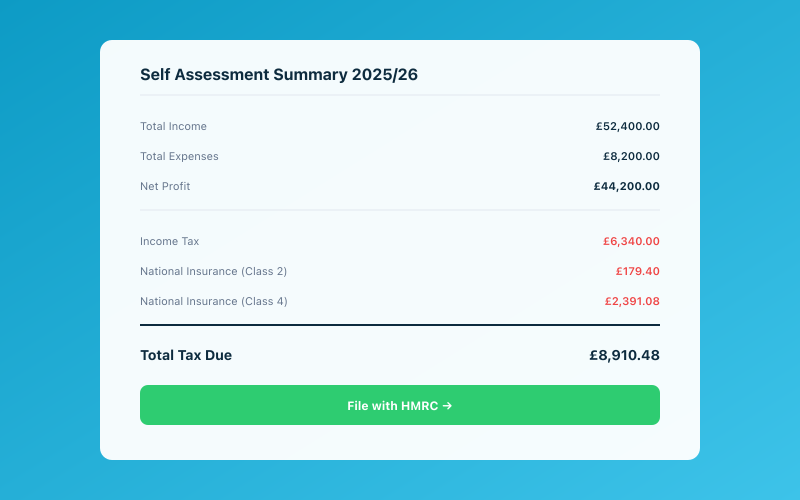 Your Accounted dashboard shows your real-time tax position
Under the original rules:
- The contractor was responsible for determining whether IR35 applied to each engagement
- If caught inside IR35, the contractor had to calculate a "deemed employment payment" at the end of the tax year and pay PAYE tax and National Insurance on it
- HMRC bore the burden of investigating and challenging status determinations
This system was widely criticised for being unenforceable. HMRC estimated that only 10% of contractors who should have been inside IR35 were actually complying. Investigations were expensive, time-consuming, and HMRC lost a significant proportion of the cases they took to tribunal.
Contractors, meanwhile, argued that the rules were vague, the tests were unclear, and genuine businesses were being caught alongside actual disguised employees.
The result was a stalemate that lasted for 17 years.
The Public Sector Reform: April 2017
The first major reform moved the responsibility for IR35 determinations away from contractors and onto the public sector bodies engaging them.
Under the new off-payroll rules for the public sector:
- The public sector body (NHS, government departments, councils, etc.) determined whether a contractor was inside or outside IR35
- If inside, the fee-payer (the agency or body paying the contractor's company) deducted PAYE and NI before making payment
- The contractor lost control over their own status determination
The impact was swift and significant. Many public sector bodies took a blanket approach, declaring all contractors inside IR35 to avoid the administrative burden and risk of getting individual assessments wrong. Contractors either accepted the tax hit, left the public sector entirely, or moved to umbrella company arrangements.
HMRC also launched the CEST (Check Employment Status for Tax) tool at this time, providing a free online assessment that the department said it would stand by. The tool was immediately controversial — for a deeper look at its strengths and weaknesses, see our guide to the CEST tool.
The Private Sector Extension: April 2021
Originally planned for April 2020 but delayed by a year due to COVID-19, the off-payroll rules were extended to medium and large private sector businesses from April 2021.
The rules mirror the public sector version:
- Medium and large businesses (those meeting at least two of: annual turnover above £10.2 million, balance sheet total above £5.1 million, or more than 50 employees) are responsible for determining IR35 status
- The client must issue a Status Determination Statement (SDS) to the contractor, setting out whether the engagement is inside or outside IR35 and the reasons for the determination
- The contractor has the right to disagree and challenge the determination through a formal process
- The fee-payer deducts PAYE and NI if the determination is inside IR35
- Small companies are exempt — for engagements with small clients, the contractor retains responsibility for their own status, as under the original rules
The Impact on Contracting
The private sector extension had a profound effect on the contracting market:
- Blanket inside IR35 determinations became common, particularly in financial services and large corporates
- Contract rates adjusted — many contractors negotiated higher day rates to compensate for the additional tax deducted inside IR35
- Some contractors moved to permanent employment, deciding the tax differential no longer justified the risk and hassle of contracting
- Umbrella companies proliferated, offering contractors a compliant way to work inside IR35 (though some umbrellas operated questionable tax avoidance schemes that later attracted HMRC attention)
- The contractor workforce contracted — certain sectors, particularly banking and insurance, saw a significant reduction in available contractors
The Brief Reversal That Wasn't: September–October 2022
In one of the most dramatic episodes in IR35's history, Chancellor Kwasi Kwarteng announced in the September 2022 mini-budget that the off-payroll rules would be repealed entirely from April 2023. Responsibility for IR35 determinations would return to contractors, essentially reverting to the pre-2017 rules.
The contracting community celebrated. Businesses began planning for the change. Recruitment agencies started adjusting their processes.
Then, less than a month later, the new Chancellor Jeremy Hunt reversed the reversal. The off-payroll rules would remain. The celebration was over before anyone had finished their coffee.
This episode perfectly captured the uncertainty that has plagued IR35 throughout its existence. Contractors learned, once again, that they couldn't rely on political promises when it came to tax legislation.
Where Things Stand in 2026
As of early 2026, the IR35 framework is essentially the same as it's been since April 2021:
- Large and medium private sector clients determine IR35 status for contractors working through intermediaries
- Public sector clients continue to determine status as they have since 2017
- Small company clients leave the determination with the contractor
- The CEST tool remains HMRC's official assessment mechanism
- Status Determination Statements must be provided with reasons, and contractors have the right to challenge
Ongoing HMRC Activity
HMRC has continued to pursue IR35 cases, with several high-profile tribunal decisions in recent years providing further clarity on how the tests are applied. The tax authority has also increased compliance checks, particularly targeting:
- Large businesses with significant contractor workforces
- Sectors known for widespread contracting (IT, financial services, media)
- Arrangements that appear designed to circumvent the off-payroll rules
The Compliance Landscape
For contractors still operating outside IR35 (whether through small company exemptions or genuine outside IR35 assessments from larger clients), the key message is that compliance expectations are higher than ever:
- Documentation is essential — HMRC expects contractors to be able to evidence their working arrangements. See our guide on how to prove you're outside IR35.
- Contracts must reflect reality — discrepancies between contractual terms and actual working practices are the fastest way to lose an IR35 case
- The three key tests remain central — substitution, control, and mutuality of obligation continue to be the primary factors. Our article on IR35 and the substitution test covers the most important of these.
What the Reforms Mean for Different Groups
For Contractors Working Through Limited Companies
The reforms have fundamentally changed the economics of contracting for those engaged by medium and large businesses. If you're assessed as inside IR35:
- Your take-home pay is reduced by roughly 15–25% compared to outside IR35
- You lose the ability to pay yourself through a tax-efficient salary/dividend combination
- You may still be able to claim some expenses, but the scope is limited
If you're outside IR35 (either through a genuine assessment or because you work for small companies), the original tax benefits of operating through a limited company remain intact — but you need to be able to justify your position.
For Sole Traders
IR35 technically applies to workers who operate through an intermediary — typically a limited company. If you work as a sole trader (self-employed, unincorporated), IR35 doesn't apply directly. However, the underlying principles of employment status are still relevant, and HMRC can challenge your self-employed status through other means if your working arrangements look like employment.
If you're a sole trader, your focus should be on maintaining genuine self-employment indicators: multiple clients, control over your work, financial risk, and proper business records. Keeping your bookkeeping up to date with a tool like Accounted is one practical way to demonstrate you're running a real business.
For Businesses Engaging Contractors
If you're a medium or large business, the off-payroll rules mean you must:
- Assess each contractor engagement individually (no blanket determinations, though many businesses still take this approach)
- Issue a Status Determination Statement with reasons
- Have a disagreement process for contractors who challenge the assessment
- Take "reasonable care" in making determinations — failure to do so can result in the tax liability transferring to the client
Small businesses are exempt from these obligations, making them more attractive to contractors — though the "small company" definition (failing to meet at least two of the three size tests) means many growing businesses transition from small to medium as they expand.
Looking Ahead: Will IR35 Change Again?
After two and a half decades of reforms, reversals, and uncertainty, the question on every contractor's mind is: what's next?
There are a few possibilities:
- Further HMRC enforcement — the most likely scenario in the short term. HMRC has the tools and the appetite to increase compliance activity.
- Simplification — there have been calls to replace IR35 with a simpler test or a single employment status framework. The Taylor Review (2017) recommended this, and the idea resurfaces periodically. However, no government has yet committed to implementation.
- Alignment with employment law — currently, tax law and employment law use different tests for determining employment status. Aligning them would bring clarity but would also be politically complex.
- Status quo — perhaps the most realistic prediction. The current framework, while imperfect, is established and operational. Governments tend to prefer stability over further upheaval, especially in areas that generate significant tax revenue.
For contractors, the practical advice remains the same regardless of future changes: understand your status, document your working arrangements, ensure your contracts reflect reality, and keep your financial records in order.
The Bottom Line
IR35 has evolved significantly since 2000, and the off-payroll reforms of 2017 and 2021 represent the biggest changes in the legislation's history. For contractors in 2026, the rules are settled (for now), and the focus should be on compliance, documentation, and ensuring genuine business-to-business working arrangements.
Whether you're a limited company contractor navigating IR35 assessments or a sole trader maintaining your self-employed status, accurate bookkeeping is fundamental. Accounted gives you a clear, real-time picture of your business finances, and Penny can help you understand how your working arrangements intersect with your tax position.
Accounted helps UK sole traders stay on top of their bookkeeping and tax. Start your free 30-day trial at getaccounted.co.uk.
Related Reading
- IR35 — The Inside and Outside Explained With Real Examples
- IR35 Explained for Contractors
- The CEST Tool — How HMRC Assesses Your IR35 Status
- Foreign Bank Accounts — Do You Need to Tell HMRC?
- Tax When Getting Married — What Changes
Penny, your AI bookkeeper, tracks your tax position in real time and flags opportunities to reduce your bill. Meet Penny →
Tax & Compliance Specialists
Our tax specialists have decades of combined experience in UK sole trader and small business taxation, MTD compliance, and HMRC submissions. All content is reviewed against current HMRC guidance before publication and updated quarterly to reflect legislative changes.
Ready to try Accounted?
Join UK sole traders who are simplifying their bookkeeping and tax.
Start your 14-day free trial