How to Prove You're Outside IR35
Knowing you're outside IR35 is one thing. Proving it — to a client, an agency, or HMRC — is another matter entirely. The burden of getting this right has shifted over the years, but regardless of who makes the formal determination, contractors who can demonstrate their genuine business status are always in a stronger position.
This guide covers the evidence you need, the tests that matter, and the practical steps to build a robust defence of your IR35 status.
Why Proof Matters
Under the current off-payroll working rules (in effect since April 2021 for medium and large private sector clients, and since 2017 for public sector clients), the responsibility for determining IR35 status sits with the end client — not the contractor.
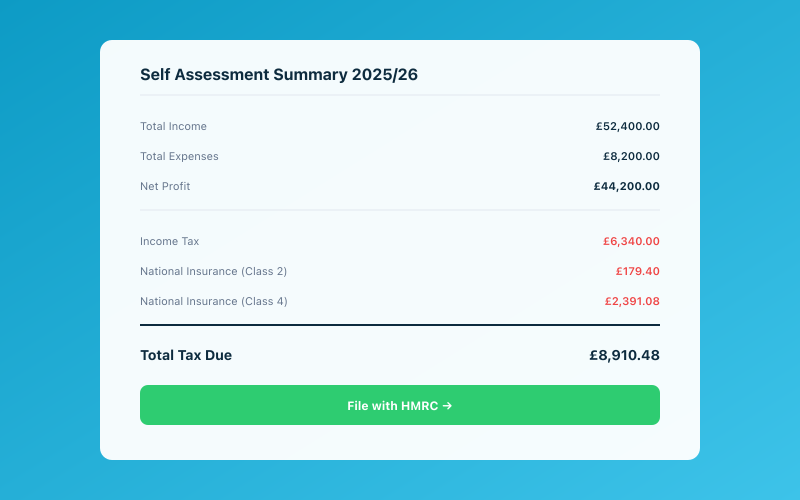 Your Accounted dashboard shows your real-time tax position
But that doesn't mean contractors can sit back and relax. Here's why:
- Clients often take a blanket approach, declaring all contractors inside IR35 to avoid risk — even when individual engagements are genuinely outside. If you can present strong evidence of your outside status, you're more likely to get a fair assessment.
- Small companies are exempt from the off-payroll rules, meaning the contractor retains responsibility for their own IR35 status. If you work for small clients, the burden is squarely on you.
- HMRC can still investigate, and if they disagree with a determination, having documented evidence is your best protection.
- Status Determination Statements (SDS) issued by clients should include reasons. If you disagree, you have the right to challenge — and evidence is essential for a successful challenge.
For the full picture on IR35 legislation, see our complete guide to IR35 for contractors.
The Three Pillars of Proof
IR35 status is assessed against multiple factors, but three tests form the backbone of any determination. Your evidence should address all three.
1. Substitution: Can You Send Someone Else?
The right of substitution is often considered the single most important IR35 test. If you have a genuine, unfettered right to send a substitute to perform the work — and the client cannot unreasonably refuse — this is powerful evidence of being outside IR35.
How to prove it:
- Contractual clause: Your contract should include a clear substitution clause that gives you the right to provide a substitute without requiring the client's prior approval (or with approval that cannot be unreasonably withheld)
- Practical reality: If you've actually used a substitute, document it — dates, who you sent, and the client's response. This is gold-standard evidence.
- Substitute availability: Having identified individuals who could substitute for you (even if you haven't needed to use them yet) shows the right is genuine, not theoretical
- Payment: Ideally, you pay the substitute from your own company, and the client continues to pay your company the agreed rate. This demonstrates that the client is contracting with your business, not you personally
Our article on IR35 and substitution goes into much more detail on this crucial test.
Common pitfalls:
- A substitution clause that requires client approval for any reason (rather than only for reasonable grounds) weakens your position
- If the nature of the work means only you could practically do it (e.g., you're providing expert testimony based on your personal experience), the contractual right may be seen as meaningless
- Never include a substitution clause if you have no intention of exercising it — HMRC sees through sham clauses
2. Control: Who Decides How the Work Is Done?
Employees are subject to their employer's control — when to work, where to work, how to work, and what to work on. Genuine contractors retain significant autonomy.
How to prove limited client control:
- Working hours: Document that you set your own hours. If you work 10am to 6pm while the client's employees work 9am to 5pm, note it. If you take days off without seeking approval, note that too.
- Location: If you choose where to work (home, your own office, on-site as it suits you), keep records. If you must be on-site, document the genuine business reason (e.g., access to secure systems) rather than it being a general attendance requirement.
- Methods: Keep evidence that you use your own professional methodology, tools, or processes rather than following the client's prescribed approach.
- Reporting lines: You should not have a line manager in the traditional sense. If you report project progress to a client contact, that's normal commercial oversight — very different from being managed.
Practical evidence to gather:
- Emails or messages showing you deciding when and where to work
- Your own professional development records (training you've arranged and paid for yourself)
- Invoices for your own equipment, software, or tools
- Evidence that you've pushed back on client requests that crossed the line into control
3. Mutuality of Obligation: Is There an Ongoing Commitment?
In employment, there's a mutual obligation — the employer must provide work and pay, and the employee must be available to do it. For contractors, the obligation should be limited to the specific project or deliverable.
How to prove limited mutuality:
- Project-based contracts: Your contract should define a specific scope of work with a clear end point — not an indefinite engagement
- No obligation to accept further work: When one project ends, neither you nor the client should be obligated to enter into another engagement
- Gaps between engagements: If you've had periods between contracts with the same client, document them — they show there's no ongoing obligation
- Right to refuse work: Document any occasions where you've declined additional work offered by the client
Beyond the Big Three: Supporting Evidence
While substitution, control, and mutuality are the primary tests, the courts and HMRC also consider the broader picture. Additional evidence that supports an outside IR35 position includes:
Financial Risk
Genuine businesses bear financial risk. Evidence includes:
- Fixed-price contracts where you bear the cost of overruns
- Professional indemnity insurance that you pay for yourself
- Bad debt risk — if a client doesn't pay, you absorb the loss
- Investment in equipment — significant capital expenditure on tools, software, or hardware
- No sick pay or holiday pay — you don't receive these employee benefits
Business on Own Account
Demonstrating that you run a genuine business strengthens your position:
- Multiple clients — working for more than one client (even if not simultaneously) shows you're operating a business, not working for a single employer
- Your own website and marketing — a professional web presence, LinkedIn profile, or business cards show you're marketing your services
- Business premises — a home office or rented workspace
- Business bank account — keeping business finances separate from personal
- Accountant or bookkeeping software — professional financial management of your business
If you're a sole trader, keeping your books in order with a tool like Accounted demonstrates you're running a proper business with clear financial records. And Penny can help you categorise expenses correctly, ensuring your accounts accurately reflect your business operation.
Part and Parcel
If you're treated like one of the client's staff, that's a red flag. Evidence you're not part of the organisation includes:
- No staff badge (or a clearly marked "contractor/visitor" badge)
- No inclusion in organisational charts
- No company email (or an email that's clearly marked as external)
- Not invited to staff social events, appraisals, or training
- No access to staff benefits (gym, canteen discounts, etc.)
Building Your Evidence File
Don't wait for an investigation to start gathering evidence. Build your file proactively:
- Keep a contract file with every engagement contract, extension, and variation
- Maintain a working practices log — note your hours, location, and any decisions you make autonomously
- Save relevant communications — emails showing you exercising autonomy, declining work, or discussing substitution
- Document multiple clients — keep records of all engagements, not just the current one
- Record financial risk — invoices for equipment, insurance policies, and evidence of fixed-price work
- Update regularly — review your evidence file every quarter to make sure it's current
Handling a Client's Inside IR35 Determination
If a client determines your engagement is inside IR35 and you disagree, you have the right to challenge through the client's disagreement process. Here's how to approach it:
- Review the Status Determination Statement (SDS) — the client must provide reasons for their determination
- Identify specific points you disagree with — don't just say "I disagree"; explain which tests you believe were wrongly assessed and why
- Provide your evidence — present the documentation you've gathered
- Request a review — the client must respond within 45 days
- Consider professional support — an IR35 specialist or employment law solicitor can strengthen your case
If the client still determines you're inside IR35 after the review, your options are to accept the determination, renegotiate your rate to compensate for the higher tax, or end the engagement and seek outside IR35 work elsewhere.
The CEST Tool and Its Limitations
HMRC's Check Employment Status for Tax (CEST) tool is the official way to assess IR35 status. It's free and gives a result that HMRC will stand by (provided the information entered is accurate). However, it has significant limitations — it doesn't adequately assess mutuality of obligation, and its binary questions don't capture the nuance of real working arrangements. See our guide to the CEST tool for a full assessment.
Use CEST as a starting point, but don't rely on it as your sole evidence.
The Bottom Line
Proving you're outside IR35 isn't about finding a magic formula or inserting clever clauses into your contract. It's about genuinely operating as a business and documenting that reality. If your working arrangements look like employment, no amount of contractual wording will save you. If they genuinely reflect a business-to-business relationship, the evidence should speak for itself.
Build your evidence file, review it regularly, and make sure your contracts and working practices align.
Accounted helps UK sole traders stay on top of their bookkeeping and tax. Start your free 30-day trial at getaccounted.co.uk.
Related Reading
- IR35 — The Inside and Outside Explained With Real Examples
- IR35 and Substitution — The Key Test Explained
- The CEST Tool — How HMRC Assesses Your IR35 Status
- Entrepreneurs' Relief Is Gone — What Replaced It?
- Tax on Tips and Gratuities for Self-Employed Workers
Penny, your AI bookkeeper, tracks your tax position in real time and flags opportunities to reduce your bill. Meet Penny →
Tax & Compliance Specialists
Our tax specialists have decades of combined experience in UK sole trader and small business taxation, MTD compliance, and HMRC submissions. All content is reviewed against current HMRC guidance before publication and updated quarterly to reflect legislative changes.
Ready to try Accounted?
Join UK sole traders who are simplifying their bookkeeping and tax.
Start your 14-day free trial