The CEST Tool — How HMRC Assesses Your IR35 Status
HMRC's Check Employment Status for Tax tool — universally known as CEST — is the government's official online tool for assessing whether a contract falls inside or outside IR35. It's free, it's quick, and HMRC says they'll stand by its results. But it's also controversial, widely criticised by contractor groups, and not always as reliable as HMRC would have you believe.
If you're a contractor or a business engaging contractors, understanding CEST — its strengths, its weaknesses, and how to use it properly — is essential.
What Is the CEST Tool?
CEST is an online questionnaire hosted on GOV.UK that asks a series of questions about a working arrangement. Based on your answers, it provides one of three results:
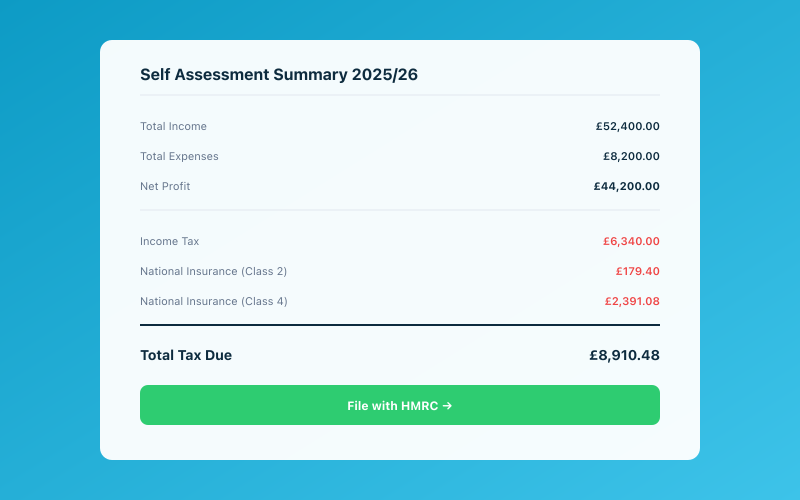 Your Accounted dashboard shows your real-time tax position
- Outside IR35 — the off-payroll rules do not apply
- Inside IR35 — the off-payroll rules apply, and tax must be deducted at source
- Undetermined — CEST cannot make a determination based on the answers provided
The tool is designed to be used by:
- End clients making Status Determination Statements under the off-payroll rules
- Contractors assessing their own status (particularly for engagements with small companies, where the contractor retains responsibility)
- Agencies verifying determinations
HMRC has stated that they will stand by the result of a CEST assessment, provided the information entered is accurate and reflects the genuine working arrangements. This is significant — it means if you answer honestly and CEST says "outside IR35," HMRC shouldn't later argue you were inside (in theory, at least).
How CEST Works
The tool asks questions across several areas:
Worker's Duties
- What does the worker do?
- Have the arrangements changed since they started?
Substitution and Helpers
- Can the worker send someone else to do the work?
- Does the client have to accept a substitute?
- Would the worker pay the substitute themselves?
- Can the worker bring helpers?
Working Arrangements
- Does the client decide how, when, or where the work is done?
- Can the client move the worker to different tasks?
- Does the worker have to work set hours?
Financial Risk
- Does the worker have to fix mistakes at their own cost?
- Does the worker provide their own equipment?
- Does the worker provide materials for the work?
Worker's Relationship with the Client
- Does the worker receive employee benefits?
- Is the worker introduced as an employee?
- Does the worker work for other clients?
Based on the combination of answers, CEST applies a weighted algorithm to produce its determination. The exact weighting isn't published, which is one source of frustration for users.
Using CEST: A Step-by-Step Guide
Here's how to get the most accurate result:
Step 1: Gather Your Information
Before you start, have the following to hand:
- The contract for the specific engagement
- A clear understanding of the actual working arrangements (not just what the contract says)
- Details of any substitution clause and whether it's been exercised
- Information about your working hours, location, and reporting arrangements
- Details of equipment you provide
- Your current client list
Step 2: Answer Honestly
This sounds obvious, but it's the most common mistake people make. CEST's result is only valid if the answers reflect reality. If your contract says you can send a substitute but you know the client would never accept one, answer based on reality, not the contract.
Common areas where people are tempted to shade the truth:
- Substitution — claiming a right exists when it doesn't in practice
- Control — downplaying how much the client actually directs the work
- Other clients — citing clients you haven't worked for in years
Step 3: Save Your Result
CEST generates a reference number for each assessment. Save this, along with:
- The date of the assessment
- The specific engagement it relates to
- The answers you provided
- The result
If you need to demonstrate your status later, this record is important.
Step 4: Reassess When Circumstances Change
A CEST result is a snapshot. If your working arrangements change — new contract terms, different working patterns, a change in client control — you should run CEST again. An old assessment based on different circumstances won't protect you.
What CEST Gets Right
Despite the criticism, CEST does some things well:
It's free and accessible. Anyone can use it, and you don't need specialist knowledge to answer the questions. This democratises IR35 assessment to some extent.
It covers the key tests. The questions address substitution, control, financial risk, and the broader working relationship — all the factors that courts and tribunals consider.
HMRC stands by it. The commitment to honour CEST results gives users a degree of certainty. If CEST says "outside" and you've answered honestly, you have a strong defensive position.
It's been updated. The current version of CEST is improved from the original, with better question phrasing and more nuanced pathways.
What CEST Gets Wrong
And here's where the criticism comes in:
It Doesn't Properly Assess Mutuality of Obligation
This is the biggest and most persistent criticism. Mutuality of obligation (MOO) — the mutual commitment to provide and accept work — is a fundamental test of employment status. Yet CEST barely addresses it. HMRC's position is that MOO is present in any contract where work is performed for payment, making it irrelevant as a distinguishing factor. Many tax professionals and employment lawyers strongly disagree.
In the landmark Ready Mixed Concrete case, the courts established that mutuality of obligation is an essential prerequisite of employment. If it's absent, there can be no employment relationship, regardless of other factors. CEST's failure to test for this means it may classify some genuinely self-employed contractors as inside IR35.
Binary Questions Don't Capture Nuance
Real working arrangements are rarely black and white. CEST's yes/no questions struggle with situations that fall in a grey area. For example:
- "Does the client decide how the work is done?" — What if they specify the technology stack but give you complete freedom on implementation?
- "Can the worker send a substitute?" — What if they can in theory, but the specialist nature of the work makes it impractical?
High Rate of "Undetermined" Results
A significant proportion of CEST assessments return an "undetermined" result — meaning the tool can't decide. This is unhelpful for everyone. Clients still need to make a determination, and the tool they're supposed to use can't give them one. If you get an undetermined result, you'll need to seek professional advice or make a judgment call based on case law.
Perception of Bias
Contractor groups have long argued that CEST is biased towards inside IR35 determinations, generating more tax revenue for HMRC. HMRC disputes this, but the perception persists. Independent analyses have shown that CEST results don't always align with how tax tribunals have decided similar cases.
CEST vs Professional IR35 Reviews
For straightforward cases — clearly inside or clearly outside — CEST is usually adequate. But for borderline engagements (which are common), a professional IR35 review from a specialist adviser offers significant advantages:
- Nuanced assessment considering all relevant factors, including mutuality of obligation
- Analysis of case law comparing your situation to decided tribunal and court cases
- Contractual review identifying clauses that strengthen or weaken your position
- Practical advice on how to adjust your working arrangements to improve your IR35 position
- Insurance-backed opinions that provide financial protection if HMRC disagrees
Professional reviews typically cost between £300 and £500. Given the financial stakes — potentially thousands of pounds per year — this is often money well spent.
What Happens If HMRC Disagrees with CEST?
HMRC has said they'll stand by CEST results, but this commitment has limits:
- The answers must have been accurate and honest
- The working arrangements must not have changed since the assessment
- HMRC may argue that the answers were wrong, even if the user believed them to be correct
In practice, if HMRC opens an investigation, they'll look at the actual working arrangements — not just the CEST answers. If reality doesn't match what was entered into CEST, the assessment offers no protection.
This is why documentation matters so much. If you've assessed your engagement using CEST and recorded the result, make sure you can also evidence that your answers were accurate. Keep records of your working practices, substitution arrangements, client relationships, and financial risk. Our guide on how to prove you're outside IR35 covers exactly what evidence to gather.
Tips for Getting an Accurate CEST Result
- Answer based on reality, not aspiration. What actually happens, not what your contract says should happen.
- Be specific to the engagement. Don't give generalised answers about how you work across all your contracts — focus on the specific client and project.
- Run it separately for each engagement. Different clients and contracts may have different IR35 positions.
- Get the client's perspective. If possible, compare your CEST answers with how the client would answer the same questions. Discrepancies highlight areas of risk.
- Keep records. Save the CEST reference, your answers, and the date of assessment.
- Reassess regularly. At minimum, reassess when a contract is renewed or when working arrangements change.
For a broader understanding of IR35 and how the inside/outside distinction works in practice, see our guide to IR35 explained with real examples.
The Bottom Line
CEST is a useful starting point for IR35 assessment, and HMRC's commitment to stand by its results gives it real weight. But it's not infallible, and its failure to properly test mutuality of obligation is a genuine weakness. For borderline cases, supplement CEST with professional advice and thorough documentation of your working arrangements.
Whether you're a sole trader tracking expenses or a limited company contractor managing complex engagements, having clean, organised financial records strengthens your position. Accounted keeps your bookkeeping tidy, and Penny can help you understand how your business structure supports your self-employed status.
Accounted helps UK sole traders stay on top of their bookkeeping and tax. Start your free 30-day trial at getaccounted.co.uk.
Related Reading
- How to Prove You're Outside IR35
- IR35 — The Inside and Outside Explained With Real Examples
- IR35 Explained for Contractors
- How the £100K Tax Trap Works (And How to Avoid It)
- Tax-Efficient Childcare Options for Self-Employed Parents
Penny, your AI bookkeeper, tracks your tax position in real time and flags opportunities to reduce your bill. Meet Penny →
Tax & Compliance Specialists
Our tax specialists have decades of combined experience in UK sole trader and small business taxation, MTD compliance, and HMRC submissions. All content is reviewed against current HMRC guidance before publication and updated quarterly to reflect legislative changes.
Ready to try Accounted?
Join UK sole traders who are simplifying their bookkeeping and tax.
Start your 14-day free trial