IR35 — The Inside and Outside Explained With Real Examples
If you've spent any time in the contracting world, you've heard the term IR35 thrown around constantly. But despite being one of the most discussed topics in UK tax, it remains one of the most misunderstood. The difference between being inside and outside IR35 can mean thousands of pounds a year — yet many contractors still aren't sure which side of the line they fall on.
Let's cut through the jargon with clear explanations and real-world examples.
What Is IR35?
IR35 is the informal name for the off-payroll working rules — tax legislation designed to identify contractors who would be employees if they weren't working through an intermediary (usually a limited company or personal service company).
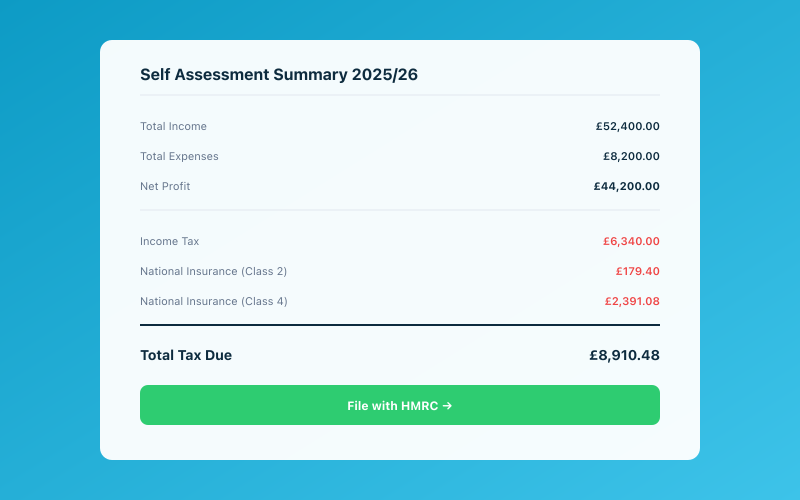 Your Accounted dashboard shows your real-time tax position
The core question IR35 asks is this: if you removed the intermediary, would the working relationship between you and the client look like employment?
If the answer is yes, the engagement is "inside IR35" (also called "caught by IR35"), and income tax and National Insurance must be deducted at source — just as they would be for an employee.
If the answer is no, the engagement is "outside IR35," and the contractor can continue to pay themselves through their limited company in the normal way, typically through a combination of salary and dividends.
For a comprehensive overview, our complete guide to IR35 for contractors covers the legislation in full.
Inside IR35: What It Means
When a contract is inside IR35, the worker is treated as an employee for tax purposes. Under the current rules (following the 2021 reforms for medium and large private sector clients):
- The client (or agency) is responsible for determining IR35 status
- The fee-payer (whoever pays the contractor's company) must deduct PAYE income tax and employee's National Insurance before paying the contractor
- The contractor receives a net payment, much like a salary
The contractor's limited company still exists, but it effectively becomes a pass-through. The tax advantages of operating through a company — lower overall tax through salary/dividend combinations — largely disappear.
The financial impact is significant. A contractor earning £500 per day (roughly £120,000 per year) could see their take-home pay drop by £15,000–£25,000 per year if caught inside IR35, depending on their personal circumstances.
Outside IR35: What It Means
When a contract is outside IR35, the contractor is genuinely in business on their own account. They control how they work, take on financial risk, and operate as a proper business rather than a disguised employee.
Outside IR35, contractors typically:
- Invoice their client through their limited company
- Pay themselves a tax-efficient combination of salary and dividends
- Claim legitimate business expenses against corporation tax
- Have full control over their financial affairs
The key is that the working arrangements must genuinely reflect a business-to-business relationship, not an employment relationship dressed up with a company in the middle.
The Three Key Tests
HMRC and the courts look at several factors when assessing IR35 status, but three tests carry the most weight:
1. Personal Service / Right of Substitution
Can you send someone else to do the work in your place? If there's a genuine, unfettered right to provide a substitute — and the client can't refuse your substitute without good reason — this strongly points to outside IR35.
If the client is hiring you specifically and wouldn't accept anyone else, that looks more like employment.
2. Control
How much control does the client have over what you do, how you do it, when you do it, and where you do it? Employees are typically subject to significant control. Genuine contractors retain autonomy over their working methods.
Key indicators of being outside IR35:
- You decide how to complete the work
- You set your own hours (within reason)
- You can work from any location
- The client specifies the desired outcome, not the process
3. Mutuality of Obligation (MOO)
Is the client obliged to offer you work, and are you obliged to accept it? In employment, there's a mutual obligation — the employer must provide work and pay, and the employee must turn up and do it.
For a contractor outside IR35, there should be no obligation on either side beyond the current project or deliverable. When one project ends, neither party is committed to another.
Real Examples: Inside vs Outside IR35
Let's look at five realistic scenarios to see how these tests apply in practice.
Example 1: The Embedded IT Contractor — INSIDE IR35
James is an IT developer who has worked at a bank for three years through his limited company. He works Monday to Friday, 9am to 5:30pm, at the bank's office. He uses the bank's equipment, follows their development processes, reports to a team lead, and attends daily stand-ups. His contract has been renewed every six months. The bank would not accept a substitute.
Why this is inside IR35:
- No right of substitution — James personally must do the work
- High level of client control — fixed hours, location, and processes
- Strong mutuality of obligation — continuous renewals suggest an ongoing obligation
- James is an employee in all but name
Example 2: The Freelance Management Consultant — OUTSIDE IR35
Priya is a management consultant who works through her limited company. She's been engaged by a retail firm to deliver a specific cost-reduction project over four months. She works from home three days a week and on-site two days. She has her own methodology, sets her own schedule, and provides monthly deliverables. Her contract includes a genuine substitution clause, and she has previously sent an associate to cover during a holiday. She works for two other clients simultaneously.
Why this is outside IR35:
- Genuine right of substitution — exercised in practice
- Limited client control — Priya uses her own methods and sets her own hours
- No mutuality of obligation — the engagement ends when the project is complete
- Multiple clients demonstrate genuine business operation
Example 3: The Agency Nurse — INSIDE IR35
David is a nurse who works shifts at an NHS hospital through an agency and his limited company. He works shifts allocated by the agency, wears a hospital uniform, follows hospital procedures, and is supervised by senior staff. He cannot send someone else to work his shifts.
Why this is inside IR35:
- No substitution — David must personally attend each shift
- Full client control — the hospital dictates procedures, hours, and location
- Mutuality of obligation — shifts are offered and expected to be accepted
Example 4: The Specialist Engineering Contractor — OUTSIDE IR35
Rachel is a structural engineer who contracts through her limited company. She's been engaged to assess and redesign a specific bridge structure for a construction firm. She works entirely from her own office using her own specialist software (which cost £15,000). She provides a fixed-price quote for the project, bears the cost of any rework, and carries her own professional indemnity insurance. Her contract contains a substitution clause, and she has genuine financial risk — if the project takes longer than estimated, her effective rate drops.
Why this is outside IR35:
- Substitution right exists, though specialist nature limits practical substitution
- Very limited control — client specifies the outcome, not the method
- No mutuality of obligation — project-based with a clear end point
- Significant financial risk borne by the contractor
- Substantial investment in own equipment
Example 5: The Grey Area — IT Project Manager
Mark works as an IT project manager through his limited company at a financial services firm. He has a six-month contract to deliver a specific system migration. He works on-site four days a week (at the client's request, for practical reasons), sets his own hours within those days, and uses his own project management methodology. His contract includes a substitution clause, but he's never exercised it. He doesn't work for other clients during this engagement.
Why this is a grey area:
- Substitution clause exists but untested
- Some control (location specified) but also some autonomy (hours, methodology)
- Project-based with a clear scope — but the duration and on-site requirement blur the line
- No other clients, which weakens the "in business on own account" argument
This is the type of contract that could go either way. The determination would likely hinge on how the substitution clause is worded, whether the on-site requirement is genuinely necessary, and the overall picture of the working arrangement.
What Determines Which Side You Fall On?
No single factor is decisive. HMRC and the courts look at the overall picture — the "hypothetical contract" that would exist if the intermediary were removed. The three tests above are weighted heavily, but other factors matter too:
- Financial risk — do you risk your own money? Can you make a loss?
- Provision of equipment — do you supply your own tools, software, or equipment?
- Part and parcel of the organisation — do you attend staff meetings, use staff facilities, have a company email?
- Intention of the parties — what do the contractual terms say?
- Multiple clients — working for several clients simultaneously suggests genuine self-employment
If you're a sole trader rather than a limited company contractor, IR35 doesn't apply directly — but the underlying principles of employment status are still relevant. Our guide to what National Insurance means for the self-employed covers the basics.
What Should You Do?
If you're contracting through a limited company, understanding your IR35 status is essential. Here are the practical steps:
- Review your contract — does it reflect the reality of your working arrangements?
- Assess your working practices — honestly evaluate control, substitution, and mutuality
- Use HMRC's CEST tool — it's not perfect, but it's free and gives you a starting point (see our guide to the CEST tool)
- Keep evidence — document your working arrangements, any substitutions made, multiple clients, and financial risk
- Get professional advice — for borderline cases, a specialist IR35 review from a qualified advisor is worth the investment
The stakes are too high to guess. Getting it wrong can result in significant tax bills, penalties, and interest going back several years.
Accounted helps UK sole traders stay on top of their bookkeeping and tax. Start your free 30-day trial at getaccounted.co.uk.
Related Reading
- How to Prove You're Outside IR35
- IR35 Explained for Contractors
- IR35 and Substitution — The Key Test Explained
- Entrepreneurs' Relief Is Gone — What Replaced It?
- Tax on Tips and Gratuities for Self-Employed Workers
Penny, your AI bookkeeper, tracks your tax position in real time and flags opportunities to reduce your bill. Meet Penny →
Tax & Compliance Specialists
Our tax specialists have decades of combined experience in UK sole trader and small business taxation, MTD compliance, and HMRC submissions. All content is reviewed against current HMRC guidance before publication and updated quarterly to reflect legislative changes.
Ready to try Accounted?
Join UK sole traders who are simplifying their bookkeeping and tax.
Start your 14-day free trial