Entrepreneurs' Relief Is Gone — What Replaced It?
If you have been running a business for a while, you have probably heard of Entrepreneurs' Relief. It was one of the most valuable tax reliefs available to business owners selling their companies. But if you go looking for it now, you will not find it — at least not under that name.
In March 2020, the government renamed Entrepreneurs' Relief to Business Asset Disposal Relief (BADR). The name changed, some of the limits changed, but the core concept remained. In this article, we will explain what happened, how BADR works today, and what it means if you are thinking about selling your business.
A Brief History of Entrepreneurs' Relief
Entrepreneurs' Relief was introduced in 2008 to encourage business ownership by offering a reduced rate of Capital Gains Tax when owners sold their businesses. Originally, the lifetime limit was £1 million, which was later increased to £10 million in 2011 — a remarkably generous threshold.
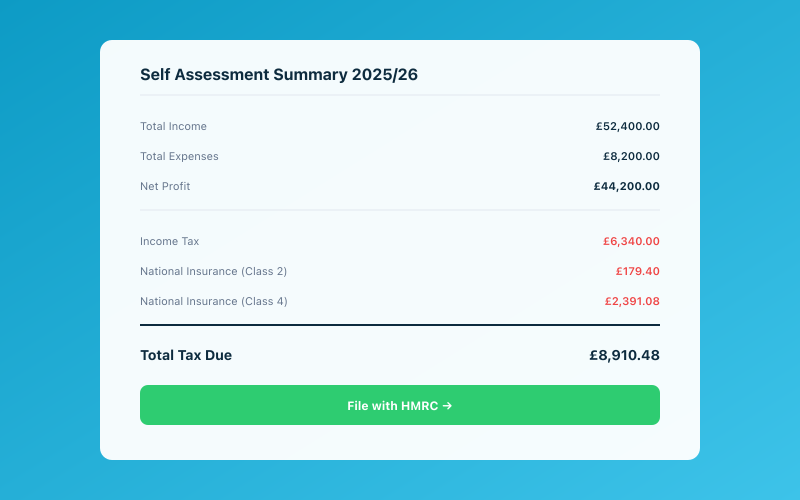 Your Accounted dashboard shows your real-time tax position
In the 2020 Budget, the Chancellor reduced the lifetime limit back to £1 million and renamed the relief to Business Asset Disposal Relief. The reasoning was that the £10 million limit primarily benefited a small number of very wealthy individuals and was not effectively encouraging new entrepreneurship.
The relief continues to exist under the new name with the £1 million lifetime limit, and it remains a significant benefit for qualifying business owners.
How Business Asset Disposal Relief Works in 2025/26
BADR allows qualifying individuals to pay Capital Gains Tax at a reduced rate of 10% on the first £1 million of lifetime qualifying gains. Without BADR, these gains would be taxed at the standard CGT rates — 18% for basic rate taxpayers or 24% for higher rate taxpayers (for non-residential assets from 2024/25 onwards).
The relief can save a substantial amount of tax. On a £500,000 gain, the difference between 10% and 24% is £70,000. That is not insignificant.
The £1 million limit is a lifetime allowance, not an annual one. If you claim BADR on a £600,000 gain when you sell one business, you have £400,000 of the relief remaining for any future qualifying disposals.
For a broader look at capital gains on business disposals, see our guide on selling a business and asset disposal relief.
Who Qualifies for BADR?
The qualifying conditions depend on whether you are disposing of a business, shares, or business assets. The requirements are quite specific, and getting them wrong can be expensive.
Sole Traders and Partners
If you are a sole trader or a partner in a partnership, you can claim BADR when you dispose of the whole or part of your business, provided:
- You have owned the business for at least two years before the date of disposal
- The business has been trading (not investment) throughout that two-year period
You can also claim on individual assets used in the business, but only if the asset was in use at the time the business ceased and the disposal happens within three years of cessation.
Company Shareholders
If you hold shares in a trading company, you can claim BADR when you sell those shares provided:
- The company is a trading company (or the holding company of a trading group)
- You have held the shares for at least two years
- You hold at least 5% of the ordinary share capital and voting rights
- You are an officer or employee of the company
All four conditions must be met throughout the two-year period ending on the date of disposal (or the date the company ceased trading, if earlier).
Associated Disposals
There is also provision for claiming BADR on the disposal of an asset owned personally but used in a business carried on by a partnership or company in which you have an interest. This is common where a business owner holds a property personally and lets the business use it. The rules here are more complex and often require professional advice.
What Does Not Qualify
It is worth being clear about what BADR does not cover:
- Investment companies — If the company primarily holds investments rather than trading, BADR will not apply.
- Shares held for less than two years — There is no exception to the two-year rule.
- Less than 5% shareholding — Minority shareholders with less than 5% cannot claim, even if they are employees.
- Buy-to-let properties — Rental property is an investment, not a trade, so BADR does not apply to residential landlords (unless the property qualifies under the furnished holiday let rules, though these rules have changed significantly from April 2025).
The Interaction With the CGT Annual Exempt Amount
Before applying BADR, you can use your CGT annual exempt amount against qualifying gains. For 2025/26, the annual exempt amount is £3,000 — a significant reduction from the £12,300 it was just a few years ago.
So if you sell your business for a gain of £500,000, you would deduct the £3,000 annual exempt amount first, leaving £497,000 taxable at 10% under BADR. That gives a tax bill of £49,700.
Without BADR, the same gain would cost £119,280 at 24% (for a higher rate taxpayer). The saving is nearly £70,000.
For more on the annual exempt amount, see our CGT annual exempt amount guide for 2025/26.
How to Claim BADR
You claim BADR through your Self Assessment tax return. The claim must be made on or before the first anniversary of 31 January following the tax year in which the disposal took place.
For example, if you sell your business in November 2025 (tax year 2025/26), your Self Assessment deadline is 31 January 2027, and you must claim BADR by 31 January 2028.
There is no separate form — it is included within the Capital Gains Tax pages of the Self Assessment return. However, you need to keep records to demonstrate that you meet all the qualifying conditions.
Planning Ahead for a Business Sale
If you are thinking about selling your business in the next few years, there are several things to consider now:
Check the Two-Year Qualification Period
Make sure you will have met the two-year ownership and employment requirements by the date of any planned sale. If you have recently restructured your shareholding, the clock may have restarted.
Maintain Trading Status
Ensure the company remains a trading company. If it has accumulated significant cash reserves or investment assets, HMRC might argue it is no longer a trading company, which could disqualify BADR. There is no bright-line test, but generally, investment activities should be a minor part of overall activity.
Consider the Lifetime Limit
If you have previously claimed Entrepreneurs' Relief or BADR, check how much of your £1 million lifetime limit remains. Previous claims under the old name count towards the same limit.
Keep Good Records
You will need to demonstrate ownership, shareholding percentages, employment status, and trading activity over the qualifying period. Good record-keeping from the outset is far easier than trying to reconstruct evidence years later.
Accounted makes it straightforward to keep organised records of your business finances. Penny, our AI assistant, can help you track key financial metrics that might be relevant when the time comes to sell.
Comparing BADR With Standard CGT Rates
| Scenario | Tax Rate | Tax on £500,000 Gain | |---|---|---| | BADR qualifying gain | 10% | £49,700* | | Higher rate taxpayer (no BADR) | 24% | £119,280* | | Basic rate taxpayer (no BADR) | 18% (partially) | Varies |
*After deducting the £3,000 annual exempt amount.
The difference is substantial enough that it is always worth checking whether you qualify before disposing of business assets.
Common Pitfalls
- Assuming you qualify without checking — The conditions are specific and must be met throughout the qualifying period. A brief gap can disqualify you.
- Missing the claim deadline — BADR is not applied automatically. You must actively claim it.
- Confusing the old and new names — The relief is the same; only the name and the lifetime limit changed. If you hear someone refer to Entrepreneurs' Relief, they mean BADR.
- Ignoring the 5% threshold — Share dilution through investment rounds can push you below 5%. Monitor this carefully.
Related Reading
Make Sure You Are Prepared
Whether you are planning to sell your business next year or in a decade, understanding BADR now puts you in a stronger position. The 10% rate on up to £1 million of qualifying gains is a significant benefit — but only if you meet the conditions and remember to claim.
Start your free trial and let Penny handle your bookkeeping automatically.
Accounted helps UK sole traders stay on top of their bookkeeping and tax. Start your free 30-day trial at getaccounted.co.uk.
Penny, your AI bookkeeper, tracks your tax position in real time and flags opportunities to reduce your bill. Meet Penny →
Tax & Compliance Specialists
Our tax specialists have decades of combined experience in UK sole trader and small business taxation, MTD compliance, and HMRC submissions. All content is reviewed against current HMRC guidance before publication and updated quarterly to reflect legislative changes.
Ready to try Accounted?
Join UK sole traders who are simplifying their bookkeeping and tax.
Start your 14-day free trial