Tax on Selling a Business — Business Asset Disposal Relief
Selling a business you have built from scratch is a major milestone. Whether you are retiring, moving on to a new venture, or simply cashing in on years of hard work, one of the biggest questions on your mind will be: how much tax will I pay? The answer often hinges on whether you qualify for Business Asset Disposal Relief (BADR), formerly known as Entrepreneurs' Relief. This relief can significantly reduce the Capital Gains Tax (CGT) you pay on the sale, but it comes with strict qualifying conditions that you need to meet. In this guide, we will explain exactly how BADR works, who qualifies, the current rates and limits, and how to plan your exit to minimise your tax bill.
What Is Business Asset Disposal Relief?
Business Asset Disposal Relief is a CGT relief that allows qualifying individuals to pay a reduced rate of just 10% on gains arising from the disposal of business assets, up to a lifetime limit of £1 million in qualifying gains. Without BADR, those gains would be taxed at the standard CGT rates of 10% (basic rate) or 20% (higher rate) for business assets.
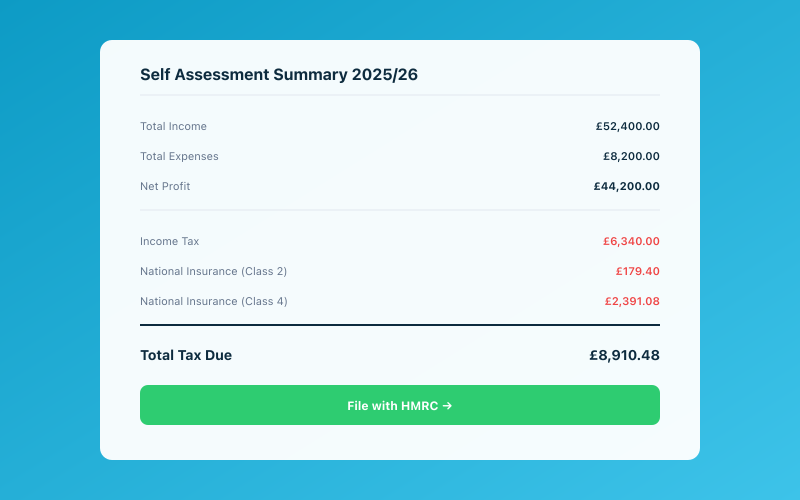 Your Accounted dashboard shows your real-time tax position
The relief was introduced in 2008 as Entrepreneurs' Relief and was renamed Business Asset Disposal Relief in 2020. At its peak, the lifetime limit was £10 million, but it was reduced to £1 million from March 2020 onwards. Despite the lower limit, BADR still offers a meaningful tax saving — the maximum benefit is £100,000 (the difference between paying 20% and 10% on £1 million of gains).
Here is a straightforward example. You sell your sole trader business for £800,000. After deducting your base cost (what you originally invested), your gain is £600,000. Without BADR, and assuming you are a higher-rate taxpayer, you would pay CGT at 20%, which is £120,000. With BADR, you pay just 10%, which is £60,000. That is a saving of £60,000 — a significant amount by anyone's standards.
The £1 million limit is a lifetime limit, not an annual one. If you have used some of your allowance on a previous disposal, only the remaining balance is available. For example, if you made a qualifying gain of £300,000 five years ago and claimed BADR on it, you have £700,000 of your lifetime limit remaining.
Who Qualifies for BADR?
The qualifying conditions depend on whether you are disposing of a whole business, part of a business, or shares in a company.
Selling a sole trader or partnership business. You qualify for BADR if:
- You have owned the business for at least two years before the date of disposal
- The business has been trading throughout that two-year period (it must be a genuine trade, not an investment activity)
- The disposal is of the whole or a distinct part of the business (you cannot cherry-pick individual assets while continuing to trade — with one exception, covered below)
Selling shares in a company. You qualify if:
- You have held the shares for at least two years before the disposal
- The company is a trading company (or the holding company of a trading group)
- You hold at least 5% of the ordinary share capital and voting rights
- You are an officer or employee of the company (such as a director)
Disposing of individual assets after the business has ceased. If you have closed your business, you can still claim BADR on the disposal of assets that were used in the business, provided the disposal takes place within three years of the business ceasing. This is useful if, for example, you close your business but take some time to sell the premises.
Associated disposals. If you personally own assets that are used by a company or partnership, and you dispose of those assets in connection with a qualifying disposal of your shares or partnership interest, you may be able to claim BADR on the associated disposal as well.
How to Calculate the Gain
The gain you claim BADR on is calculated in the standard CGT way:
- Start with the disposal proceeds (the sale price)
- Deduct the acquisition cost (what you originally paid or invested)
- Deduct any incidental costs of disposal (legal fees, agent's fees, accountancy costs related to the sale)
- Deduct any enhancement expenditure (capital improvements you made to the business assets)
The result is your chargeable gain. You can then deduct your annual CGT exempt amount (£3,000 for 2025/26) and apply BADR at 10% on up to £1 million of qualifying gains.
If your gain exceeds £1 million, the excess is taxed at the normal CGT rates — 10% if you are a basic-rate taxpayer after accounting for all your income, or 20% if you are a higher-rate or additional-rate taxpayer.
It is worth noting that the gain on which you pay CGT is added to your income for the year to determine which tax band it falls into. Even if your regular income is below the basic-rate threshold, a large gain could push you into higher-rate territory. However, with BADR, the qualifying portion is always taxed at 10% regardless of your income level — that is the whole point of the relief.
Planning Your Exit
Proper planning can make a significant difference to the tax you pay when selling your business. Here are some key considerations.
Start planning early. The two-year qualifying period means you need to have your ownership structure right well in advance of any sale. If you are thinking of selling within the next couple of years, review your position now to make sure you meet the conditions.
Do not accidentally breach the conditions. If you are a company director, make sure you maintain your 5% shareholding and your employment status right up to the point of sale. Dilution through new share issues, or stepping back from day-to-day involvement, could disqualify you.
Consider the timing of the sale. If your annual CGT exempt amount has not been used, timing the sale to fall in a tax year where you can use it saves an additional £600 (10% of £3,000 at the 20% rate, offset against the 10% BADR rate). The saving is modest, but every bit counts.
Think about whether to sell assets or shares. If you run a limited company, buyers often prefer to buy assets rather than shares (because they get a step-up in base cost). But as a seller, you generally prefer to sell shares because the gain qualifies for BADR more straightforwardly. This is a common negotiation point, and the tax implications for both sides should be factored into the deal.
Use your lifetime limit wisely. If you expect to start another business and sell it in the future, consider how much of your £1 million lifetime limit you are using now. There is no way to reset the limit, so once it is gone, it is gone.
Claim the relief. BADR is not automatic — you must claim it on your Self Assessment tax return for the year of disposal. Missing the deadline to claim could mean losing the relief entirely. The claim must be made by the first anniversary of the 31 January following the tax year of disposal. So for a disposal in 2025/26, the deadline would be 31 January 2028.
Using a tool like Accounted to keep track of your business finances throughout the life of your business means you have clean, accurate records when the time comes to calculate your gain. Penny, the AI bookkeeping assistant, helps ensure all your costs and income are properly recorded, which feeds directly into the CGT calculation.
Other Reliefs and Interactions
BADR does not exist in isolation. There are several other reliefs that may apply when you sell a business, and understanding how they interact can save you additional tax.
Investors' Relief. This applies to external investors in unlisted trading companies and offers a 10% CGT rate on qualifying gains up to a separate £10 million lifetime limit. It does not apply to directors or employees, so it is not relevant if you are selling your own business, but it might apply to outside shareholders.
Gift Relief (holdover relief). If you are giving your business to a family member rather than selling it, you may be able to defer the CGT using gift holdover relief. The gain is "held over" and only becomes payable when the recipient eventually sells the assets.
Incorporation Relief. If you are incorporating your sole trader business (transferring it to a limited company), you can defer the gain by rolling it into the base cost of your shares in the new company. BADR would then apply when you eventually sell those shares.
Enterprise Investment Scheme (EIS) reinvestment relief. If you reinvest the proceeds of a business disposal into qualifying EIS shares within three years, you can defer the CGT on the original gain.
For a more detailed look at how CGT works on property disposals, our capital gains tax property guide is a useful companion read. And for guidance on how the relief was previously structured and how the transition to BADR works, our article on entrepreneurs' relief and business disposal covers the history.
Mistakes to Avoid
Assuming BADR applies automatically. It does not. You must make an active claim on your tax return.
Not meeting the two-year condition. If you have owned the business or shares for less than two years, you do not qualify, no matter how substantial the gain. There are no exceptions.
Confusing BADR with property CGT rates. BADR applies to trading business assets, not to property investments. Selling a buy-to-let property does not qualify. The CGT rates for residential property are 18% (basic rate) and 24% (higher rate) — completely separate from BADR.
Overlooking lifetime limit usage. If you have claimed BADR before, check how much of your £1 million limit remains. Over-claiming will result in HMRC adjusting your tax bill.
Not getting a professional valuation. If you are disposing of part of a business, or if the sale is to a connected person, HMRC may challenge the valuation you use. A professional valuation from a qualified surveyor or business valuator protects you in the event of an enquiry.
For further guidance on selling business assets and understanding the tax consequences, see our guide on tax on selling business assets.
Related Reading
Start your free trial and let Penny handle your bookkeeping automatically.
Accounted helps UK sole traders stay on top of their bookkeeping and tax. Start your free 30-day trial at getaccounted.co.uk
Penny, your AI bookkeeper, tracks your tax position in real time and flags opportunities to reduce your bill. Meet Penny →
Tax & Compliance Specialists
Our tax specialists have decades of combined experience in UK sole trader and small business taxation, MTD compliance, and HMRC submissions. All content is reviewed against current HMRC guidance before publication and updated quarterly to reflect legislative changes.
Ready to try Accounted?
Join UK sole traders who are simplifying their bookkeeping and tax.
Start your 14-day free trial