Business Asset Disposal Relief: Selling Your Business Tax-Efficiently
Selling a business is one of the most significant financial events in an owner's life. Business Asset Disposal Relief (BADR), formerly known as Entrepreneurs' Relief, can reduce the Capital Gains Tax (CGT) you pay on qualifying disposals to just 10%, compared with the standard CGT rates of 18% or 24%. With a lifetime limit of £1 million in qualifying gains, BADR can save up to £140,000 in tax. Here is everything you need to know about qualifying, claiming, and making the most of this valuable relief.
The Name Change: Entrepreneurs' Relief to BADR
In the Spring Budget 2020, the government renamed Entrepreneurs' Relief to Business Asset Disposal Relief and reduced the lifetime limit from £10 million to £1 million. Despite the name change, the mechanics of the relief remain broadly the same. Many business owners and advisers still refer to it as Entrepreneurs' Relief, so you may see both names used interchangeably.
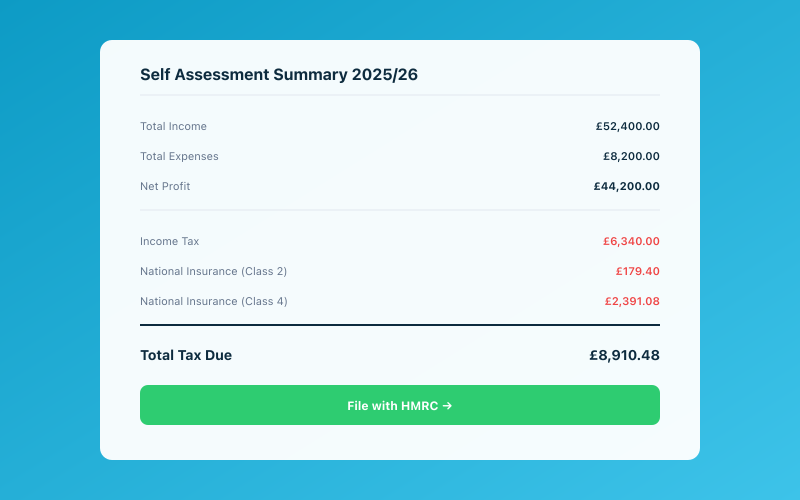 Your Accounted dashboard shows your real-time tax position
How BADR Works
When you dispose of qualifying business assets and make a capital gain, you can claim BADR to pay CGT at 10% on those gains instead of the standard rates. For the 2025/26 tax year, the standard CGT rates are 18% for basic rate taxpayers and 24% for higher and additional rate taxpayers on most assets (with the exception of residential property, which has its own rates).
The 10% rate applies to the first £1 million of qualifying gains across your lifetime. Once you have used up your £1 million allowance, any further gains are taxed at the standard CGT rates.
Note that from 6 April 2025, the BADR rate increased from 10% to 14%, and it is scheduled to rise again to 18% from 6 April 2026. This makes timing particularly important for anyone considering a disposal in the near future.
Qualifying Conditions
BADR is not automatic. You must meet specific qualifying conditions, and these vary depending on the type of disposal.
Selling All or Part of a Business (Sole Traders and Partners)
If you are a sole trader or a partner in a partnership, you can claim BADR when you dispose of all or part of your business. You must have owned the business for at least two years before the date of disposal. The business must be a trading business, not an investment business. If you are disposing of part of a business, it must be a distinct and viable part, not just individual assets.
Selling Shares in a Trading Company
If you are selling shares in a company, the following conditions must all be met for a continuous period of at least two years ending on the date of disposal (or, if the company has ceased trading, ending within three years of cessation).
The company must be a trading company or the holding company of a trading group. You must hold at least 5% of the ordinary share capital. You must hold at least 5% of the voting rights. You must be entitled to at least 5% of the distributable profits and 5% of the net assets on a winding up. You must be an officer or employee of the company (or of a company in the same group).
Associated Disposals
An associated disposal is a disposal of an asset that you own personally but which has been used in your business or by your company. A common example is selling a commercial property that you own and have let to your trading company.
To claim BADR on an associated disposal, you must be making a qualifying disposal of all or part of your interest in the business at the same time (or within three years of the business ceasing). The asset must have been used in the business for at least two years. Relief is restricted if you were charged rent at market rate for the use of the asset, or if the asset was only partly used for business purposes.
The Two-Year Ownership Requirement
The two-year qualifying period is strict. If you set up a company and sell it 18 months later, you will not qualify for BADR even if all other conditions are met. Similarly, if you acquire additional shares that take you above 5% ownership, the two-year clock starts from the date you reached the 5% threshold, not from when you first acquired shares.
Planning ahead is essential. If you are contemplating a sale, ensure you have met the two-year threshold well in advance. Restructuring share capital or adjusting roles close to a sale can put the relief at risk.
How the £1 Million Lifetime Limit Works
The £1 million limit applies across your entire lifetime, not per transaction. If you sold a business five years ago and claimed BADR on £400,000 of gains, you have £600,000 of your lifetime allowance remaining for future disposals.
Before the limit was reduced in 2020, the threshold was £10 million. If you made claims under the old higher limit, those previous claims still count against your current £1 million allowance. In practice, anyone who claimed more than £1 million before March 2020 has already used their full entitlement.
Claiming BADR
You must actively claim BADR. It is not applied automatically. The claim is made on your Self Assessment tax return for the tax year in which the disposal takes place. If you do not file a Self Assessment return, you can make the claim by writing to HMRC.
The deadline for claiming is the first anniversary of 31 January following the tax year of disposal. For a disposal in the 2025/26 tax year, the deadline would be 31 January 2028.
Interaction with the Annual Exempt Amount
You can still use your annual CGT exempt amount (£3,000 for 2025/26) before applying BADR. The £3,000 exemption reduces your total taxable gain, and BADR then applies to the remaining qualifying gain at 10%.
Common Pitfalls
Holding Company Structures
If your business operates through a group structure, the holding company must be a holding company of a trading group. If the group includes substantial non-trading activities (such as investment property or surplus cash holdings), this can jeopardise the trading company status and disqualify the whole disposal from BADR.
Substantial Non-Trading Activities
A company that carries on both trading and non-trading activities may lose its trading company status if the non-trading activities are substantial. HMRC does not define a precise threshold, but generally looks at a range of indicators including turnover, asset values, expenses, and management time devoted to non-trading activities. A commonly cited rule of thumb is that non-trading activities should represent no more than 20% of the overall business, but this is a guideline rather than a hard rule.
Dilution Below 5%
If new shares are issued (for example, to investors or through an EMI scheme exercise) and your holding drops below 5%, you may lose BADR eligibility. If this is a risk, consider whether anti-dilution provisions or a restructuring can protect your position.
MVL and Informal Winding Up
Many owner-managed company directors extract value through a Members' Voluntary Liquidation (MVL), which is treated as a capital disposal and can qualify for BADR. However, if HMRC considers that the distribution could have been made as income (under the Transactions in Securities rules), BADR may be denied. The targeted anti-avoidance rule (TAAR) introduced in 2016 can also re-characterise capital distributions as income if you continue to carry on a similar trade within two years of the distribution.
Planning for the Rate Increases
With BADR rising to 14% from April 2025 and 18% from April 2026, the window to benefit from the lower rates is narrowing. If you are considering selling your business, it may be worth accelerating the timeline to lock in the lower rate. However, rushing a sale purely for tax reasons is rarely advisable. The commercial terms of the deal, the readiness of the business, and your personal circumstances should all factor into the decision.
Let Accounted and Penny Help
Preparing for a business disposal means having clean, accurate financial records that a buyer and your tax adviser can rely on. Accounted keeps your books in order throughout the life of your business, so when the time comes to sell, everything is ready. Penny, your AI bookkeeper, handles day-to-day categorisation and tracking so your accounts are always up to date. Start your free trial today and build the financial clarity that makes selling your business smoother and more tax-efficient.
Related Reading
-
Tax on Selling Business Assets: Vehicles, Equipment, and Property
-
Mixed-Use Property Tax: When Your Home is Also Your Business
Start your free trial and let Penny handle your bookkeeping automatically.
Penny, your AI bookkeeper, tracks your tax position in real time and flags opportunities to reduce your bill. Meet Penny →
Tax & Compliance Specialists
Our tax specialists have decades of combined experience in UK sole trader and small business taxation, MTD compliance, and HMRC submissions. All content is reviewed against current HMRC guidance before publication and updated quarterly to reflect legislative changes.
Ready to try Accounted?
Join UK sole traders who are simplifying their bookkeeping and tax.
Start your 14-day free trial