Tax on Selling Business Assets: Vehicles, Equipment, and Property
When you sell a business asset — whether it is a van, a piece of equipment, or a commercial property — there are tax consequences. The amount of tax you pay depends on the type of asset, how it was treated for capital allowances, and whether the sale generates a profit above the original cost.
This guide explains the tax implications of selling different types of business assets, including how balancing charges work, when Capital Gains Tax applies, and what reliefs are available to defer or reduce the tax bill.
Capital Allowances and Balancing Charges
If you claimed capital allowances on an asset when you bought it, selling that asset triggers a recalculation. This is called a balancing adjustment and can result in either a balancing charge (tax to pay) or a balancing allowance (tax relief).
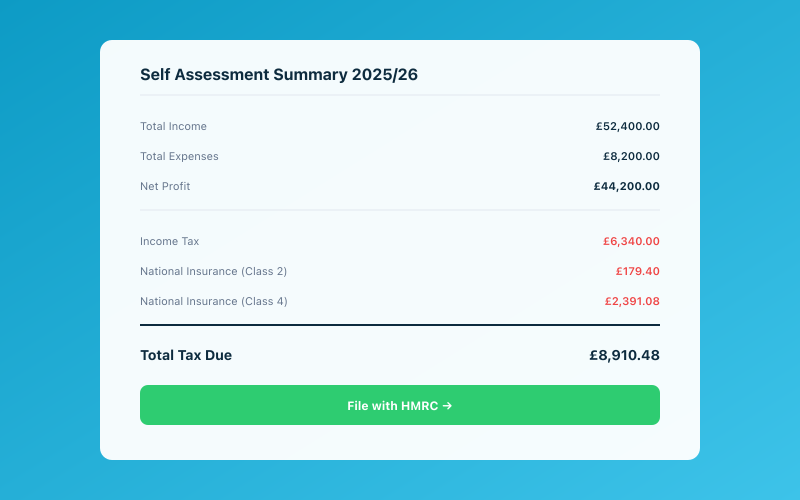 Your Accounted dashboard shows your real-time tax position
How Balancing Charges Work
When you buy an asset and claim capital allowances, the cost is added to your capital allowances pool. Each year, you claim writing down allowances (WDA), reducing the pool value. When you sell the asset, the sale proceeds are deducted from the pool.
If the sale proceeds exceed the pool value, the excess is a balancing charge. This amount is added back to your taxable profits for the year, effectively recapturing some of the tax relief you previously received.
Example: Selling Equipment
You bought equipment for £10,000 and claimed it through the Annual Investment Allowance (AIA), deducting the full £10,000 from your profits in the year of purchase.
Three years later, you sell the equipment for £3,000.
- The £10,000 was fully deducted via AIA, so the pool value is £0
- Sale proceeds: £3,000
- Balancing charge: £3,000 (added back to your taxable profits)
You originally received tax relief on £10,000. The balancing charge of £3,000 means the net relief is on £7,000, which reflects the true economic cost of using the asset (£10,000 purchase minus £3,000 sale).
When Balancing Allowances Arise
If the pool value exceeds the sale proceeds, the difference is a balancing allowance — additional tax relief. This typically occurs when an asset is sold for less than its written-down value.
The Main Pool
Most business assets go into the main pool (currently written down at 18% per year). Balancing adjustments on the main pool only arise when the business ceases or the pool balance is small (£1,000 or less). During normal trading, disposals simply reduce the pool balance.
However, assets in single asset pools (cars with mixed business/personal use, and certain other assets) do generate balancing charges or allowances when sold.
Selling Vehicles
Vehicles have specific rules depending on whether they are cars or commercial vehicles.
Cars
Cars are never eligible for the Annual Investment Allowance. Instead, they go into one of three pools based on CO2 emissions:
- Zero emissions (electric): 100% first year allowance
- CO2 up to 50g/km: Main pool at 18% WDA
- CO2 over 50g/km: Special rate pool at 6% WDA
When you sell a car, the proceeds are deducted from the relevant pool. If the car was in a single asset pool (because it had private use), a balancing charge or allowance arises.
The balancing charge is restricted to the business use proportion. If you used the car 70% for business, only 70% of the balancing charge is taxable.
Example: Selling a Car with Private Use
You bought a car for £20,000. It was in a single asset pool with a written-down value of £12,000. You sell it for £15,000. Business use was 60%.
- Disposal proceeds: £15,000
- Pool value: £12,000
- Balancing charge (gross): £3,000
- Taxable balancing charge: £3,000 x 60% = £1,800
Commercial Vehicles (Vans, Lorries, etc.)
Vans and other commercial vehicles qualify for the AIA and go into the main pool. When sold, the proceeds reduce the main pool balance. A balancing charge only arises if the total disposals exceed the total pool balance (which is uncommon during normal trading).
Selling Business Property
Selling business property involves different tax rules. Business property typically falls outside the capital allowances system (land and buildings do not qualify for standard capital allowances, although certain fixtures and integral features within buildings may).
Capital Gains Tax (CGT)
When you sell a business property for more than you paid for it, the profit is subject to Capital Gains Tax. CGT rates for business assets are:
- 10% for gains falling within the basic rate band
- 20% for gains falling within the higher rate band
For residential property used in a business (such as a buy-to-let), the rates are higher:
- 18% within the basic rate band
- 24% within the higher rate band (from April 2025)
Calculating the Gain
The gain is calculated as:
Sale price - Purchase price - Allowable costs = Taxable gain
Allowable costs include:
- Legal fees on purchase and sale
- Stamp Duty Land Tax paid on purchase
- The cost of improvements (not repairs or maintenance)
- Professional fees (surveyor, architect) for improvements
You then deduct your Annual Exempt Amount (£3,000 in 2025/26) before applying the CGT rate.
Reliefs Available When Selling Business Assets
Several reliefs can reduce or defer the tax on selling business assets.
Business Asset Disposal Relief (BADR)
Formerly known as Entrepreneurs' Relief, BADR reduces the CGT rate to 10% on qualifying disposals, up to a lifetime limit of £1,000,000 in gains.
To qualify, you must:
- Be a sole trader or partner disposing of all or part of the business
- Have owned the business for at least two years before the disposal
- The disposal must be of the whole or a distinct part of the business
BADR applies to the disposal of the business as a whole, not individual assets sold in isolation while the business continues.
Rollover Relief
If you sell a business asset and reinvest the proceeds in a new qualifying business asset within three years (or one year before the sale), you can defer the gain through rollover relief. The gain is rolled over into the cost of the new asset, reducing its base cost for future CGT purposes.
Qualifying assets include:
- Land and buildings used for the trade
- Fixed plant and machinery
- Ships, aircraft, and hovercraft
- Goodwill (with restrictions for certain disposals to connected companies)
Example: Rollover Relief
You sell a business premises for £300,000, making a gain of £80,000. Within two years, you buy new premises for £350,000.
You can claim rollover relief to defer the entire £80,000 gain. The base cost of the new premises is reduced by £80,000 (from £350,000 to £270,000). When you eventually sell the new premises, the deferred gain comes back into charge.
If you only partially reinvest (for example, buying new premises for £250,000), you can defer part of the gain. The gain that cannot be deferred is the amount not reinvested: £300,000 - £250,000 = £50,000 taxable now.
Gift Relief (Holdover Relief)
If you give away a business asset (or sell it at below market value), holdover relief allows the gain to be deferred. The recipient takes over the asset at the donor's base cost, so the gain is held over until they sell it.
Gift relief is available for:
- Assets used in a trade
- Shares in unquoted trading companies
- Agricultural property
- Certain heritage property
Both the donor and recipient must claim the relief jointly.
Market Value vs Sale Price
When selling assets to connected persons (family members, business partners, or companies you control), HMRC treats the transaction as taking place at market value, regardless of the actual sale price.
If you sell your van to your spouse for £1 when it is worth £8,000, HMRC will assess the disposal as if the sale was at £8,000. This prevents tax avoidance through undervalue transfers.
The same principle applies when you transfer assets into a limited company if you incorporate your sole trader business.
Let Accounted Track Your Asset Values
Keeping track of capital allowances pools, written-down values, and disposal proceeds is essential for calculating balancing charges accurately. Accounted maintains a clear record of all your business assets and their tax position, and Penny, your AI bookkeeper, flags the tax implications when you record an asset sale — so you are never surprised by a balancing charge at tax return time. Start your free trial and keep your asset records in order.
Related Reading
-
Business Asset Disposal Relief: Selling Your Business Tax-Efficiently
-
Mixed-Use Property Tax: When Your Home is Also Your Business
Start your free trial and let Penny handle your bookkeeping automatically.
Penny, your AI bookkeeper, tracks your tax position in real time and flags opportunities to reduce your bill. Meet Penny →
Tax & Compliance Specialists
Our tax specialists have decades of combined experience in UK sole trader and small business taxation, MTD compliance, and HMRC submissions. All content is reviewed against current HMRC guidance before publication and updated quarterly to reflect legislative changes.
Ready to try Accounted?
Join UK sole traders who are simplifying their bookkeeping and tax.
Start your 14-day free trial