What is the Dividend Allowance for 2025/26?
The Dividend Allowance: £500 for 2025/26
The dividend allowance for the 2025/26 tax year is £500. This means the first £500 of dividend income you receive in the tax year is tax-free, regardless of which income tax band you fall into.
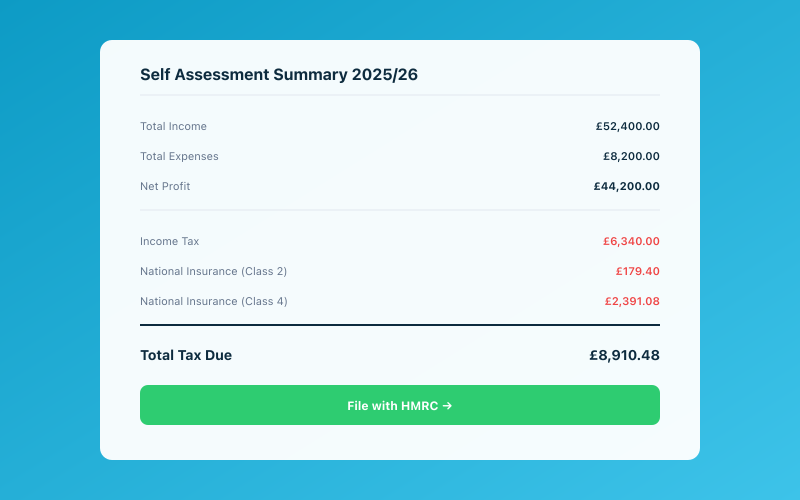 Your Accounted dashboard shows your real-time tax position
This is a significant reduction from previous years:
- 2022/23: £2,000
- 2023/24: £1,000
- 2024/25: £500
- 2025/26: £500
The sharp cut in the allowance means that many more company directors and investors now pay tax on their dividends. If you run a limited company and take a mix of salary and dividends, this affects your take-home pay directly.
Dividend Tax Rates for 2025/26
Once you exceed the £500 dividend allowance, your dividend income is taxed at the following rates:
| Tax band | Dividend tax rate | |---|---| | Basic rate (up to £50,270) | 8.75% | | Higher rate (£50,271 to £125,140) | 33.75% | | Additional rate (over £125,140) | 39.35% |
These rates are lower than the equivalent rates for employment or self-employment income (20%, 40%, and 45%), which is one of the reasons limited company directors often pay themselves partly in dividends.
How Dividends Interact with Income Tax Bands
This is the part that trips people up. Dividends are treated as the top slice of your income for tax purposes. This means they sit on top of your other income (salary, self-employment, rental, pensions, etc.) when determining which tax band they fall into.
Worked Example: Basic Rate Dividend
James is a limited company director. In 2025/26, he pays himself:
- Salary: £12,570 (the Personal Allowance — no income tax due)
- Dividends: £30,000
His total income is £42,570. The salary uses up his Personal Allowance, so his taxable income is £30,000 (all dividends).
The first £500 of dividends is covered by the dividend allowance (tax-free). The remaining £29,500 is taxed at the basic rate dividend rate of 8.75%.
Tax on dividends: £29,500 x 8.75% = £2,581.25
Worked Example: Crossing into Higher Rate
Priya is also a limited company director. She takes:
- Salary: £12,570
- Dividends: £45,000
Her total income is £57,570. Her taxable income is £45,000.
The basic rate band runs from £12,571 to £50,270, which means she has £37,700 of basic rate band available after her Personal Allowance.
- First £500 of dividends: Tax-free (dividend allowance)
- Next £37,200 of dividends (filling the basic rate band): 8.75% = £3,255
- Remaining £7,300 of dividends (in the higher rate band): 33.75% = £2,463.75
Total dividend tax: £3,255 + £2,463.75 = £5,718.75
Notice how the jump from basic to higher rate dividend tax is significant — from 8.75% to 33.75%. This is why many directors try to keep their total income within the basic rate band.
The Dividend Allowance Does NOT Reduce Your Total Income
An important technical point: the £500 dividend allowance is a zero-rate band, not a deduction. The dividends covered by the allowance still count as part of your total income for the purposes of determining which tax band the rest of your income falls into. They are simply taxed at 0% rather than being ignored entirely.
In practice, this means the dividend allowance does not push your other income into a lower band. It just means £500 of your dividends are taxed at zero.
Planning Around the Dividend Allowance
With only £500 of tax-free dividends, planning becomes more important. Here are some strategies to consider:
Optimise Your Salary and Dividend Mix
Most limited company directors take a small salary (often £12,570 to use the Personal Allowance, or sometimes lower at the NI threshold) and the rest as dividends. The optimal split depends on your total income level, Corporation Tax position, and whether you have employees.
For 2025/26, a common approach is:
- Salary of £12,570 — Uses the Personal Allowance, with National Insurance due on earnings above the NI threshold
- Dividends up to £37,700 (to fill the basic rate band) — Taxed at 8.75%
- Keep total income under £50,270 if possible — To avoid the jump to 33.75%
Use Your Spouse's Dividend Allowance
If your spouse or civil partner is a shareholder in your company, they have their own £500 dividend allowance and their own income tax bands. Paying dividends to both of you (where this reflects genuine shareholdings) can reduce the family tax bill.
However, be careful. HMRC has "settlements" legislation that can challenge arrangements where income is diverted to a spouse purely for tax purposes. The shares must be genuinely owned, and the company must be a "close company" (which most small companies are). If in doubt, take professional advice on setting up share structures correctly.
Pension Contributions
Making pension contributions from your company can be more tax-efficient than taking additional dividends. Employer pension contributions are a tax-deductible expense for the company (reducing Corporation Tax) and are not treated as personal income for the director (so no income tax or NI). There are annual and lifetime limits to observe, but pensions remain one of the most tax-efficient ways to extract profits from a company.
Consider the Corporation Tax Impact
Remember that dividends are paid from post-tax profits. The company has already paid Corporation Tax (25% for most companies, or 19% for small companies with profits under £50,000 in 2025/26) before paying dividends.
The total tax on company profits distributed as dividends is therefore a combination of Corporation Tax and dividend tax. For a basic rate taxpayer:
- Corporation Tax at 19% (small profits rate) plus dividend tax at 8.75% on the remainder = effective combined rate of about 26.1%
- Corporation Tax at 25% (main rate) plus dividend tax at 8.75% on the remainder = effective combined rate of about 31.6%
This combined rate is still generally lower than the equivalent employment income tax and NI for basic rate taxpayers, which is why the salary-plus-dividends approach remains popular.
Dividends from Investments
The dividend allowance does not just apply to your own company dividends. It covers all dividend income, including dividends from:
- Shares in publicly listed companies
- Investment funds that pay dividends
- Other companies you may hold shares in
All your dividend income from all sources is pooled, and the first £500 is tax-free. If you receive significant dividends from an investment portfolio on top of your company dividends, you could be paying more tax than you expect.
How to Report Dividends
If your total dividend income is above £500 (after using the allowance), you will need to report it on your Self Assessment tax return. The dividend income goes in a specific section, and you should keep records of all dividends received, including dividend vouchers from your company.
If your only income outside PAYE is dividends of £10,000 or less, you may be able to report this to HMRC without filing a full Self Assessment return, but most company directors will need to file anyway because of their directorship.
Keep Your Dividend Tax Under Control
With the dividend allowance at just £500, every pound of planning matters. Whether you are deciding how much to draw from your company or reviewing your overall tax position, having accurate, up-to-date figures is essential.
Accounted helps limited company directors track their income, expenses, and dividend payments throughout the year. Penny, our AI bookkeeper, keeps everything organised so you always know where you stand against your tax bands and allowances. Start your free trial of Accounted today and make smarter decisions about how you pay yourself.
Related Reading
-
Do I Pay Tax on Savings Interest? Personal Savings Allowance Explained
-
Sole Trader vs Limited Company: Which Is Right for You in 2026?
Start your free trial and let Penny handle your bookkeeping automatically.
Penny, your AI bookkeeper, tracks your tax position in real time and flags opportunities to reduce your bill. Meet Penny →
Tax & Compliance Specialists
Our tax specialists have decades of combined experience in UK sole trader and small business taxation, MTD compliance, and HMRC submissions. All content is reviewed against current HMRC guidance before publication and updated quarterly to reflect legislative changes.
Ready to try Accounted?
Join UK sole traders who are simplifying their bookkeeping and tax.
Start your 14-day free trial