R&D Tax Relief for Small Businesses: Could You Claim?
Innovation Pays — Literally
Research and Development (R&D) tax relief is one of the most generous tax incentives available to UK businesses, yet many small companies do not realise they qualify. If your business has worked on a project that sought to advance science or technology — even if it failed — you could be sitting on a significant tax saving.
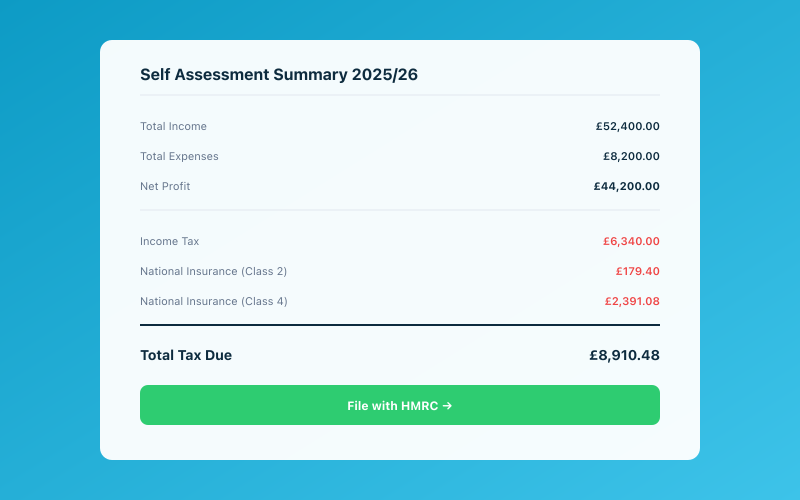 Your Accounted dashboard shows your real-time tax position
This guide explains how R&D tax relief works for small and medium-sized enterprises (SMEs) in the 2025/26 tax year, what counts as qualifying activity, and how to make a claim.
What Is R&D Tax Relief?
R&D tax relief allows companies to claim an additional tax deduction (or cash credit) for expenditure on qualifying research and development activities. The relief is designed to encourage innovation by reducing the cost of R&D projects.
The scheme is available to UK limited companies that are subject to Corporation Tax. Sole traders and partnerships cannot claim R&D tax relief — it is exclusively for companies.
The Merged R&D Scheme
From 1 April 2024, the previous two R&D schemes — the SME scheme and the RDEC (Research and Development Expenditure Credit) scheme — were merged into a single scheme for most companies. This merged scheme applies to accounting periods beginning on or after 1 April 2024.
How the merged scheme works
Under the merged scheme, companies can claim an above-the-line taxable credit of 20% of qualifying R&D expenditure. This is calculated as follows:
- Identify your qualifying R&D expenditure.
- Calculate 20% of that expenditure — this is your R&D credit.
- The credit is taxable, so the net benefit depends on your Corporation Tax rate.
For a company paying Corporation Tax at 25%, the net benefit of the merged scheme credit is approximately 15% of qualifying expenditure. For a company paying at the small profits rate of 19%, the net benefit is approximately 16.2%.
R&D-intensive SMEs
There is a more generous scheme for "R&D-intensive" SMEs — companies where qualifying R&D expenditure represents 30% or more of total expenditure. These companies can claim an enhanced rate of 27% and, if loss-making, can surrender losses for a payable credit at a higher rate. This is particularly valuable for early-stage technology companies that are not yet profitable.
What Counts as R&D?
This is where many businesses undersell themselves. R&D for tax purposes is broader than many people think. It does not require a laboratory, white coats, or a PhD. The test is whether your project sought to achieve an advance in science or technology by overcoming scientific or technological uncertainty.
The advance
An advance means creating something that was not readily deducible by a competent professional in the field. It does not have to be new to the world — just new to your business and not something that could be easily worked out from existing knowledge.
Scientific or technological uncertainty
Uncertainty exists when the solution to a problem is not readily available. If a competent professional in the field would not know in advance whether the approach would work, how to achieve it, or what the outcome would be, there is uncertainty.
Examples across industries
R&D is not limited to technology companies. Qualifying projects can be found across many sectors:
Software development: Building a new platform, creating a novel algorithm, developing an integration that has not been done before, working on machine learning models, or solving complex data processing challenges.
Manufacturing: Developing a new production process, creating a new material formulation, improving product performance beyond current industry standards, or automating a process in a novel way.
Food and drink: Creating new recipes that require solving preservation, texture, or shelf-life challenges. Developing new production methods or packaging solutions.
Construction: Developing new building techniques, working with novel materials, solving complex structural engineering challenges, or creating innovative environmental solutions.
Engineering: Designing new products, improving existing designs to overcome performance limitations, or developing prototypes that require solving technical challenges.
Healthcare and life sciences: Developing new treatments, diagnostic tools, medical devices, or health technology platforms.
What Expenditure Qualifies?
Staff costs
The largest qualifying cost for most companies is staff. You can claim for employees who are directly engaged in R&D activities, including their salaries, wages, employer's NI contributions, and employer's pension contributions.
If an employee spends part of their time on R&D and part on other activities, you claim the proportion of their time spent on R&D. Keep timesheets or time estimates to support your claim.
Subcontracted R&D
If you subcontract R&D work to another party, you can include a proportion of the subcontractor costs in your claim. Under the merged scheme, subcontracted costs are generally restricted to 65% of the amount paid.
Consumables and materials
Materials consumed or transformed in the R&D process are qualifying expenditure. This includes raw materials used in prototyping, chemicals used in experiments, and components that are incorporated into prototypes or test products.
Materials that end up in a commercially sold product do not qualify — only materials consumed or transformed in the R&D process itself.
Software
Software used directly in R&D activities is qualifying expenditure. This includes specialist development tools, simulation software, testing platforms, and cloud computing costs used for R&D purposes.
Utilities
A proportion of power, water, and fuel costs used directly in R&D activities can be claimed.
The Claim Process
Step 1: Identify qualifying projects
Review your activities over the accounting period and identify projects that involved seeking an advance in science or technology. A single company might have multiple qualifying projects.
Step 2: Calculate qualifying expenditure
For each project, identify the staff costs, materials, subcontractor costs, software, and utilities directly attributable to the R&D work.
Step 3: Prepare the technical narrative
Since April 2023, all R&D claims must include an Additional Information Form submitted to HMRC. This includes a description of each qualifying project, the advance being sought, the scientific or technological uncertainties, and how these were addressed.
Step 4: Complete the Corporation Tax return
The R&D claim is made through your Corporation Tax return (CT600). The qualifying expenditure and relief claimed are entered in the relevant boxes.
Step 5: Submit the claim
File your amended or original CT600 with the R&D claim. HMRC may process the claim without queries, or they may open an enquiry and ask for more information about your qualifying activities.
Claim deadline
You have two years from the end of the accounting period to make an R&D claim. For an accounting period ending 31 March 2026, the deadline would be 31 March 2028. Do not miss this deadline — late claims are not accepted.
How Much Can You Save?
The value of your claim depends on your qualifying expenditure and your Corporation Tax position.
Profitable company (25% Corporation Tax rate)
If your qualifying R&D expenditure is £100,000:
- Merged scheme credit: £100,000 x 20% = £20,000 credit
- Less Corporation Tax on the credit: £20,000 x 25% = £5,000
- Net benefit: £15,000
Loss-making R&D-intensive SME
If your company qualifies as R&D-intensive (30%+ of expenditure on R&D) and is loss-making, the benefit is more generous. You can surrender losses for a payable credit, providing a cash payment from HMRC — invaluable for pre-revenue startups.
Recent Changes to Be Aware Of
Merged scheme (from April 2024)
The merger of the SME and RDEC schemes simplified the landscape but reduced the benefit for most profitable SMEs compared to the old SME scheme. The old SME scheme offered a 130% enhanced deduction, which was significantly more generous than the current 20% above-the-line credit.
Additional Information Form
Since April 2023, all R&D claims must be accompanied by a detailed Additional Information Form. This was introduced to combat fraud and low-quality claims. You must describe your projects, the advances sought, and the uncertainties overcome.
Pre-notification requirement
For first-time claimants (or companies that have not claimed in the previous three years), you must notify HMRC of your intention to claim within six months of the end of the accounting period. Miss this notification, and you cannot make the claim.
Subcontractor and overseas restrictions
The merged scheme restricts claims for overseas subcontractors and externally provided workers unless specific conditions are met. Most qualifying work must be carried out in the UK.
Common Mistakes
- Not claiming at all. Many companies assume R&D is only for tech firms or big pharma. If you have solved a technical problem that was not straightforward, you may qualify.
- Overclaiming. Including routine development work, cosmetic changes, or projects without genuine uncertainty will lead to HMRC rejecting your claim — or worse, penalties.
- Poor record keeping. Keep contemporaneous records of your R&D projects, including timesheets, project notes, and technical documentation.
- Missing the pre-notification deadline. First-time claimants must notify HMRC within six months of the period end.
- Not seeking specialist advice. R&D claims can be complex. A specialist R&D tax adviser can identify qualifying projects you might miss and ensure your claim is robust.
How Accounted Can Help
While R&D claims typically require specialist tax advice, Accounted helps you lay the groundwork. Penny, the AI bookkeeper, tracks your business expenditure in detail — staff costs, software subscriptions, materials, and subcontractor payments are all categorised and ready when your R&D adviser needs the numbers. Clean, accurate records make the claim process faster and more reliable.
Start Your Free Trial With Accounted
Good record keeping is the foundation of a strong R&D claim. Accounted keeps your expenditure organised, your receipts matched, and your accounts ready for your tax adviser to review. Start your free trial today and let Penny make sure every qualifying pound is accounted for.
Related Reading
-
Can I Claim Clothing as a Business Expense? HMRC Rules Explained
-
Tax-Efficient Company Cars: BIK Rates and Electric Vehicle Benefits
Start your free trial and let Penny handle your bookkeeping automatically.
Penny, your AI bookkeeper, tracks your tax position in real time and flags opportunities to reduce your bill. Meet Penny →
Tax & Compliance Specialists
Our tax specialists have decades of combined experience in UK sole trader and small business taxation, MTD compliance, and HMRC submissions. All content is reviewed against current HMRC guidance before publication and updated quarterly to reflect legislative changes.
Ready to try Accounted?
Join UK sole traders who are simplifying their bookkeeping and tax.
Start your 14-day free trial