Can I Claim Clothing as a Business Expense? HMRC Rules Explained
It seems like it should be straightforward. You buy clothes because you need them for work. So surely you can claim them as a business expense? Unfortunately, HMRC does not see it that way — at least not for most clothing. The rules are stricter than most people expect, and getting them wrong can lead to trouble.
Here is the honest answer on what you can and cannot claim.
The Short Answer
You can claim uniforms, protective clothing, and costumes that you would not wear outside of work. You cannot claim everyday clothing, even if you only wear it for work. That includes suits, smart shoes, and anything you could reasonably wear in normal life.
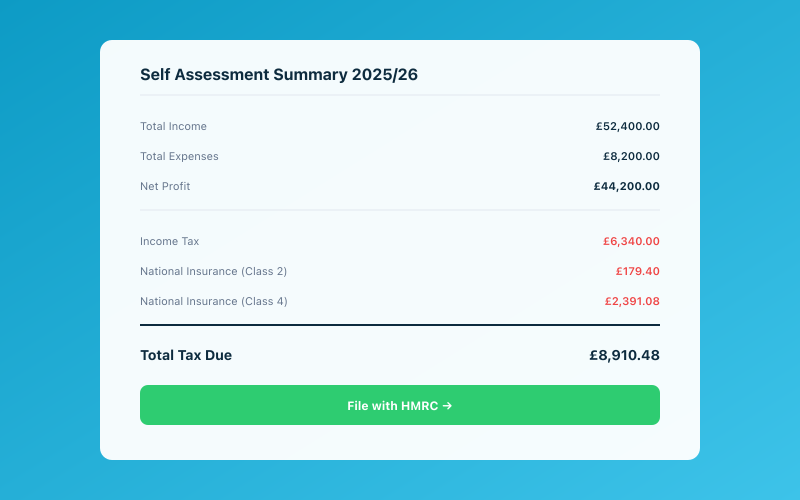 Your Accounted dashboard shows your real-time tax position
The Duality Test
The rule behind all of this is called the "duality of purpose" test. HMRC says an expense is only deductible if it is incurred "wholly and exclusively for the purposes of your trade." Clothing almost always fails this test because, in HMRC's view, clothes serve a dual purpose — they keep you warm, decent, and presentable in your personal life as well as your work life.
It does not matter that you only bought the clothes because of your job. It does not matter that you never wear them outside of work. What matters is whether the clothes could be worn as ordinary everyday clothing. If they could, HMRC says there is a dual purpose, and you cannot claim them.
This is one of the most frustrating rules in the tax system, and it has been tested in court multiple times. The courts have consistently sided with HMRC.
What You CAN Claim
Protective Clothing (PPE)
If you work in construction, manufacturing, or any trade where you need protective clothing, you can claim it. This includes:
- Steel-toe-capped boots
- Hard hats
- High-visibility jackets and trousers
- Safety goggles and ear defenders
- Overalls and boiler suits
- Gloves (work gloves, not fashion gloves)
- Waterproof clothing designed for outdoor work
The key is that these items are clearly not everyday wear. Nobody is going to Tesco in a hard hat and hi-vis vest (well, maybe on a lunch break, but the point stands).
Uniforms With a Logo
If you have clothing with your business name or logo permanently attached — printed, embroidered, or sewn on — you can claim it. A plain polo shirt is not claimable. The same polo shirt with your company logo embroidered on it is, because the logo makes it clearly a work uniform rather than everyday clothing.
This is a useful trick for tradespeople. Get your t-shirts and fleeces branded with your business name, and they become a deductible expense. You get free advertising and a tax deduction at the same time.
Costumes and Specialist Clothing
If you are a performer, entertainer, or work in a role that requires clothing you would genuinely never wear in everyday life, you can claim it. A magician's stage outfit, a mascot costume, or a chef's whites all qualify.
Laundry and Repair of Qualifying Clothing
If the clothing itself is claimable, the cost of washing, repairing, or replacing it is also claimable. So if you wash your branded work fleeces at home, you can claim a reasonable amount for the laundry costs.
HMRC does not give a specific flat rate for this, but a reasonable estimate based on your usage is acceptable. Keep a note of how you calculated it.
What You CANNOT Claim
Business Suits
This is the one that catches most people. A consultant buys a suit specifically for client meetings. They would never wear it at the weekend. They bought it entirely because of their work. And yet — it is not deductible.
Why? Because a suit is ordinary clothing that could be worn in everyday life. The fact that you choose not to wear it outside of work does not change its nature. HMRC's position is that it serves the dual purpose of keeping you clothed and presentable, which is a personal need as well as a business one.
This rule was tested in the famous case of Mallalieu v Drummond (1983), where a barrister tried to claim the cost of black court clothing. The House of Lords ruled against her, establishing the principle that clothing which serves any personal purpose — even just warmth and decency — has a dual purpose and is not deductible.
Smart Clothing
The same logic applies to:
- Smart shoes
- Blouses, shirts, and ties
- Dresses and trousers
- Coats and jackets (unless they are PPE or branded)
Even if you have a separate wardrobe of "work clothes" that you never wear outside the office, they are not claimable.
"I Only Bought It for Work"
Your intention does not matter. HMRC looks at the nature of the item, not your reason for buying it. If the item could function as everyday clothing, it fails the duality test regardless of why you bought it.
The Grey Areas
Scrubs and Medical Clothing
Healthcare workers can usually claim scrubs, lab coats, and similar medical clothing. These are specialist items that you would not wear outside of a clinical setting.
Chef Whites
Deductible. They are clearly work-specific clothing, in the same category as uniforms.
Steel-Toe Boots That Look Like Normal Boots
If they meet safety standards and you bought them for a workplace that requires PPE, they are claimable even if they look relatively normal. The safety specification is what makes them PPE, not the appearance.
Thermal Base Layers for Outdoor Work
This one is genuinely grey. If you work outdoors and buy specialist thermal layers, there is an argument that they are protective clothing. However, HMRC could also argue they are general clothing that keeps you warm (a personal need). If you claim these, keep a record of why you needed them and be prepared to justify it.
How to Handle Clothing in Your Records
For items you do claim, keep the receipts and make a note of what the item is and why it qualifies. If you are ever asked by HMRC, you want to be able to explain clearly why each item falls on the right side of the line.
In Accounted, Penny will flag clothing purchases and ask you what type of clothing it is. If it is PPE or a branded uniform, Penny categorises it as an allowable expense. If it looks like general clothing, Penny will let you know it is not deductible — saving you from making an incorrect claim that could cause problems later.
The Flat Rate for Uniforms (Employed Workers)
It is worth noting that if you are an employee (not self-employed) who has to wash their own uniform, you can claim a flat rate tax relief of £60 per year without receipts. This is different from the self-employed rules above and is claimed through HMRC's P87 form or your tax code.
As a self-employed sole trader, you claim the actual cost of qualifying clothing through your Self Assessment, not through flat rate relief.
Quick Summary
| Type of Clothing | Claimable? | |-----------------|------------| | PPE (hard hat, steel-toe boots, hi-vis) | Yes | | Branded uniform with logo | Yes | | Overalls and boiler suits | Yes | | Costumes and specialist clothing | Yes | | Laundry of qualifying items | Yes | | Business suits | No | | Smart shoes, shirts, ties | No | | General "work clothes" | No | | Coats and jackets (non-PPE) | No |
The Bottom Line
The clothing rules are frustrating, but they are clear once you understand the principle. If you would not wear it in everyday life and it exists purely for work, you can probably claim it. If it could double as normal clothing, you almost certainly cannot.
If you are not sure whether a specific item qualifies, Accounted's AI bookkeeper Penny can help you work it out based on HMRC's rules. Start your free trial and get your expenses right from day one.
Related Reading
- Charitable Donations and Tax Relief for Sole Traders
- Flat Rate VAT and Limited Cost Traders: Is It Still Worth It?
Start your free trial and let Penny handle your bookkeeping automatically.
Penny, your AI bookkeeper, tracks your tax position in real time and flags opportunities to reduce your bill. Meet Penny →
Tax & Compliance Specialists
Our tax specialists have decades of combined experience in UK sole trader and small business taxation, MTD compliance, and HMRC submissions. All content is reviewed against current HMRC guidance before publication and updated quarterly to reflect legislative changes.
Ready to try Accounted?
Join UK sole traders who are simplifying their bookkeeping and tax.
Start your 14-day free trial