Charitable Donations and Tax Relief for Sole Traders
Giving to charity and getting tax relief sounds like it should be straightforward. In many ways it is, but there are specific rules for self-employed people that differ from employees, and there are planning opportunities that most sole traders miss entirely. Getting this right means more money goes to the causes you support, and less to HMRC.
This guide covers how charitable tax relief works for sole traders in the 2025/26 tax year, including Gift Aid, carrying back donations, payroll giving (if you also have a job), higher rate relief, and the overlooked option of donating trading stock.
How Gift Aid Works
Gift Aid is the main way that charitable donations attract tax relief in the UK. When you donate to a registered charity and declare Gift Aid, two things happen:
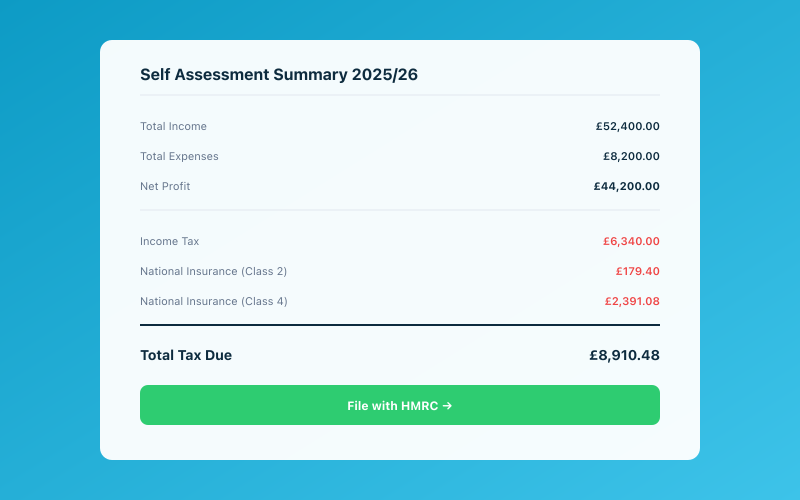 Your Accounted dashboard shows your real-time tax position
-
The charity claims back basic rate tax. For every £1 you donate, the charity reclaims 25p from HMRC. So your £100 donation is worth £125 to the charity. This happens automatically — the charity handles the claim.
-
You get additional relief if you pay higher or additional rate tax. This is the part you claim through Self Assessment.
The Key Requirement
To use Gift Aid, you must have paid enough UK income tax (or Capital Gains Tax) in the tax year to cover the basic rate tax that charities reclaim on your donations. If you donate £1,000, the charity reclaims £250 in basic rate tax. So you need to have paid at least £250 in tax that year.
If you have not paid enough tax, you will have to repay the shortfall to HMRC. This is a common trap for people with low incomes who make generous donations.
How Much Tax Have You Paid?
For sole traders, your income tax liability is based on your net profit. If your net profit is £20,000, your tax (after the personal allowance of £12,570) is approximately £1,486 in income tax. You could make Gift Aid donations where the basic rate reclaim totals up to £1,486 — meaning donations of up to roughly £5,944 would be covered.
In practice, most sole traders' donations are well within their tax liability, so this is not usually a concern. But if you have a low-profit year and make a large donation, double-check the numbers.
Higher Rate Relief Through Self Assessment
If you are a higher rate taxpayer (income over £50,270 in 2025/26), you get extra relief beyond what the charity reclaims.
Here is how it works in practice:
You donate £1,000 to charity with Gift Aid.
- The charity gets £1,250 (your £1,000 plus £250 reclaimed from HMRC)
- On your Self Assessment return, you enter the gross donation of £1,250
- Your basic rate band is extended by £1,250
- This means £1,250 of income that would have been taxed at 40% is instead taxed at 20%
- Tax saving for you: £1,250 x 20% = £250
So the total tax relief on a £1,000 donation for a higher rate taxpayer is £250 to the charity from HMRC, plus £250 back to you through Self Assessment. The actual cost to you is £500 for a donation worth £1,250 to the charity.
For additional rate taxpayers (income over £125,140), the relief is even greater. The extra relief is 25% rather than 20%, making the effective cost of a £1,000 donation just £375.
Where to Claim on Your Tax Return
On the SA100, there is a section for charitable giving. Enter the total amount you donated under Gift Aid during the tax year. HMRC calculates the relief and applies it to your tax bill.
Keep records of all your Gift Aid donations — the charity name, date, and amount. Gift Aid declarations (the form the charity asks you to sign or tick) should be kept with your records.
Carrying Back Donations
This is a useful planning tool that not enough people know about. You can elect to treat a Gift Aid donation made between 6 April 2026 and 31 January 2027 as if it was made in the 2025/26 tax year.
Why would you do this? Several reasons:
You were a higher rate taxpayer in 2025/26 but expect to be basic rate in 2026/27. Carrying back the donation gives you higher rate relief instead of no additional relief.
You want to reduce your 2025/26 tax bill. If you file your Self Assessment return in January 2027 and include a carried-back donation, it reduces the tax you owe on that return.
You forgot to make a donation before 5 April. Carry-back gives you an extra window.
To carry back, you must make the election on your 2025/26 Self Assessment return. There is a box for this in the charitable giving section. You cannot carry back more than you actually donated after 5 April 2026, and the donation must have been made before you file the return.
Payroll Giving (If You Are Also Employed)
Some sole traders also have a part-time job or a directorship with a salary. If your employer operates a Payroll Giving scheme, donations through it come out of your gross pay — before income tax is deducted.
This means you get tax relief at your marginal rate automatically, with no need to claim through Self Assessment. A £100 payroll giving donation costs a basic rate taxpayer £80, a higher rate taxpayer £60, and an additional rate taxpayer £55.
The downside is that only some employers offer this, and the charity does not get the Gift Aid top-up (because you have already received full relief at source). But for higher rate taxpayers, payroll giving can be slightly more tax-efficient than Gift Aid because the relief is immediate rather than claimed a year later.
If you use both payroll giving and Gift Aid (on different donations), keep them separate in your records. Donations made through payroll giving should not be included in the Gift Aid section of your Self Assessment return — the relief has already been given.
Donating Trading Stock
This is the option almost nobody talks about. If you are a sole trader and you donate items from your trading stock to charity, there is a specific tax relief available.
Normally, if you give away trading stock, you are treated as having sold it at market value. This means you would include the market value as income on your tax return, even though you received no money. The purpose is to stop people avoiding tax by "donating" stock instead of selling it.
However, there is a relief that overrides this. If you donate trading stock to a charity for no payment, you can elect to treat the disposal as happening at cost rather than market value. Since the cost was already deducted when you bought the stock, the effect is that no additional profit arises from the donation.
How It Works in Practice
Say you are an electrician and you have £500 worth of unused cable that you donate to a community project run by a registered charity.
Without the relief: You would need to include £500 as income (the market value of the goods), increasing your taxable profit by £500.
With the relief: The disposal is treated as being at your cost price. If you paid £300 for the cable, the disposal value is £300. Since you already deducted £300 when you bought it, the net effect on your profit is zero.
You can also choose to treat the disposal at any value between cost and market value, which gives you flexibility. But for most straightforward donations, electing for cost price is the simplest approach.
To claim this relief, make the election on your Self Assessment return for the year of the donation.
Donations That Do Not Qualify for Tax Relief
Not everything counts:
- Donations to organisations that are not registered charities or Community Amateur Sports Clubs (CASCs). Giving money to your neighbour's GoFundMe is not tax-deductible.
- Payments where you receive something in return. Buying a raffle ticket or a charity dinner ticket is not a donation if you receive goods or services in return. However, charities can provide minor benefits (up to certain limits) without affecting Gift Aid.
- Political donations. Donations to political parties do not attract tax relief.
- Donations to overseas charities unless the charity is registered with HMRC as a qualifying overseas charity.
Record Keeping
For Gift Aid donations, keep:
- The name of the charity
- The date of each donation
- The amount donated
- Confirmation that you made a Gift Aid declaration
For donated trading stock, keep:
- The nature of the goods donated
- The cost price and estimated market value
- The name of the charity
- The date of the donation
- Evidence of the donation (a receipt from the charity, for example)
If you are tracking your business finances in Accounted, Penny categorises charitable donations separately so they are easy to identify at Self Assessment time. You can also attach receipt images to donation transactions for a complete audit trail.
Making the Most of It
Charitable giving is one of the few areas where the tax system actively encourages you to do something good. The relief is generous — especially for higher rate taxpayers — and the carry-back rules give you flexibility in timing.
The key is to plan. Know your marginal tax rate. Time your donations to get the best relief. Keep records so you can claim everything you are entitled to.
Accounted makes it easy to track charitable donations alongside all your other business transactions. Penny keeps everything categorised and ready for your tax return, so you never miss a claim. Start your free trial today and keep your bookkeeping — and your giving — in perfect order.
Related Reading
Start your free trial and let Penny handle your bookkeeping automatically.
Penny, your AI bookkeeper, tracks your tax position in real time and flags opportunities to reduce your bill. Meet Penny →
Tax & Compliance Specialists
Our tax specialists have decades of combined experience in UK sole trader and small business taxation, MTD compliance, and HMRC submissions. All content is reviewed against current HMRC guidance before publication and updated quarterly to reflect legislative changes.
Ready to try Accounted?
Join UK sole traders who are simplifying their bookkeeping and tax.
Start your 14-day free trial