Can I Claim Travel Expenses as Self-Employed? The Complete Rules
Travel is one of the biggest expenses for many self-employed people. Plumbers drive to client homes. Consultants travel to meetings. Photographers go to shoots. But not all travel is claimable, and getting the line wrong between business travel and commuting can land you in trouble with HMRC.
Here is how the rules work, clearly and completely.
The Fundamental Rule
Business travel is deductible. Commuting is not.
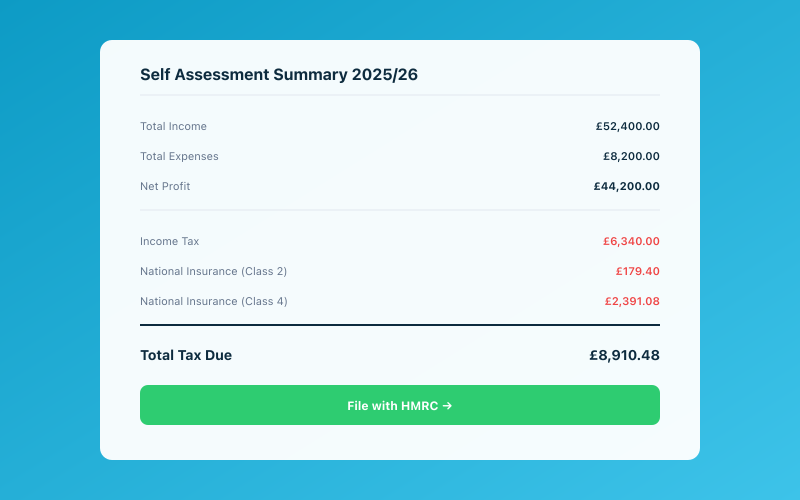 Your Accounted dashboard shows your real-time tax position
Business travel means journeys you make for the purpose of your work — visiting clients, going to suppliers, attending training, or travelling between different work sites.
Commuting means travelling between your home and a permanent place of work. Even if the journey is essential for your job, HMRC considers it a personal choice (you chose where to live) and does not allow it as a business expense.
The tricky bit is working out which category each journey falls into.
What Counts as Your "Base"?
For sole traders, your "base" is where you normally do most of your work. This is crucial because journeys from your base to other locations are usually business travel, while journeys from your home to your base are commuting.
If You Work From Home
If your home is genuinely your main place of business — you have an office or workshop there, you do your admin there, you store your tools and materials there — then your home is your base. Every journey from home to a client site, a supplier, or a meeting is business travel.
This is the situation for most sole traders. A plumber who keeps their tools in the van at home and drives out to jobs is travelling from their base (home) to client sites (business travel). A freelance designer who works from a home office and occasionally visits clients is in the same position.
If You Have a Separate Business Premises
If you rent a workshop, office, or studio and work there most days, that premises is your base. Travelling from home to your workshop is commuting (not claimable). Travelling from your workshop to a client site is business travel (claimable).
If You Work at Multiple Sites
Some self-employed people work at different locations regularly — perhaps a contractor who works on different building sites. If you do not have a single permanent place of work, all your travel between sites is business travel. Your home serves as your base.
However, if you work at one site for a prolonged period (HMRC uses 24 months as a guideline), that site can become your permanent place of work, and travel to it becomes commuting.
What Travel Can You Claim?
Client Site Visits
Any journey from your base to a client's home, office, or site is business travel. This is the most common type of claimable travel for tradespeople and freelancers.
Supplier Trips
Journeys to collect materials, parts, or supplies are business travel. Going to the builders' merchant, the plumbing wholesaler, or picking up specialist equipment all count.
Meeting Travel
Travelling to meet clients, business partners, or professional contacts is business travel. This includes travel to your accountant's office.
Training and Courses
Travel to training courses, professional development events, or conferences is claimable — provided the training relates to your current trade. Learning a new skill for your existing business counts. Training for a completely different career does not.
Travelling Between Jobs
If you go directly from one client to another during the day, the journey between the two is business travel.
What Travel Can You NOT Claim?
Home to Fixed Workplace
The daily commute from your home to a fixed business premises is not claimable, even if it is your own workshop.
Personal Detours
If you stop to do personal errands on a business journey, only the business portion is claimable.
Long-Term Site Work
If you work at one site as a contractor every day for an extended period, HMRC may classify it as commuting. Their guideline is 24 months — after that, the site becomes your permanent place of work.
Two Ways to Claim Vehicle Expenses
You have a choice between two methods for claiming vehicle expenses. Once you choose a method for a particular vehicle, you must stick with it for as long as you use that vehicle in your business.
Method 1: Simplified Mileage Rates (Recommended for Most)
HMRC publishes approved mileage rates that cover all the costs of running your vehicle — fuel, insurance, road tax, servicing, depreciation, the lot. You claim a flat rate per business mile.
2025/26 mileage rates:
| Vehicle | Rate | |---------|------| | Car or van — first 10,000 business miles | 45p per mile | | Car or van — above 10,000 business miles | 25p per mile | | Motorcycle | 24p per mile | | Bicycle | 20p per mile |
How it works:
- Keep a log of every business journey (date, destination, purpose, miles)
- At the end of the year, add up your total business miles
- Apply the rate: first 10,000 miles at 45p, any additional miles at 25p
- Claim the total as an expense on your Self Assessment
Example: You drive 12,000 business miles in a year.
- First 10,000 miles: 10,000 x 45p = £4,500
- Next 2,000 miles: 2,000 x 25p = £500
- Total claim: £5,000
The mileage rate method is simpler because you do not need to keep receipts for fuel, insurance, servicing, or any other vehicle costs. The rate is designed to cover all of them.
If you carry a passenger who is also travelling for business purposes, you can claim an extra 5p per mile for each passenger.
Method 2: Actual Costs
With this method, you add up the total annual cost of running your vehicle — fuel, insurance, road tax, MOT, servicing, repairs, breakdown cover, and lease or loan payments — then claim the business proportion based on your mileage split.
Example: Your total vehicle costs for the year are £6,000. You drove 15,000 miles total, 10,000 for business (67%). You can claim 67% of £6,000 = £4,000.
Which Method Should You Choose?
For most sole traders, the mileage rate method is better. It is simpler, requires less paperwork, and the 45p rate is generous. The actual costs method may be better if you drive an expensive vehicle, do very high mileage, or lease your vehicle.
Important: once you choose a method for a vehicle, you must stick with it for as long as you use that vehicle in your business.
Other Claimable Travel Expenses
Beyond vehicle costs, you can also claim public transport fares (trains, buses, Tube), taxis to business locations, parking at client sites, bridge tolls, congestion charges, and overnight accommodation with reasonable meals for business trips that require a stay away from home. Keep receipts for all of these.
Keeping a Mileage Log
You need a record of your business journeys, whichever method you use. Your log should include the date, starting point and destination, purpose of the journey, and miles driven. Keep it consistently throughout the year — reconstructing journeys from memory in January is painful and inaccurate.
Accounted makes this easy. Send your trips to Penny via WhatsApp, and she logs the miles, calculates the claimable amount at the right HMRC rate, and keeps a running total for the year. She even switches to the 25p rate automatically when you cross 10,000 miles.
Common Mistakes
The biggest mistakes people make: claiming the daily commute to a fixed workplace (not allowed), not keeping a proper mileage log (HMRC wants individual journeys, not estimates), mixing the mileage rate and actual costs methods for the same vehicle (you must pick one and stick with it), and forgetting that parking and tolls are claimable on top of mileage rates.
Summary
| Journey Type | Claimable? | |-------------|------------| | Home (base) to client site | Yes | | Between two client sites | Yes | | To suppliers or merchants | Yes | | To training courses | Yes | | Home to fixed workshop/office (commute) | No | | Personal detours on a business trip | No | | Regular travel to one site for over 24 months | No (becomes commuting) |
Travel expenses can add up to thousands of pounds a year, so getting this right makes a real difference to your tax bill. If you want to make sure you are claiming every mile you are entitled to, start your free trial of Accounted. Penny tracks your mileage, applies the correct HMRC rates, and keeps your records ready for Self Assessment — all from a quick WhatsApp message.
Related Reading
- Director's Loan Account: Tax Rules Every Director Must Know
- Spring Budget 2026: What It Means for Sole Traders and Landlords
Start your free trial and let Penny handle your bookkeeping automatically.
Penny, your AI bookkeeper, tracks your tax position in real time and flags opportunities to reduce your bill. Meet Penny →
Tax & Compliance Specialists
Our tax specialists have decades of combined experience in UK sole trader and small business taxation, MTD compliance, and HMRC submissions. All content is reviewed against current HMRC guidance before publication and updated quarterly to reflect legislative changes.
Ready to try Accounted?
Join UK sole traders who are simplifying their bookkeeping and tax.
Start your 14-day free trial