Director's Loan Account: Tax Rules Every Director Must Know
What Is a Director's Loan Account?
A director's loan account (DLA) is a record of all financial transactions between a company director and their limited company that aren't salary, dividends, or expense reimbursements. It tracks money flowing in both directions.
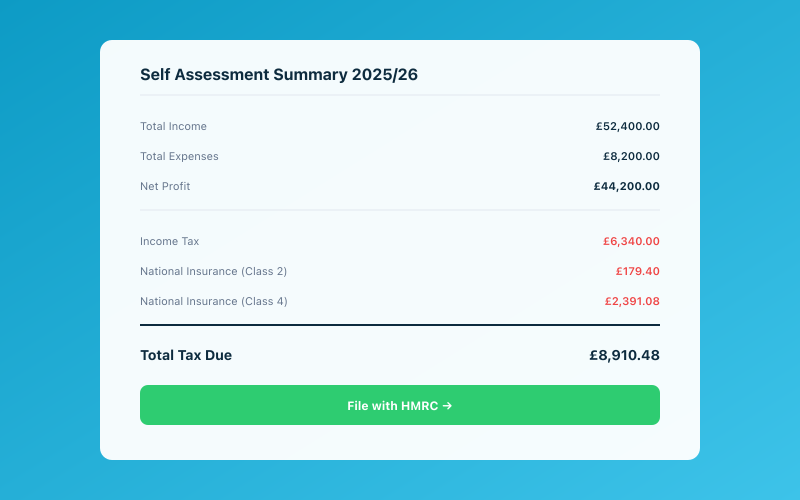 Your Accounted dashboard shows your real-time tax position
When you put personal money into the company — perhaps to fund startup costs or cover a cash shortfall — the DLA shows the company owes you money. When you withdraw money from the company outside of salary and dividends — perhaps drawing cash for personal use or paying a personal bill from the company account — the DLA shows you owe the company money.
A DLA in credit (the company owes you) is perfectly fine from a tax perspective. The problems start when the DLA is overdrawn — meaning you owe money to the company. That's when HMRC takes a keen interest.
Section 455 Tax: The Big One
If your DLA is overdrawn at the end of the company's accounting period — meaning you owe the company money — the company must pay Section 455 tax (sometimes called S455 tax) on the outstanding balance.
The Rate
The Section 455 tax rate is 33.75% of the outstanding loan balance. This matches the higher-rate dividend tax rate, and that's no coincidence — HMRC views an unpaid director's loan as, in effect, an untaxed dividend extraction.
When It's Due
Section 455 tax is due alongside your Corporation Tax payment — nine months and one day after the end of the accounting period.
A Worked Example
Your company's year-end is 31 March 2026. At that date, your DLA shows you owe the company £20,000.
The company must pay: £20,000 × 33.75% = £6,750 in Section 455 tax.
This is due by 1 January 2027 (nine months and one day after 31 March).
Getting It Back
Here's the important part: Section 455 tax is refundable. If you repay the loan, the company can reclaim the S455 tax from HMRC. However, the refund isn't immediate — it's repaid nine months and one day after the end of the accounting period in which the loan was repaid.
So if you repay the £20,000 during the year ending 31 March 2027, the company gets the £6,750 back around 1 January 2028. That's potentially two years between paying and reclaiming. The cash flow impact is real, even though the tax is ultimately temporary.
Beneficial Loan Interest
If your overdrawn DLA exceeds £10,000 at any point during the tax year, a separate charge kicks in: you're deemed to have received a benefit in kind (a perk of employment) in the form of an interest-free loan.
How It's Calculated
HMRC charges a notional interest rate on the loan, currently 2.25% per annum. The company must report this as a benefit in kind on your P11D, and the company pays Class 1A National Insurance at 13.8% on the benefit.
Example:
Your DLA is overdrawn by £30,000 for the full tax year.
- Beneficial loan interest: £30,000 × 2.25% = £675
- Class 1A NICs payable by the company: £675 × 13.8% = £93.15
- You may also owe personal tax on the £675 benefit
How to Avoid It
You can eliminate the beneficial loan charge by paying the company interest at the official rate (2.25%). The interest you pay is tax-deductible for you as a business expense of the loan, and the company declares it as interest income. In practice, this is a minor administrative exercise that saves you the P11D hassle — but only worth doing if the loan is substantial.
Bed and Breakfasting: HMRC's Anti-Avoidance Rule
"Bed and breakfasting" is HMRC's term for the practice of temporarily repaying a director's loan just before the year-end, only to re-borrow the same amount shortly after. The goal is to ensure the DLA isn't overdrawn at the balance sheet date, thereby avoiding Section 455 tax.
HMRC saw this coming and introduced specific anti-avoidance rules.
The 30-Day Rule
If you repay a loan of £15,000 or more and then re-borrow £5,000 or more within 30 days, the repayment is matched against the new loan. In effect, it's treated as if the original loan was never repaid.
Example:
- 25 March: You repay £20,000 to the company (clearing the DLA before the 31 March year-end)
- 15 April: You borrow £18,000 from the company
HMRC treats £18,000 of the repayment as ineffective. The DLA is still considered overdrawn by £18,000, and Section 455 tax is due on that amount.
The Intention Test
Even outside the 30-day window, HMRC can challenge arrangements where there's a clear pattern of repaying and re-borrowing around year-ends. If the intention was always to re-borrow, the repayment may not be accepted as genuine.
The safest approach: if you repay a director's loan, don't re-borrow for a meaningful period.
How to Clear an Overdrawn DLA
If your DLA is overdrawn, you have several options to clear it before the year-end:
1. Vote a Dividend
The most common approach. The company declares a dividend, which is credited to your DLA to reduce or clear the balance. You'll pay dividend tax on the amount (8.75% at basic rate, 33.75% at higher rate, 39.35% at additional rate), but this is typically cheaper than leaving the Section 455 charge in place.
Remember the £500 dividend allowance — the first £500 of dividends in each tax year is tax-free.
2. Declare a Bonus
The company pays you a bonus, which is credited against the DLA. The bonus is subject to Income Tax through PAYE and both employee and employer National Insurance. For most directors, this is less tax-efficient than a dividend unless you need to build up National Insurance credits or pension entitlements.
3. Repay the Loan
Simply transfer the money back from your personal account to the company. This is the cleanest option if you have the cash available.
4. Write Off the Loan
The company can formally write off the loan, but this triggers a tax charge. The written-off amount is treated as a distribution (like a dividend) for Income Tax purposes. The company also loses the Corporation Tax deduction it might otherwise have claimed. This is rarely the best option.
Best Practices for Managing Your DLA
Keep It Simple
Ideally, your DLA should stay close to zero. Pay yourself through salary and dividends in a planned, tax-efficient way rather than dipping into the company account ad hoc. Our guide on dividends vs salary covers the optimal strategy.
Track It in Real Time
Don't wait until year-end to discover your DLA is overdrawn by a surprising amount. Monitor it throughout the year so you can take action — vote an interim dividend, make a personal repayment — before the accounting period closes.
Separate Personal and Business Spending
Use a personal card for personal spending and the company card for business spending. Mixing the two is how DLAs become overdrawn unintentionally. That coffee with a friend, the weekend supermarket shop, the personal Amazon order — they all add up.
Plan Dividends Quarterly
Rather than taking a large annual dividend, consider voting dividends quarterly. This keeps your DLA tidy, spreads your personal tax liability, and means you're always extracting money through a tax-efficient route rather than building up an informal loan.
Document Everything
Minutes of dividend declarations, board resolutions for loans, and clear records of all transactions through the DLA. If HMRC investigates, documentation turns a potential problem into a straightforward review.
Tracking Your DLA with Accounted
Accounted's Corporation Tax features include automatic DLA tracking. Every transaction between you and the company is logged, your running balance is visible at a glance, and you'll receive alerts if the account is heading into overdrawn territory — giving you time to act before the year-end. Check our pricing to find the right plan for your limited company.
Get Started with Accounted
Don't let a director's loan account become a tax headache. Accounted tracks your DLA in real time, alerts you to potential Section 455 exposure, and helps you plan tax-efficient extractions throughout the year. Start your free trial today — no credit card required.
Related Reading
Penny, your AI bookkeeper, tracks your tax position in real time and flags opportunities to reduce your bill. Meet Penny →
Tax & Compliance Specialists
Our tax specialists have decades of combined experience in UK sole trader and small business taxation, MTD compliance, and HMRC submissions. All content is reviewed against current HMRC guidance before publication and updated quarterly to reflect legislative changes.
Ready to try Accounted?
Join UK sole traders who are simplifying their bookkeeping and tax.
Start your 14-day free trial