Dividends vs Salary: Optimising Director Pay in 2025/26
Why the Mix Matters
As a director of your own limited company, you have a choice that employees don't: you can decide how to pay yourself. The two main routes are salary (through PAYE) and dividends (from company profits). Each is taxed differently, and the optimal combination can save you thousands of pounds per year compared to getting it wrong.
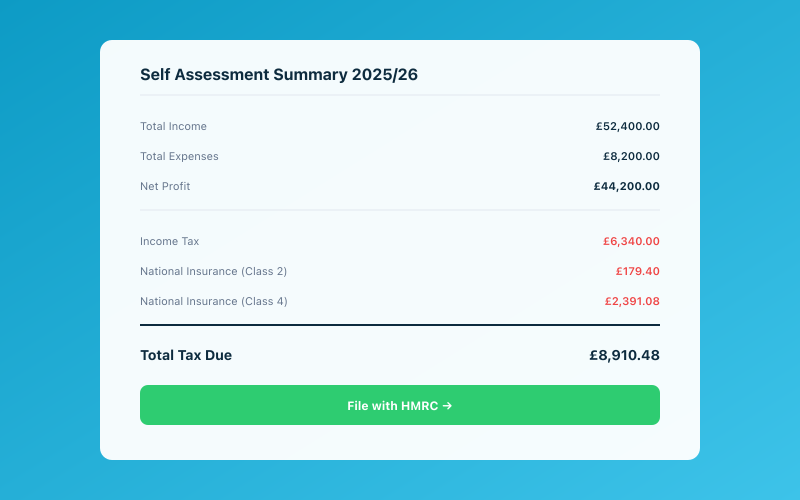 Your Accounted dashboard shows your real-time tax position
This isn't aggressive tax avoidance — it's structuring your affairs sensibly within the rules HMRC has created. The tax system treats employment income and dividend income differently, and there's nothing wrong with paying attention to that.
How Salary Is Taxed
When your company pays you a salary, three things happen:
Income Tax
Your salary is subject to Income Tax through PAYE at the standard rates:
- 0% on the first £12,570 (Personal Allowance)
- 20% on £12,571 to £50,270
- 40% on £50,271 to £125,140
- 45% above £125,140
Employee National Insurance
You pay Class 1 employee NICs on your salary:
- 8% on earnings between £12,570 and £50,270
- 2% above £50,270
Employer National Insurance
Your company pays employer NICs:
- 13.8% on earnings above £5,000 (the secondary threshold)
- The Employment Allowance (£10,500 for 2025/26) can offset this, but only if you have other employees or your company's employer NICs bill exceeds £100,000
The employer NICs are a real cost to the company. They're tax-deductible (they reduce your Corporation Tax bill), but they're still money leaving the business.
How Dividends Are Taxed
Dividends are paid from company profits after Corporation Tax. The tax treatment is:
Dividend Allowance
The first £500 of dividends in the tax year is tax-free.
Dividend Tax Rates
- 8.75% at the basic rate (income up to £50,270)
- 33.75% at the higher rate (£50,271 to £125,140)
- 39.35% at the additional rate (above £125,140)
No National Insurance
Crucially, dividends do not attract any National Insurance — neither employee nor employer. This is the primary reason dividends are more tax-efficient than salary for most directors.
Corporation Tax First
Before you can pay a dividend, the company must have sufficient retained profits. Those profits have already been subject to Corporation Tax at 19-25%. So the effective tax rate on dividends includes Corporation Tax plus personal dividend tax — but even with both layers, it's typically less than salary plus National Insurance.
The Optimal Salary: £12,570
For most single-director limited companies in 2025/26, the optimal salary is £12,570 — equal to the Personal Allowance.
Here's why:
- No Income Tax is due on salary up to £12,570 (covered by the Personal Allowance)
- No employee NICs are due (the primary threshold is also £12,570)
- Employer NICs of 13.8% apply on the salary above £5,000 — that's 13.8% of £7,570 = £1,045
- But the salary is a Corporation Tax deductible expense, saving the company 19-25% of £12,570 = up to £3,143
The Corporation Tax saving on the salary more than offsets the employer NICs cost. You've extracted £12,570 from the company at a net cost to the business of negative — it actually saves total tax compared to not paying a salary at all.
When to Go Lower
If your company doesn't qualify for the Employment Allowance (typically because you're the sole employee-director with no other staff), some advisers suggest a salary at the secondary threshold of £5,000 to avoid employer NICs entirely. This saves £1,045 in employer NICs but costs you up to £1,893 in lost Corporation Tax relief on the foregone salary. In most cases, £12,570 still wins.
When to Go Higher
Paying a higher salary makes sense if:
- You want to maximise your State Pension entitlement (you need qualifying years of NICs)
- You're building a mortgage application (some lenders weigh salary more heavily than dividends)
- You have employment allowance available to offset employer NICs
But purely on tax efficiency, £12,570 is the sweet spot for most directors.
Taking the Rest as Dividends
After paying yourself a salary of £12,570, take additional income as dividends. The company has already paid Corporation Tax on the profits, and dividends don't attract National Insurance — making them significantly cheaper than additional salary.
A Full Worked Example
Let's compare three scenarios for a director whose company has £80,000 in profits before any director remuneration.
Scenario A: All Salary (£60,000)
| Item | Amount | |------|--------| | Gross salary | £60,000 | | Employer NICs (13.8% above £5,000) | £7,590 | | Total company cost | £67,590 | | Corporation Tax saving (19% of £67,590) | -£12,842 | | Net company cost | £54,748 | | Employee Income Tax | £9,432 | | Employee NICs | £3,834 | | Director takes home | £46,734 |
Scenario B: All Dividends (No Salary)
| Item | Amount | |------|--------| | Corporation Tax on £80,000 (19%) | £15,200 | | Available for dividends | £64,800 | | Dividend paid | £64,800 | | Dividend tax (£500 at 0%, £37,200 at 8.75%, £27,100 at 33.75%) | £12,396 | | Director takes home | £52,404 |
Scenario C: Optimal Mix — £12,570 Salary + Dividends
| Item | Amount | |------|--------| | Salary | £12,570 | | Employer NICs | £1,045 | | Total salary cost | £13,615 | | Taxable profits after salary | £66,385 | | Corporation Tax (19%) | £12,613 | | Available for dividends | £53,772 | | Dividend tax (£500 at 0%, £37,200 at 8.75%, £16,072 at 33.75%) | £8,679 | | Income Tax on salary | £0 | | Employee NICs on salary | £0 | | Director takes home | £57,663 |
The Difference
- Scenario C vs A: £10,929 more take-home pay
- Scenario C vs B: £5,259 more take-home pay
That's nearly £11,000 per year saved by using the optimal salary-plus-dividends structure instead of all salary, and over £5,000 saved compared to dividends only.
Marginal Relief Considerations
If your company's profits fall in the marginal relief band (£50,000 to £250,000), paying yourself a salary reduces the profits subject to Corporation Tax. Since the marginal rate within the band is effectively 26.5%, the Corporation Tax saving from a salary deduction is even more valuable in this range.
Practical Considerations
Dividend Documentation
Every dividend must be properly declared. You need:
- A board meeting minute (even if you're the sole director) recording the dividend declaration
- A dividend voucher for each payment
- Sufficient retained profits to cover the dividend (paying dividends from reserves that don't exist is illegal)
Timing
You can pay interim dividends throughout the year — you don't have to wait until the year-end. Quarterly dividends are common and help manage your personal cash flow and DLA position.
Pension Contributions
Employer pension contributions are another tax-efficient extraction method. They're Corporation Tax deductible, don't attract National Insurance, and aren't taxed as personal income (until you draw the pension). If you have available annual allowance (£60,000 for 2025/26), this is worth building into your remuneration planning.
The £100,000 Income Trap
Be careful if your total income (salary plus dividends plus other income) approaches £100,000. Between £100,000 and £125,140, you lose your Personal Allowance at a rate of £1 for every £2 of income, creating an effective marginal tax rate of around 60%. It may be worth keeping income just below £100,000 and directing excess profits to pension contributions instead.
Get Started with Accounted
Accounted's Corporation Tax tools help you model the optimal salary and dividend combination for your specific circumstances. See your take-home pay in real time as you adjust the mix, and ensure every dividend is properly documented. Start your free trial today — no credit card required.
Related Reading
Penny, your AI bookkeeper, tracks your tax position in real time and flags opportunities to reduce your bill. Meet Penny →
Tax & Compliance Specialists
Our tax specialists have decades of combined experience in UK sole trader and small business taxation, MTD compliance, and HMRC submissions. All content is reviewed against current HMRC guidance before publication and updated quarterly to reflect legislative changes.
Ready to try Accounted?
Join UK sole traders who are simplifying their bookkeeping and tax.
Start your 14-day free trial