Employing Family Members: Tax Benefits and HMRC Rules
Employing family members in your business is one of the most straightforward and legitimate tax planning strategies available to sole traders and company directors in the UK. Done correctly, it can make full use of personal allowances, reduce your overall tax bill, and build pension entitlements for your family. Done badly, it can attract HMRC scrutiny and potentially result in the expenses being disallowed. This guide explains the rules, the benefits, and the pitfalls to avoid.
Why Employ Family Members?
The fundamental tax benefit of employing a family member is income splitting. If you are a higher or additional rate taxpayer and your spouse or partner has little or no income, paying them a genuine salary for genuine work shifts income from a higher tax band to a lower one. The salary is a deductible business expense for you, reducing your taxable profits, while your family member can use their own personal allowance and basic rate band.
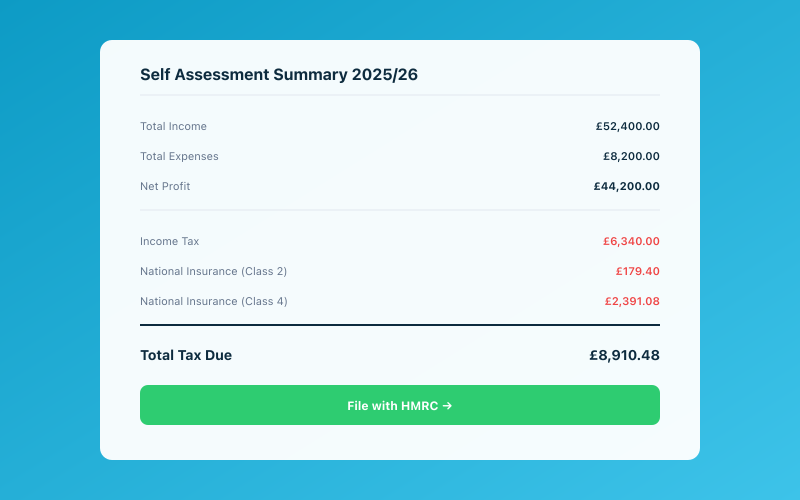 Your Accounted dashboard shows your real-time tax position
For the 2025/26 tax year, the personal allowance is £12,570, meaning the first £12,570 of earnings is tax-free. If your spouse has no other income and you pay them a salary up to this amount, no income tax is due on the payment, and you receive a tax deduction for the expense.
Paying Your Spouse or Partner
The Work Must Be Genuine
HMRC's primary requirement is that the work must be genuine, and the salary must be reasonable for the work performed. You cannot simply put your spouse on the payroll and pay them for doing nothing. The work must actually be carried out, and the rate of pay must be commensurate with what you would pay an unrelated employee for the same role.
Common roles that spouses genuinely fulfil include bookkeeping and administration, answering phones and managing correspondence, managing social media and marketing, stock management and ordering, and property management for landlords.
How Much to Pay
The optimal salary depends on your family member's other income and the National Insurance thresholds. For 2025/26, the key thresholds to consider are as follows.
The personal allowance is £12,570, below which no income tax is payable. The Primary Threshold for employee National Insurance contributions is £12,570 per year. The Secondary Threshold for employer National Insurance contributions is £5,000 per year (following the reduction in the Autumn Budget 2024).
If you pay a salary above £5,000 but below £12,570, no income tax or employee NI is due, but you will owe employer NI at 15% on the amount above £5,000. If you pay exactly at or below £5,000, neither employer nor employee NI is triggered.
However, paying at least at the Lower Earnings Limit (£6,500 for 2025/26) is important if your family member wants to protect their State Pension entitlement. Earnings between the LEL and the Primary Threshold count as qualifying years for State Pension purposes without actually triggering NI contributions.
Record-Keeping
Treat the employment exactly as you would any other employee. Set up a proper employment contract, run payroll through Real Time Information (RTI), issue payslips, and keep timesheets or records of work done. If HMRC ever queries the arrangement, you will need evidence that the role is genuine and the pay is reasonable.
Employing Your Children
Employing children in the family business is permissible but comes with additional restrictions.
Age Restrictions
There is no minimum age at which a child can be employed in the family business, but local authority bylaws and child employment legislation apply. In practice, children under 13 cannot be employed in most circumstances (with some exceptions for performance, modelling, and similar). Children aged 13 to 16 can work limited hours, typically no more than 12 hours per week during term time and 25 hours during school holidays. They cannot work during school hours, before 7am, or after 7pm.
National Minimum Wage
If your child is of school-leaving age or above, National Minimum Wage (NMW) rules apply. For 2025/26, the NMW rates are £7.55 per hour for workers aged 16-17, £10.00 per hour for 18-20-year-olds, and £12.21 per hour for those 21 and over (the National Living Wage).
However, there is an important exemption: NMW does not apply to family members who live in the employer's household and participate in the family's activities. This means that if your child lives at home and works in the family business, you are not strictly required to pay NMW, though the salary still must be reasonable for the work performed.
Tax Treatment
Children have their own personal allowance of £12,570. If they have no other income, you can pay them up to this amount tax-free. The salary is deductible against your business profits, providing the same tax benefit as employing a spouse.
Be mindful that if your child is a student, their earnings may affect eligibility for certain student finance or means-tested benefits.
Pension Contributions for Family Employees
One of the most powerful planning opportunities is making pension contributions for employed family members. As an employer, you can make pension contributions that are tax-deductible for the business, provided the total remuneration package (salary plus pension) is reasonable for the work done.
Even if a family member earns a low salary, they can receive employer pension contributions up to £60,000 per year (the annual allowance for 2025/26) without triggering a tax charge, as long as the total remuneration is commercially justifiable.
For a non-earning spouse, basic rate tax relief on personal pension contributions is available on contributions up to £3,600 gross per year, even if they have no earnings. This means they can contribute £2,880 and the pension provider claims £720 in tax relief, giving £3,600 in the pension pot.
Auto-Enrolment
If your family employee earns above £10,000 per year, you will need to comply with auto-enrolment duties. This requires you to enrol them into a qualifying workplace pension scheme and make minimum employer contributions. While this is an additional cost and administrative requirement, it also provides a tax-efficient way to build their retirement savings.
Sole Traders vs Limited Companies
Sole Traders
A sole trader can employ their spouse and children directly. The salary is deducted from business profits on the Self Assessment tax return. No special considerations apply beyond the general rules about genuine work and reasonable pay.
Limited Companies
A company director can employ family members through the company. The salary is a deductible expense for Corporation Tax purposes. The company must operate PAYE and comply with all employment obligations.
One additional consideration for limited companies is that paying a salary to a family member reduces the profits available for dividends. This is not necessarily a disadvantage, as the salary may be taxed more favourably overall, but it should be factored into the planning.
Partnerships
In a partnership, a partner's spouse can be employed by the partnership. Alternatively, if the spouse is made a partner, profits can be shared according to the partnership agreement. HMRC may challenge a partnership arrangement if the spouse has no genuine involvement in the business and the profit share is not commercially justified.
What HMRC Looks For
HMRC is well aware that employing family members is a common tax planning strategy, and in most cases they accept it as perfectly legitimate. However, they will look closely at arrangements that appear artificial. Red flags include salaries that are disproportionately high for the work done, no evidence of work actually being performed, no employment contracts or payroll records, and payments that coincidentally equal the personal allowance each year without regard to actual hours worked.
The best defence is thorough record-keeping. Document the role, maintain timesheets, keep the employment contract up to date, and ensure the pay rate is defensible by reference to what you would pay someone else for the same work.
Common Mistakes to Avoid
One frequent mistake is paying a family member more than a reasonable salary for the work they do. If you would pay a stranger £8,000 for the same role, paying your spouse £12,570 simply to use their full personal allowance will not withstand HMRC scrutiny.
Another mistake is failing to actually run payroll. Even if the salary is below the tax and NI thresholds, you should register as an employer and operate PAYE. This creates a proper paper trail and ensures the family member has a record of employment for State Pension and other purposes.
Finally, do not overlook the impact on tax credits, Universal Credit, or student loan repayments. Additional income for a family member may reduce entitlement to means-tested benefits.
Let Accounted and Penny Help
Employing family members means running payroll properly, tracking hours, and keeping your records HMRC-ready. Accounted makes this straightforward by helping you manage payroll expenses and keep clean records that stand up to scrutiny. Penny, your AI bookkeeper, automatically categorises salary payments and flags any payroll deadlines so you never miss a submission. Start your free trial today and get the peace of mind that comes with knowing your family employment arrangements are properly documented.
Related Reading
Start your free trial and let Penny handle your bookkeeping automatically.
Penny, your AI bookkeeper, tracks your tax position in real time and flags opportunities to reduce your bill. Meet Penny →
Tax & Compliance Specialists
Our tax specialists have decades of combined experience in UK sole trader and small business taxation, MTD compliance, and HMRC submissions. All content is reviewed against current HMRC guidance before publication and updated quarterly to reflect legislative changes.
Ready to try Accounted?
Join UK sole traders who are simplifying their bookkeeping and tax.
Start your 14-day free trial