Gift Aid for Higher Rate Taxpayers: Claim Extra Relief
Gift Aid is one of the most well-known tax reliefs in the UK, but many higher rate taxpayers do not realise they are entitled to claim additional relief beyond what the charity receives. If you pay tax at 40% or 45%, you are leaving money on the table if you do not claim this relief on your Self Assessment return.
This guide explains exactly how Gift Aid works for higher and additional rate taxpayers, with worked examples at both 40% and 45%, plus the common mistakes to avoid.
How Gift Aid Works: The Basics
When you make a donation to a UK-registered charity and tick the Gift Aid box, the charity can reclaim basic rate tax from HMRC. This is worth 25p for every £1 you donate.
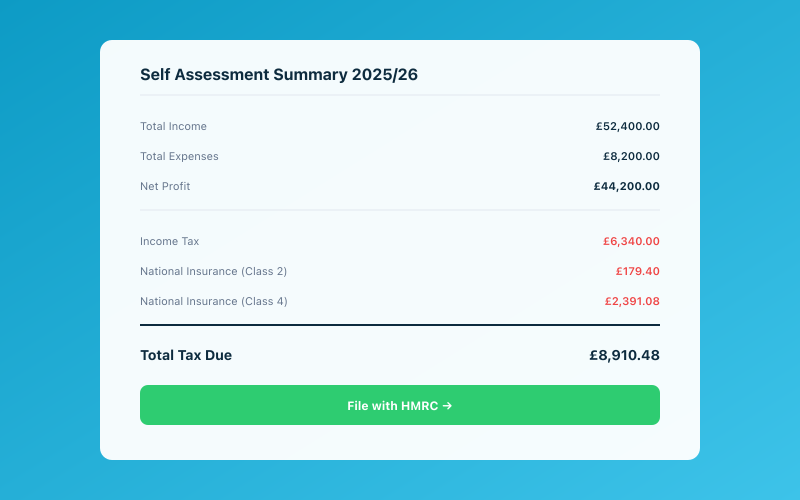 Your Accounted dashboard shows your real-time tax position
This happens because your donation is treated as having been made after basic rate tax (20%) has been deducted. The charity claims back the tax that was "already paid" on your donation.
So if you donate £100, the charity reclaims £25 from HMRC, making your donation worth £125 to the charity. That £125 figure is the gross donation — the amount before basic rate tax was deducted.
The maths works like this:
- You donate £100 (the net amount)
- Gross donation = £100 / 0.80 = £125
- Basic rate tax reclaimed by charity = £125 x 20% = £25
- Total received by charity = £100 + £25 = £125
This basic rate relief applies to all taxpayers who have paid enough UK tax to cover it. But for higher and additional rate taxpayers, there is more relief to claim.
Extra Relief for Higher Rate Taxpayers (40%)
If your income exceeds £50,270 in the 2025/26 tax year, you pay tax at 40% on income above that threshold. When you make Gift Aid donations, you can claim the difference between the higher rate (40%) and the basic rate (20%) through your Self Assessment return.
How the Relief Works
The gross donation amount extends your basic rate band. This means income that would have been taxed at 40% is instead taxed at 20%, giving you relief at the difference of 20%.
Worked Example: 40% Taxpayer
Sarah is a self-employed consultant with taxable income of £70,000 in 2025/26. She donates £1,000 to charity with Gift Aid during the tax year.
Step 1: Charity reclaims basic rate tax
- Net donation: £1,000
- Gross donation: £1,000 / 0.80 = £1,250
- Charity reclaims from HMRC: £1,250 x 20% = £250
- Charity receives total: £1,250
Step 2: Sarah's basic rate band is extended
- Normal basic rate band: £12,571 to £50,270 (£37,700)
- Extended basic rate band: £12,571 to £51,520 (£37,700 + £1,250 = £38,950)
- This means £1,250 of Sarah's income that would have been taxed at 40% is now taxed at 20%
Step 3: Sarah's tax saving
- Tax saving: £1,250 x (40% - 20%) = £1,250 x 20% = £250
Summary for Sarah:
| Item | Amount | |------|--------| | Sarah pays | £1,000 | | Charity receives (with Gift Aid) | £1,250 | | HMRC pays to charity | £250 | | Sarah claims back via Self Assessment | £250 | | Actual cost to Sarah | £750 |
The charity gets £1,250, and it costs Sarah only £750 after claiming her higher rate relief.
Extra Relief for Additional Rate Taxpayers (45%)
If your income exceeds £125,140 in 2025/26, you pay tax at 45% on income above that threshold. The relief for additional rate taxpayers is even more generous.
Worked Example: 45% Taxpayer
James is a self-employed IT contractor with taxable income of £160,000 in 2025/26. He donates £2,000 to charity with Gift Aid during the tax year.
Step 1: Charity reclaims basic rate tax
- Net donation: £2,000
- Gross donation: £2,000 / 0.80 = £2,500
- Charity reclaims from HMRC: £2,500 x 20% = £500
- Charity receives total: £2,500
Step 2: James claims relief through Self Assessment
- James's income above £125,140 is taxed at 45%
- The gross donation of £2,500 extends his basic rate band
- But since his income is well above the additional rate threshold, the relief is calculated on the difference between 45% and 20%
Step 3: James's tax saving
- Tax saving: £2,500 x (45% - 20%) = £2,500 x 25% = £625
Summary for James:
| Item | Amount | |------|--------| | James pays | £2,000 | | Charity receives (with Gift Aid) | £2,500 | | HMRC pays to charity | £500 | | James claims back via Self Assessment | £625 | | Actual cost to James | £1,375 |
The charity receives £2,500, and it costs James just £1,375.
A Note on Mixed Rate Taxpayers
If your income spans multiple tax bands, the relief you receive depends on which band the gross donation falls into. If £1,000 of the gross donation falls within the higher rate band and £1,500 within the additional rate band, your relief is calculated proportionally across both rates.
How to Claim on Your Self Assessment Return
Claiming higher and additional rate Gift Aid relief is done through your Self Assessment tax return. On the SA100, you will find a section specifically for charitable giving.
What to Enter
Enter the total amount you actually donated (the net amount, not the gross) during the tax year. HMRC's system grosses up the amount and calculates the additional relief automatically.
For the 2025/26 tax year, enter donations made between 6 April 2025 and 5 April 2026.
Carrying Back Donations
You can also elect to carry back donations. If you make a Gift Aid donation between 6 April 2026 and 31 January 2027 (the filing deadline for 2025/26), you can elect to treat it as if it was made in 2025/26. This is useful if:
- You had higher income in the previous tax year
- You want the tax relief sooner
- It helps manage your personal allowance (see below)
The election is made on your tax return by entering the amount in the "Gift Aid payments carried back" box.
Gift Aid and the Personal Allowance
For taxpayers with income between £100,000 and £125,140, Gift Aid donations can help preserve your personal allowance. The personal allowance (£12,570 in 2025/26) is reduced by £1 for every £2 of income above £100,000, disappearing entirely at £125,140.
Because Gift Aid extends your basic rate band, it effectively reduces your adjusted net income for personal allowance purposes. This creates a marginal tax benefit that can be as high as 60% in this income range.
Example
If your income is £105,000, you have lost £2,500 of your personal allowance. Making gross Gift Aid donations of £5,000 would restore your full personal allowance, saving you an additional £1,000 in tax (£2,500 x 40%) on top of the standard higher rate relief.
Common Mistakes to Avoid
Not Claiming at All
The most common mistake is simply not claiming. The charity receives its 25% top-up automatically, but your additional relief only comes if you claim it through Self Assessment. HMRC does not apply it for you.
Insufficient Tax Paid
If you declare Gift Aid but have not paid enough UK income tax or Capital Gains Tax to cover the basic rate tax reclaimed by the charity, you will have to repay the shortfall. This is a particular risk for:
- People with low income years
- People who receive most of their income as dividends (which are taxed at different rates)
- Retired individuals with income below the personal allowance
Always check that your total UK income tax and CGT liability for the year exceeds the basic rate tax that charities will reclaim on your donations.
Forgetting to Keep Records
Keep a record of every Gift Aid donation: the charity name, the date, the amount, and confirmation that you made a Gift Aid declaration. HMRC can enquire into your claim, and you need evidence to support it.
Donations to Non-Qualifying Bodies
Gift Aid only applies to donations to UK-registered charities, Community Amateur Sports Clubs (CASCs), and certain EU/EEA charities. Donations to individuals, crowdfunding campaigns, or organisations without charity registration do not qualify.
Let Accounted Track Your Donations
Keeping track of charitable donations throughout the year means you never miss a claim at tax return time. Accounted records all your Gift Aid payments, and Penny, your AI bookkeeper, ensures they are correctly categorised and included in your Self Assessment calculations — so you always claim the full relief you are entitled to. Start your free trial and make sure every donation is working as hard as it can.
Related Reading
Start your free trial and let Penny handle your bookkeeping automatically.
Penny, your AI bookkeeper, tracks your tax position in real time and flags opportunities to reduce your bill. Meet Penny →
Tax & Compliance Specialists
Our tax specialists have decades of combined experience in UK sole trader and small business taxation, MTD compliance, and HMRC submissions. All content is reviewed against current HMRC guidance before publication and updated quarterly to reflect legislative changes.
Ready to try Accounted?
Join UK sole traders who are simplifying their bookkeeping and tax.
Start your 14-day free trial