Loss Relief for Sole Traders: How to Use Business Losses to Reduce Tax
Making Your Losses Work for You
Nobody goes into business planning to make a loss. But losses happen — a slow start, a major investment year, an unexpected downturn, or simply the cost of getting a new venture off the ground. When they do, the UK tax system offers several ways to use those losses to reduce your tax bill, either now or in the future.
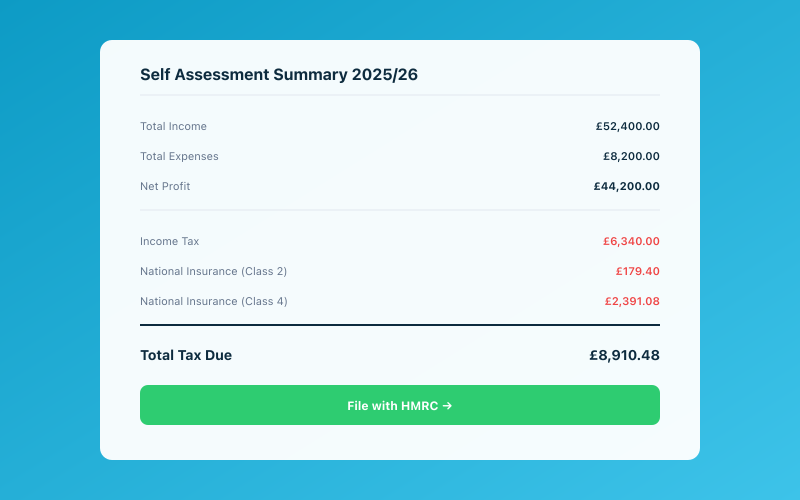 Your Accounted dashboard shows your real-time tax position
This guide explains the loss relief options available to sole traders and partners in the 2025/26 tax year, with practical examples of how each one works.
How Business Losses Arise
A business loss occurs when your allowable expenses exceed your income for the accounting period. For example, if you earn £20,000 from your freelance work but have £25,000 in legitimate expenses, you have a trading loss of £5,000.
Losses can also arise through capital allowances. If you buy a large piece of equipment and claim the full cost through the Annual Investment Allowance (AIA), the resulting deduction might push your profits into a loss for that year.
Under the cash basis, you can still make a loss, but the ways you can use it are more limited. Under the accrual basis, all loss relief options are available. This is one reason some sole traders choose the accrual basis even though the cash basis is simpler.
Option 1: Carry Forward Against Future Profits
This is the simplest and most common form of loss relief. If you make a loss in one year, you can carry it forward and set it against your trading profits from the same business in future years.
How it works
- The loss is carried forward indefinitely — there is no time limit.
- It must be set against the first available profits from the same trade.
- You cannot choose to use only part of the loss — it is set against profits in full, up to the amount of those profits.
Example
Tom is a self-employed web developer. In 2024/25, he makes a loss of £8,000 after buying new equipment. In 2025/26, he makes a profit of £30,000. His carried-forward loss of £8,000 reduces his taxable profit to £22,000.
Cash basis restriction
Under the cash basis, carry forward is the only loss relief option available (with one exception for terminal losses). You cannot use sideways relief, carry back, or early years relief under the cash basis.
Option 2: Sideways Relief (Set Against Other Income)
Sideways relief allows you to set your trading loss against your other income in the same tax year. "Other income" includes employment income, rental income, savings interest, dividend income, and pension income.
How it works
- You can claim sideways relief in the year the loss arises, the previous year, or both.
- If you claim for both years, you choose which year to apply first.
- The loss must be set against general income before capital gains.
- You must use the accrual basis — sideways relief is not available under the cash basis.
Example
Lisa works part-time as an employee earning £25,000 and runs a small pottery business on the side. In 2025/26, her pottery business makes a loss of £6,000. She can set this £6,000 loss against her employment income, reducing her taxable income from £25,000 to £19,000 and generating a tax refund.
The cap on sideways relief
Since 2013/14, there has been a cap on the amount of sideways relief you can claim. The cap is the greater of £50,000 or 25% of your adjusted total income. For most sole traders, this cap will not be an issue, but if you have a very large loss and very high other income, it could restrict your claim.
Anti-avoidance rules
HMRC has specific rules to prevent people from using loss relief to shelter other income artificially. Sideways relief is not available if your trade is not run on a commercial basis with a reasonable expectation of profit. Hobby businesses or arrangements designed primarily to create tax losses will be challenged.
Option 3: Carry Back Against Previous Year's Profits
You can carry a trading loss back to the previous tax year and set it against your general income from that year. This generates a tax refund for the previous year.
How it works
- The loss is set against your total income for the previous tax year.
- You must use the accrual basis.
- The claim must be made by the first anniversary of the 31 January filing deadline for the loss year. For a 2025/26 loss, the claim deadline is 31 January 2028.
Example
James is a self-employed electrician. In 2024/25, he earned £40,000 and paid tax accordingly. In 2025/26, he invested heavily in a new van and tools and made a loss of £10,000. He carries the £10,000 loss back to 2024/25, reducing his taxable income for that year from £40,000 to £30,000 and receiving a tax refund.
When to use carry back
Carry back is particularly useful when your income was higher in the previous year than it is likely to be in future years. By carrying the loss back, you get relief at your highest marginal tax rate.
Option 4: Early Years Relief (Opening Year Losses)
If you make a loss in any of the first four tax years of a new trade, you can carry the loss back against your general income from the three tax years before the loss year, starting with the earliest year first.
How it works
- Available in the first four tax years of trading (not just the first year).
- The loss is carried back to the three preceding tax years, earliest first.
- You must use the accrual basis.
- This is particularly valuable if you had employment income before starting your business.
Example
Rachel leaves her job as a marketing manager (salary £55,000) in April 2025 and starts a freelance marketing consultancy. In her first year (2025/26), she makes a loss of £12,000 while building her client base.
She can carry this loss back three years:
- First against 2022/23 income
- Then 2023/24
- Then 2024/25
Since she was earning £55,000 as an employee in those years, the full £12,000 loss is relieved against her employment income, generating a tax refund at 40% (to the extent her income was in the higher rate band). That could mean a refund of up to £4,800 — a significant cash boost when starting a new business.
Option 5: Terminal Loss Relief
If you cease trading and make a loss in your final 12 months, you can carry that loss back against your trading profits from the same trade in the three tax years before the year of cessation, starting with the most recent year first.
How it works
- Only available when you permanently stop trading.
- The loss is the trading loss of the final 12 months.
- It is set against trading profits (not general income) of the three preceding years, latest first.
- Available under both the cash basis and the accrual basis.
Example
David runs a small printing business. He decides to close in December 2025, making a loss of £15,000 in his final 12 months. He can carry this back against his printing business profits from 2024/25, 2023/24, and 2022/23 (latest year first), receiving tax refunds for those years.
Interaction With the Personal Allowance
Be careful when using loss relief not to waste your personal allowance (£12,570 for 2025/26). If you set a large loss against other income and reduce your total income below £12,570, the personal allowance cannot be carried forward — it is simply lost for that year.
It may be better to carry forward part of the loss rather than claiming full sideways relief, depending on your circumstances.
Interaction With Other Income
Employment income
Sideways relief and carry back work well if you have employment income alongside your self-employment. The loss reduces your total income, potentially generating a PAYE refund.
Rental income
Trading losses can be set against rental income using sideways relief. However, rental losses can only be carried forward against future rental income from the same property business — they cannot be used sideways against trading income.
Capital gains
If, after setting your loss against income, you still have unused loss, you can set the remainder against capital gains for the same year (or the previous year, if you are carrying back). This is only available if you have first set the loss against income.
Practical Steps to Claim
- Calculate your loss accurately. Ensure all income and allowable expenses are correctly recorded.
- Choose your relief method. Consider which option gives you the best tax outcome, taking into account your marginal tax rate in each relevant year.
- Make the claim on your tax return. For carry forward, include the loss on your Self Assessment. For sideways relief and carry back, complete the relevant boxes on the SA103 and any supplementary pages.
- Keep records. HMRC can enquire into loss claims, so keep full records of how the loss arose.
How Accounted Tracks Your Losses
Keeping track of losses, carry-forward amounts, and relief claims across multiple years is exactly the kind of thing that gets lost in spreadsheets. Accounted tracks your trading profits and losses automatically, and Penny, the AI bookkeeper, flags when you have a loss that could be used to reduce your tax bill. No more forgotten carry-forwards, no more missed relief claims.
Start Your Free Trial With Accounted
Business losses are never fun, but claiming the right relief can make a real difference to your cash flow. Accounted ensures your losses are tracked and your relief is claimed. Start your free trial today and let Penny help you make the most of a difficult year.
Related Reading
-
How Much Tax Will I Pay as a Sole Trader? Calculator and Examples
-
Buy-to-Let in a Company vs Personal Name: Which Saves More Tax?
Start your free trial and let Penny handle your bookkeeping automatically.
Penny, your AI bookkeeper, tracks your tax position in real time and flags opportunities to reduce your bill. Meet Penny →
Tax & Compliance Specialists
Our tax specialists have decades of combined experience in UK sole trader and small business taxation, MTD compliance, and HMRC submissions. All content is reviewed against current HMRC guidance before publication and updated quarterly to reflect legislative changes.
Ready to try Accounted?
Join UK sole traders who are simplifying their bookkeeping and tax.
Start your 14-day free trial