Mixed-Use Property Tax: When Your Home is Also Your Business
Millions of self-employed people in the UK work from home, and many use part of their property exclusively for business. While this brings convenience and potential tax savings through expense claims, it also creates tax implications that are often misunderstood — particularly around Capital Gains Tax when you eventually sell your home.
This guide explains how mixed business and residential use of a property affects your tax position, covering CGT principal private residence relief, claimable expenses, council tax, and planning permission considerations.
Principal Private Residence Relief and Business Use
When you sell your home, you normally benefit from Principal Private Residence Relief (PPR), which exempts the entire gain from Capital Gains Tax. This is one of the most valuable tax reliefs available, and for most homeowners it means no CGT at all when they sell.
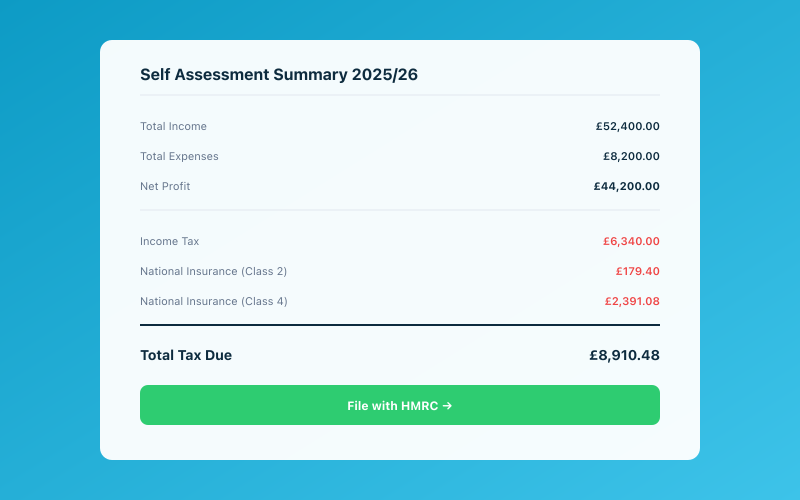 Your Accounted dashboard shows your real-time tax position
However, if part of your home is used exclusively for business, HMRC can restrict your PPR relief to exclude the business portion of the property.
The Key Word: Exclusively
The risk to your PPR relief arises when a room or area is used exclusively for business — meaning it is never used for any domestic or personal purpose.
If you have a spare bedroom that you use as an office during the day but that doubles as a guest bedroom, a playroom, or is occasionally used for personal purposes, the room is not exclusively business use. In this case, your full PPR relief is preserved.
If, on the other hand, you convert a room into a dedicated office that is never used for anything other than business — with a separate entrance, a lock, or clear physical separation from the living space — HMRC could argue that this room is exclusively business use and restrict your PPR relief.
How the Restriction Works
If HMRC determines that part of your home was used exclusively for business, the CGT exemption is restricted proportionally.
For example, if your home has six rooms and one is used exclusively for business, five-sixths of any capital gain on sale would be exempt under PPR, and one-sixth would be subject to CGT.
A Practical Example
You bought your home for £250,000 and sold it for £450,000, making a gain of £200,000.
If one-sixth of the property was exclusively business use:
- Exempt gain (PPR): £200,000 x 5/6 = £166,667
- Taxable gain: £200,000 x 1/6 = £33,333
- Less Annual Exempt Amount (£3,000 in 2025/26): £30,333
- CGT at 24% (residential property, higher rate): £7,280
That is a significant tax bill that would not have arisen if the room had been used for mixed purposes.
How to Protect Your PPR Relief
The simplest way to preserve your full PPR relief is to ensure that no room is used exclusively for business. Practical steps include:
- Keep personal items in your home office (a bookshelf with personal books, a sofa, a TV)
- Use the room for personal activities outside working hours
- Do not install a separate entrance or physically partition the room
- Avoid describing any room as "exclusively business" on any correspondence or documentation
Claiming Home Office Expenses
Even though exclusive business use can jeopardise PPR relief, you can still claim a proportion of your household expenses as a business deduction without triggering CGT problems.
The Flat Rate Method (Simplified Expenses)
HMRC offers a simplified method for claiming home office costs, based on the number of hours you work from home each month:
| Hours worked from home per month | Monthly flat rate | |---|---| | 25 to 50 hours | £10 | | 51 to 100 hours | £18 | | 101 or more hours | £26 |
This method requires no detailed calculations or apportionment. You simply record your hours and apply the rate. The flat rate covers the additional costs of working from home (heating, lighting, electricity, broadband). It does not affect your PPR relief.
The Actual Cost Method
If your actual costs are higher than the flat rates, you can calculate the business proportion of your household expenses and claim that instead.
Allowable household expenses include:
- Heating and electricity (or gas)
- Water rates (if metered)
- Council tax
- Mortgage interest (the business proportion) or rent (the business proportion)
- Home insurance
- Broadband and phone line
- Repairs and maintenance (general property maintenance, not improvements)
- Cleaning (the business proportion)
Calculating the Business Proportion
The most common method is to apportion by room count and time:
- Count the number of rooms in your home (excluding bathrooms and kitchens)
- Determine how many rooms are used for business
- Consider what proportion of time the room is used for business
For example, if you have five rooms, use one for business, and work from home five days a week (roughly 71% of the time):
Business proportion = (1/5) x 71% = 14.2%
You can then claim 14.2% of qualifying household expenses.
Does Claiming Actual Costs Affect PPR Relief?
HMRC has stated that simply claiming a proportion of household expenses does not automatically mean the property is used exclusively for business. As long as the rooms have mixed use, you can claim expenses under the actual cost method without jeopardising your PPR relief.
The risk to PPR relief comes from exclusive use, not from claiming expenses. You can have a room that is 80% business use and still maintain PPR relief, provided the room is also used for personal purposes.
Mortgage Interest for Home Businesses
If you claim actual costs and include mortgage interest in your calculation, be aware that:
- Only the business proportion of mortgage interest is claimable
- For self-employed sole traders, this is deducted from trading profits (unlike residential landlords, who are subject to Section 24 restrictions)
- If you remortgage or increase your mortgage, only interest on the original amount (or the amount attributable to the property's purchase and improvement) is allowable
Claiming mortgage interest on a home office does not convert your private residence into a business premises for any other purpose.
Council Tax Implications
Residential Council Tax
If you work from home but the property remains primarily residential, your council tax position does not change. You continue to pay normal residential council tax.
Business Rates
If part of your property is used wholly for business (with no domestic use at all), the local authority could reclassify that part of the property for business rates instead of council tax. This is the same "exclusive use" test that affects PPR relief.
In practice, this rarely happens for people working from a spare bedroom or a room within the home. It is more likely to be relevant if you:
- Convert a garage, annexe, or outbuilding into a dedicated business space
- Have a separate entrance for clients or customers
- Carry on a trade that requires premises (such as a shop, salon, or workshop within your home)
If part of your property is reclassified for business rates, the remainder continues to attract council tax (potentially at a reduced band). You may qualify for small business rate relief on the business-rated portion, which provides 100% relief for properties with a rateable value below £12,000.
Planning Permission
Working from home does not normally require planning permission, provided:
- Your home remains primarily a residential property
- There is no significant increase in traffic, noise, or disturbance to neighbours
- There are no external modifications to the property
- The business use does not change the character of the property or the neighbourhood
If you carry on a business that involves regular customer visits, deliveries, signage, or changes to the building's external appearance, you may need planning permission. Check with your local planning authority if in doubt.
Permitted Development
Some home-based business activities fall within permitted development rights, meaning no formal planning application is needed. This includes most home offices, studios, and small-scale home-based businesses that do not affect the neighbourhood.
Let Accounted Calculate Your Home Office Claim
Working out the business proportion of your home expenses and keeping track of the figures year after year can be time-consuming. Accounted automates your home office expense calculations, and Penny, your AI bookkeeper, ensures your claims are optimised without risking your CGT position — tracking hours worked, applying the right method, and keeping everything neatly recorded for your Self Assessment return. Start your free trial and claim your home office expenses with confidence.
Related Reading
-
Section 24 Mortgage Interest Relief: How It Affects Your Tax in 2025/26
-
Buy-to-Let in a Company vs Personal Name: Which Saves More Tax?
Start your free trial and let Penny handle your bookkeeping automatically.
Penny, your AI bookkeeper, tracks your tax position in real time and flags opportunities to reduce your bill. Meet Penny →
Tax & Compliance Specialists
Our tax specialists have decades of combined experience in UK sole trader and small business taxation, MTD compliance, and HMRC submissions. All content is reviewed against current HMRC guidance before publication and updated quarterly to reflect legislative changes.
Ready to try Accounted?
Join UK sole traders who are simplifying their bookkeeping and tax.
Start your 14-day free trial