Section 24 Mortgage Interest Relief: How It Affects Your Tax in 2025/26
What Is Section 24?
Section 24 of the Finance (No. 2) Act 2015 changed how individual landlords claim tax relief on mortgage interest. Before this rule came in, you could deduct your full mortgage interest from your rental income before calculating tax. That meant if you earned £12,000 in rent and paid £5,000 in mortgage interest, you only paid tax on £7,000.
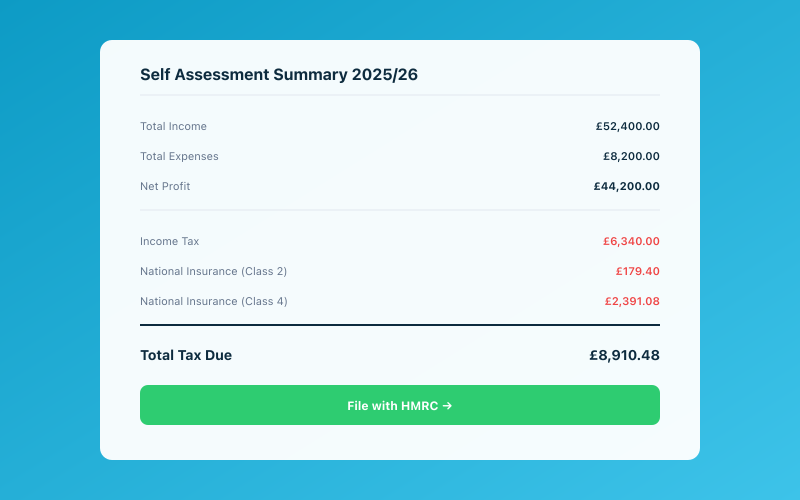 Your Accounted dashboard shows your real-time tax position
That old system is gone. Since April 2020, Section 24 has been fully in force. You can no longer deduct mortgage interest as an expense. Instead, you get a basic rate tax credit worth 20% of your mortgage interest payments.
This might sound like a small change in wording, but for many landlords it means paying hundreds or even thousands of pounds more in tax each year.
Who Does Section 24 Affect?
Section 24 applies to individual landlords who have a mortgage on a residential rental property. That includes:
- Sole owners of buy-to-let properties
- Joint owners (married couples, business partners)
- Landlords who operate as sole traders or in a partnership
It does not apply to:
- Properties held in a limited company
- Commercial property (shops, offices, warehouses)
- Furnished holiday lettings (though these rules are changing — see below)
If you own rental property in your personal name and have a mortgage on it, Section 24 affects you.
How the 20% Tax Credit Works
Under the old rules, mortgage interest was a deductible expense. Under Section 24, it becomes a tax reducer instead. Here is how it works step by step.
Step 1: Calculate Your Rental Profit Without Deducting Mortgage Interest
Add up all your rental income for the year. Deduct all your allowable expenses except mortgage interest. The result is your rental profit for tax purposes.
Step 2: Work Out Your Total Tax Bill
Your rental profit gets added to your other income (salary, pension, dividends, etc.) and taxed at whatever rate applies to you. If this pushes you into higher rate tax, you pay 40% on the portion above the threshold.
Step 3: Apply the 20% Tax Credit
You then get a tax credit worth 20% of your mortgage interest payments. This credit reduces your final tax bill.
Why This Matters for Higher Rate Taxpayers
If you are a basic rate taxpayer (20%), the effect is roughly the same as the old system. You were getting 20% relief before, and you still get 20% relief now.
But if you are a higher rate taxpayer (40%) or additional rate taxpayer (45%), you lose out. Under the old rules, you got relief at your marginal rate. Now you only get 20%, regardless of your tax bracket.
Worked Example: Basic Rate Taxpayer
Sarah earns £30,000 from her job and receives £10,000 in rental income. Her mortgage interest is £4,000 per year and her other allowable expenses total £2,000.
Rental profit: £10,000 - £2,000 = £8,000 (mortgage interest is not deducted here)
Total taxable income: £30,000 + £8,000 = £38,000
Tax on income: The first £12,570 is covered by her personal allowance. The remaining £25,430 is taxed at 20% = £5,086.
Tax credit: 20% of £4,000 mortgage interest = £800
Final tax bill: £5,086 - £800 = £4,286
For Sarah, the result is similar to what she would have paid under the old rules, because she is a basic rate taxpayer throughout.
Worked Example: Higher Rate Taxpayer
James earns £45,000 from his job and receives £15,000 in rental income. His mortgage interest is £8,000 per year and his other allowable expenses total £3,000.
Rental profit: £15,000 - £3,000 = £12,000
Total taxable income: £45,000 + £12,000 = £57,000
Under the old system, James would have declared only £4,000 of rental profit (£12,000 minus £8,000 mortgage interest), giving total income of £49,000. Now his taxable income is £57,000.
Tax on income: Personal allowance covers £12,570. Basic rate (20%) on £37,700 = £7,540. Higher rate (40%) on £6,730 (the portion from £50,270 to £57,000) = £2,692. Total = £10,232.
Tax credit: 20% of £8,000 = £1,600
Final tax bill: £10,232 - £1,600 = £8,632
Under the old system, with taxable income of £49,000, James would have paid less tax and would not have been pushed into higher rate territory at all. Section 24 has effectively created a higher tax bill by inflating his taxable income.
The Hidden Sting: Losing Your Personal Allowance
There is another nasty effect that catches some landlords off guard. Your personal allowance (£12,570 in 2025/26) starts to reduce once your adjusted net income exceeds £100,000. For every £2 over £100,000, you lose £1 of personal allowance.
Because Section 24 inflates your taxable income (you cannot deduct the mortgage interest), it can push you over the £100,000 threshold. This means you could lose part or all of your personal allowance, even though your actual cash profit from the property is much lower.
This creates an effective marginal tax rate of 60% in the £100,000 to £125,140 band. If your rental income and mortgage interest sit in this zone, the impact of Section 24 can be severe.
Strategies to Reduce the Section 24 Impact
Transfer to a Limited Company
Companies are not affected by Section 24. Corporation tax in 2025/26 is 25% for profits over £250,000 and 19% for profits under £50,000, with marginal relief in between. Many landlords with large portfolios have moved properties into a company structure.
However, transferring a property triggers capital gains tax and stamp duty land tax, so this only makes sense with careful planning. Your mortgage lender also needs to agree, and commercial mortgage rates for companies are often higher than personal buy-to-let rates.
Split Ownership Between Spouses
If one spouse is a basic rate taxpayer and the other is higher rate, transferring a share of the property to the lower earner can reduce the overall tax bill. Married couples and civil partners can transfer property between them without triggering capital gains tax.
By default, HMRC assumes married couples split rental income 50/50 regardless of ownership share. You can change this by filing a Form 17 declaration, but only if the ownership shares genuinely differ.
Reduce Your Mortgage
The less mortgage interest you pay, the less Section 24 affects you. Overpaying your mortgage or using savings to reduce the outstanding balance can lower your tax bill. This is a straightforward option if you have the cash available.
Increase Your Allowable Expenses
Make sure you are claiming every expense you are entitled to. Landlords often miss items like landlord insurance, letting agent fees, repairs and maintenance, accountancy fees, and travel costs to the property. Every pound of allowable expense reduces your taxable profit.
Consider Furnished Holiday Lettings
Furnished holiday lettings (FHLs) were previously exempt from Section 24 and offered several other tax advantages. However, the government announced the abolition of the FHL tax regime from April 2025 onwards. This means FHLs will now be treated the same as standard rental properties for income tax purposes, including being subject to Section 24 restrictions.
Keep Accurate Records
Section 24 makes your tax calculations more complex. You need to track mortgage interest separately from other expenses, and you need to understand how it interacts with your other income to know your true tax position.
Accounted makes this straightforward. When you enter your rental income and expenses, Penny — the AI bookkeeper — categorises your mortgage interest payments correctly and keeps them separate for your tax return. You can see the impact on your tax position throughout the year, rather than getting a surprise when your return is due.
What to Do Next
If you are a landlord with a mortgage, Section 24 is one of the most important tax rules affecting your bottom line. Understanding how it works is the first step to managing its impact.
Review your current position. Look at your total income, your rental profit, and your mortgage interest. Work out whether you are being pushed into a higher tax bracket or losing part of your personal allowance. Then consider whether any of the mitigation strategies above could work for your situation.
If you want a clear picture of how Section 24 affects your specific tax position, try Accounted free for 30 days. Connect your bank account, let Penny categorise your income and expenses, and see exactly where you stand — no accountancy jargon, no guesswork.
Related Reading
-
Buy-to-Let in a Company vs Personal Name: Which Saves More Tax?
-
Tax-Efficient Pension Withdrawal Strategies for Self-Employed
Start your free trial and let Penny handle your bookkeeping automatically.
Penny, your AI bookkeeper, tracks your tax position in real time and flags opportunities to reduce your bill. Meet Penny →
Tax & Compliance Specialists
Our tax specialists have decades of combined experience in UK sole trader and small business taxation, MTD compliance, and HMRC submissions. All content is reviewed against current HMRC guidance before publication and updated quarterly to reflect legislative changes.
Ready to try Accounted?
Join UK sole traders who are simplifying their bookkeeping and tax.
Start your 14-day free trial