Work-Life Balance When Your Office Is Your Living Room
There's a particular kind of guilt that only home-workers understand. You're watching telly at eight o'clock on a Tuesday evening, and your laptop is sitting on the dining table, and you can see the notification light blinking, and you know there's an email you should probably reply to, and suddenly the programme you're watching doesn't feel like relaxation — it feels like skiving.
When your office is your living room (or your bedroom, or your kitchen table), work and life don't just overlap. They merge. The physical space that's supposed to be your sanctuary becomes your workplace, and neither role gets done properly.
You can't fully relax at home because work is always there, humming in the background. And you can't fully focus on work because the laundry basket is staring at you from across the room.
If this sounds familiar, you're not alone. It's one of the most common challenges for self-employed people who work from home, and it's solvable — but it requires deliberate effort. Balance doesn't happen by accident when your commute is seven steps.
The Problem With "Balance"
Before we go any further, let's acknowledge that "work-life balance" is a slightly misleading term. It implies a perfect 50/50 split, with work on one side and life on the other, both in serene equilibrium. That's not realistic for anyone, and it's especially not realistic for sole traders.
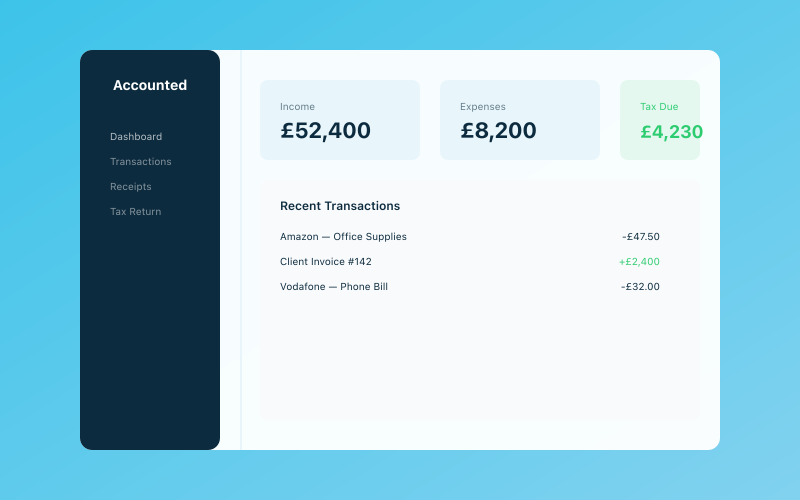 Your Accounted dashboard — income, expenses, and tax at a glance
Some weeks, work will dominate. You'll have a deadline, a busy period, a new client to onboard. Other weeks, life will take precedence — a family event, a holiday, a day when you simply need to rest. The balance isn't day-to-day. It's seasonal, fluid, and personal.
What matters isn't achieving perfect balance at every moment. What matters is having the ability to choose which takes priority, rather than letting work win by default every single time.
Because that's what happens when you work from home without boundaries. Work doesn't aggressively take over your life. It quietly seeps into every available space, like water finding cracks. You check emails over breakfast. You take a client call during dinner. You finish "one more thing" at 10pm. And before you know it, you're working fourteen-hour days without having consciously decided to.
Create Physical Boundaries (Even Small Ones)
The most effective way to separate work from life at home is to create a physical boundary. If you have a spare room that can serve as a dedicated office, brilliant — use it, and close the door when you're done for the day.
But most people don't have that luxury. If you're working from a kitchen table, a corner of the living room, or a desk wedged into your bedroom, you need to get creative.
Put your work away at the end of the day. Literally. Close the laptop and put it in a drawer or a bag. Clear your desk. Remove the visible reminders of work from your living space. If your brain can see work, it thinks about work. Removing the visual cues is surprisingly powerful.
Use a physical object to mark the boundary. Some people use a desk lamp — when it's on, they're working; when it's off, they're not. Others change from "work clothes" to "home clothes" (even if "work clothes" is just a slightly different jumper). The specific object doesn't matter. The ritual of transitioning matters.
If possible, face your desk away from your living space. Working at a desk that faces the sofa means you stare at your leisure space all day, and your leisure space stares back at you all evening. A desk facing a wall or a window creates a natural visual separation.
Consider a room divider or screen. If your desk is in a shared living space, a folding screen or bookshelf can create a visual partition. It won't block sound, but it will prevent your work setup from dominating your relaxation space.
Create Time Boundaries (And Defend Them)
Physical boundaries help, but time boundaries matter even more. You need clear start times and, crucially, clear stop times.
Decide when your working day ends and treat it like a hard deadline. Not "when I've finished everything" (you will never finish everything). Not "when the inbox is empty" (it never will be). A specific time. Five o'clock. Six o'clock. Whatever works for your life.
When that time arrives, stop. Close the laptop. Put it away. Leave the room if you can. The work will still be there tomorrow. The email can wait until morning. The client does not need a response at 8pm, regardless of what they think.
If you struggle with this, set an alarm. Make it a different sound from your regular phone notifications — something that unmistakably signals "the day is over." When it goes off, begin your shutdown routine.
And yes, you need a shutdown routine. Something that marks the transition from work to life. A short walk. Making dinner. Putting on music. Anything that tells your brain "we're done now." Without a clear ending, work bleeds into the evening, and you end up in that guilty-television situation from the opening paragraph.
If you find yourself consistently working past your stop time, our guide on how to stop working evenings and weekends tackles this in detail.
The Admin Trap
One of the sneakiest ways work invades your personal time is through admin. The actual client work might stop at five, but then you spend the evening catching up on invoicing, bookkeeping, filing receipts, updating your spreadsheet.
Admin is real work. It takes real time and real energy. But because it doesn't feel like "proper" work, we tend to push it into our personal hours, which erodes the very boundaries we're trying to build.
There are two solutions here. First, schedule admin time during your working day. Block out an hour or two each week specifically for administrative tasks, and protect that time as fiercely as you'd protect client work. Admin that happens during work hours doesn't need to happen during your evening.
Second, automate everything you possibly can. This is where Accounted genuinely changes the equation. Penny handles your bookkeeping automatically — categorising transactions, tracking expenses, keeping your records in order — which means you're not spending your evenings wrestling with spreadsheets. The admin that used to steal your personal time simply... doesn't need to happen anymore.
Protect Your Weekends
Weekends are the frontline of the work-life balance battle. When you work from home, Saturday and Sunday don't feel fundamentally different from Monday through Friday. The same desk is there. The same inbox beckons. The same to-do list lurks.
Protecting your weekends requires active resistance. Here are some strategies that work:
Make plans. It's harder to drift into work mode when you've committed to doing something specific with someone else. Weekend plans create accountability and give you a reason to step away.
Leave the house. Physical distance from your workspace is your greatest ally. Even if you don't have specific plans, getting out of the house — a walk, a coffee shop, a trip to the market — puts distance between you and the temptation to "just check one thing."
Batch your weekend admin. If you absolutely must do some work at the weekend, contain it. Ninety minutes on Saturday morning, then done. Don't let it sprawl across both days.
Turn off notifications. During the week, you need to be reachable. At the weekend, you don't. Turn off email notifications, mute work-related chat apps, and give yourself permission to be unavailable. Your clients survived weekends before they met you. They'll survive this one too.
The Guilt Problem
Let's talk about guilt, because it's the invisible force that sabotages every boundary you try to set.
Self-employed guilt comes in two flavours. There's the "I should be working" guilt that hits whenever you're doing something that isn't work. And there's the "I should be relaxing" guilt that hits when you're working and know you should have stopped an hour ago.
You cannot guilt your way to balance. Both flavours are lying to you. When you're resting, you are not being lazy — you are maintaining the physical and mental capacity that makes your work possible. When you're working late because a genuine deadline requires it, you are not failing at life — you are making a temporary trade-off.
The antidote to guilt is intentionality. When you've consciously decided to stop working at five, the guilt has less purchase. When you've deliberately chosen to work a Saturday morning because a big project demands it, you're making a decision, not falling into a trap.
Write it down if it helps. "Today I am choosing to rest because rest makes me better at my job." It feels silly. It also works.
Relationships Need Attention Too
If you live with a partner, family, or flatmates, your work-life balance affects them too. When you work from the living room until 9pm, you're not just stealing from your own personal time — you're stealing from shared time.
Have an honest conversation about expectations. What hours will you work? What hours will you be fully present? What does "fully present" actually look like? (Hint: it's not sitting on the sofa with one eye on your phone.)
Partners of self-employed people often feel like they're competing with the business for attention — and they're usually right. Acknowledge this. Make an effort. Put the phone in another room during dinner. Have evenings where work doesn't get mentioned. Go on a proper date, not just a meal where you talk about your client pipeline.
Your business is important. Your relationships are important too. Getting the balance right isn't about choosing one over the other — it's about being fully present for each, in turn.
For a broader look at protecting your personal time and your relationships from the demands of self-employment, have a read of our guide on taking a holiday when you're self-employed. If you can't take a proper break, the smaller daily boundaries will eventually crumble too.
Small Changes, Big Difference
You don't need to overhaul your entire life to improve your work-life balance. Small, consistent changes compound over time:
- Close your laptop at the same time each day
- Put your phone on Do Not Disturb after work hours
- Eat at least one meal a day without a screen
- Take a ten-minute walk between your last task and your evening
- Keep one day per weekend completely work-free
- Let Penny in Accounted handle your bookkeeping and admin so it doesn't eat into your personal time
None of these things are revolutionary. All of them, done consistently, will transform how your home feels. Because when your home stops feeling like an office that you happen to sleep in, everything gets easier — your work, your rest, and the space between them.
You deserve to enjoy your living room. Let it be a living room again.
Related reading:
- How to Stop Working Evenings and Weekends
- Taking a Holiday When You're Self-Employed
- How to Automate Your Admin as a Sole Trader
Accounted helps UK sole traders stay on top of their bookkeeping and tax. Start your free 30-day trial at getaccounted.co.uk.
Related Reading
- The 4-Hour Work Week for Sole Traders — Is It Realistic?
- The Pomodoro Technique for Getting Your Admin Done
Start your free trial and see how Accounted simplifies your bookkeeping.
Business & Operations Advisors
Our business advisors cover the practical side of running a UK sole trader business — from HMRC registration to managing growth. Content is written for real business owners in plain English, not accountants.
Ready to try Accounted?
Join UK sole traders who are simplifying their bookkeeping and tax.
Start your 14-day free trial