How to Take a Holiday When You're Self-Employed
When was the last time you had a proper holiday? Not a "working from a different location" trip where you spend half the day on your laptop by the pool. Not a long weekend where you check your emails every few hours. A genuine, switch-off-completely, forget-about-work-for-a-bit holiday.
If you're self-employed, there's a decent chance the answer is "I can't remember" or "does Christmas count?" You're not alone. A staggering number of UK sole traders take fewer than ten days of holiday per year, and many take none at all.
The reasons are understandable. When you don't work, you don't earn. There's nobody to cover for you. Your clients still need things. And there's that nagging voice in the back of your head whispering that you'll miss out on opportunities or come back to a disaster.
But here's the truth: taking regular breaks isn't a luxury — it's a business necessity. Burnout is real, and it's far more damaging to your business than a week away from your desk. So let's figure out how to make holidays happen, even when you're the entire workforce.
Why You Need to Take Time Off
Before we get into the practical stuff, let's be clear about why this matters:
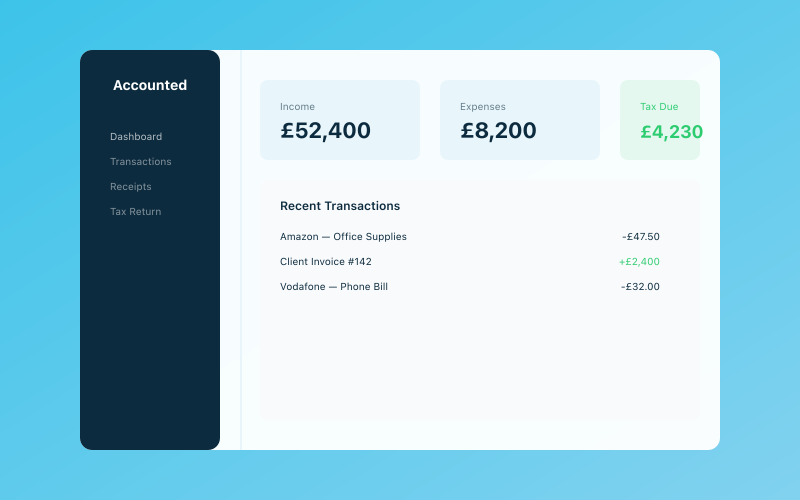 Your Accounted dashboard — income, expenses, and tax at a glance
Burnout destroys businesses
Working without breaks leads to exhaustion, reduced creativity, declining quality of work, and eventually burnout. When you burn out, you don't just feel a bit tired — you can become unable to work at all. A week's holiday now is far less costly than three months of recovery from burnout later.
Rest improves your work
Study after study shows that taking breaks improves productivity, creativity, and decision-making. You'll come back from a holiday with fresh perspective, renewed energy, and often your best ideas. Some of the most successful business decisions happen not at your desk but during a long walk on the beach.
It's what you started your business for
Many sole traders went self-employed for the freedom and flexibility. If you're working more hours than you ever did as an employee and never taking time off, something has gone wrong. Reclaiming your right to rest is part of building a sustainable business.
Step 1: Plan Your Finances
The biggest barrier to self-employed holidays is financial. When you don't work, you don't earn — but your bills don't stop. Here's how to make it work:
Build a holiday fund
Treat holiday pay as a business expense. Set aside a percentage of your income each month into a dedicated savings pot. A common approach is to save the equivalent of what you'd earn during your planned holiday days, plus a bit extra for the holiday itself.
For example, if you typically earn £200 per day and want to take 20 days off per year:
- £200 x 20 = £4,000
- That's roughly £335 per month set aside for holiday "pay"
Many business bank accounts let you create separate savings pots — perfect for this purpose. You could set one up alongside your tax savings pot.
Account for tax too
Remember that when you're earning well in the months you are working, your tax bill reflects that income. Don't forget to continue setting aside money for tax even during your busier earning periods. For the 2025/26 tax year:
- Personal Allowance: £12,570 (tax-free)
- Basic rate: 20% on income from £12,571 to £50,270
- Higher rate: 40% on income from £50,271 to £125,140
A good bookkeeping tool helps you see your real-time profit position, so you know exactly how much you can afford to take off. With Accounted, you can track your income and expenses throughout the year and get a clear picture of where you stand before booking that trip.
Time your holidays strategically
If your business has busy and quiet periods, plan your holidays during naturally slower times. A wedding photographer probably shouldn't take August off. An accountant might avoid January. Work with your business cycle, not against it.
Similarly, if you have payments on account coming up or a tax bill due, make sure you've accounted for those before booking flights.
Step 2: Prepare Your Clients
Good communication with clients is essential. Nobody likes being surprised by an out-of-office message when they're waiting for something urgent.
Give plenty of notice
Let your regular clients know about your holiday at least two to four weeks in advance — longer if possible. This gives them time to:
- Bring forward any urgent work
- Adjust their own timelines
- Arrange alternative cover if needed
Set clear expectations
Be specific about:
- The exact dates you'll be away
- Whether you'll be checking emails (ideally, you won't)
- When you'll be available again
- What to do in an emergency (if you have a genuinely critical situation process)
- Any deadlines that need to be met before you go
Complete or hand off outstanding work
In the weeks before your holiday, make a concerted effort to complete all current projects or reach clear milestone points. If something will be ongoing while you're away, provide the client with a detailed update so they know exactly where things stand.
Invoice before you leave
Send all outstanding invoices before you go. This way, payments will (hopefully) arrive while you're away, and you won't come back to a pile of invoicing admin. For tips on making your invoices prompt and professional, see our guide on how to invoice correctly in the UK.
Step 3: Set Up Your Out-of-Office Systems
Email auto-responder
Set up an out-of-office message that includes:
- The dates you're away
- When you'll respond to messages
- An alternative contact for genuine emergencies (only if applicable)
Keep it friendly but clear. Something like:
"Thanks for your email. I'm away from [date] to [date] and won't be checking messages during this time. I'll get back to you when I return on [date]. If your matter is urgent, please [alternative instruction]."
Phone and messaging
If clients call or message you, set up a voicemail message with similar information. If you use WhatsApp Business, you can set up an automatic away message.
The key is to remove the temptation to check and respond. If clients know you're away and won't reply, they'll either wait or find their own solution. Both outcomes are fine.
Step 4: Actually Switch Off
This is the hardest part for most self-employed people. Here are strategies that help:
Remove work apps from your phone
Temporarily delete your email app, work messaging apps, and any other work-related apps from your phone. Out of sight, out of mind. You can reinstall them when you get back.
Redefine "emergency"
Before you leave, define what constitutes a genuine emergency that would require you to break your holiday. Be honest with yourself — very few things truly can't wait a week. "Client has a question about invoice format" is not an emergency. "The website I built for a client has been hacked and is actively causing harm" might be.
Start with shorter breaks
If a full week feels too scary, start with a long weekend. Get comfortable with being away for three or four days, then gradually extend the duration. Once you see that your business survives (spoiler: it will), longer breaks become easier to take.
Remember why you're doing this
When you feel the pull to check your emails, remind yourself why you went self-employed in the first place. Freedom, flexibility, being your own boss. A boss who never lets their employee take holiday is a terrible boss — don't be that boss to yourself.
Step 5: Come Back Smoothly
The return from holiday can be almost as stressful as the pre-holiday preparation if you don't manage it well.
Don't schedule client work on your first day back
Give yourself a buffer day (or two) to catch up on emails, review what happened while you were away, and ease back in. Scheduling a client deliverable for the morning you return is a recipe for stress.
Prioritise ruthlessly
You'll come back to a full inbox and a mental to-do list a mile long. Resist the urge to do everything at once. Prioritise the genuinely urgent items, respond to the most important messages, and let the rest wait.
Reflect on the break
How did it feel? Were you able to switch off? Did any problems arise while you were away? Use this reflection to plan future holidays better. Maybe you realised you need a better handoff process, or that your clients coped perfectly well without you (a liberating discovery).
How Many Days Off Should You Take?
There's no legal minimum for self-employed holiday, but UK employees get 28 days (including bank holidays) as a statutory minimum. That's a reasonable benchmark to aim for.
Many financial advisers suggest calculating your day rate based on around 230-240 working days per year (allowing for weekends, holidays, bank holidays, and the occasional sick day). This builds time off into your pricing structure from the start, so you're not losing money when you take a break.
If 28 days feels ambitious, start with 15. Even that is a significant improvement over zero.
The Financial Side: Tracking Holiday as a Business Cost
While you can't claim "holiday pay" as a business expense in the way employees receive it, the travel and accommodation costs of a holiday are personal expenses. However, the administrative costs of preparing for time off — updating your auto-responder, briefing clients, preparing handover documents — are part of running your business.
The real financial preparation is ensuring you've earned enough, saved enough, and managed your cash flow well enough to take time off without financial stress. This is where good bookkeeping throughout the year pays dividends. When you know your numbers — what you've earned, what you've spent, what you owe in tax — planning a holiday becomes straightforward rather than anxiety-inducing.
Building Rest Into Your Business Model
The ultimate goal isn't to squeeze in an annual holiday despite your business — it's to build a business that naturally accommodates regular rest. Some approaches that help:
- Passive or recurring income — Products, courses, or retainer agreements that generate income even when you're not actively working
- Systematic processes — Well-documented processes mean the business can pause and resume without chaos
- Clear boundaries — Clients who understand and respect your working hours and availability
- Financial buffer — Savings that cover your expenses during time off
- Regular short breaks — Don't save all your rest for one big annual holiday. Regular long weekends and days off prevent burnout from building in the first place
Wrapping Up
Taking a holiday when you're self-employed requires more planning than it does for employees, but it's absolutely achievable — and absolutely necessary. Your business depends on you being at your best, and you can't be at your best without rest.
Start planning your next break today. Work out the finances, give your clients notice, set up your out-of-office systems, and commit to actually switching off. You've earned it. Your business will still be there when you get back — and you'll be in much better shape to run it.
Accounted helps UK sole traders stay on top of their bookkeeping and tax. Start your free 30-day trial at getaccounted.co.uk.
Related reading:
- Working From Home vs Coworking — Which Is Better for Your Business?
- Cash Flow Management for Sole Traders
- Pricing Your Services — A Guide for Sole Traders
Related Reading
- Back to School — A Freelancer's Guide to Refocusing in September
- How to Stop Procrastinating on Your Admin
For step-by-step guidance, see our article on How to Automate Invoicing and Get Paid Faster.
Related reading: Batch Your Bookkeeping: Spend Less Time on Admin.
Related reading: Time Tracking for Self-Employed: Best Methods.
Related reading: The One-Day-a-Week Finance System for Sole Traders.
Related reading: The Weekly Review Habit for Self-Employed.
Business & Operations Advisors
Our business advisors cover the practical side of running a UK sole trader business — from HMRC registration to managing growth. Content is written for real business owners in plain English, not accountants.
Ready to try Accounted?
Join UK sole traders who are simplifying their bookkeeping and tax.
Start your 14-day free trial