How to Stop Procrastinating on Your Admin
Let's be honest for a moment. You know you need to do your admin. You know it's important. You know that putting it off makes everything worse — the pile grows, the stress builds, the tax deadline looms. And yet, somehow, you find yourself reorganising your desk drawer, making a third cup of tea, and scrolling through Reddit instead of opening your bookkeeping software.
You're not lazy. You're not bad with money. You're not uniquely incapable of managing a business. You're procrastinating, and you're doing it for very specific, very human reasons.
Admin procrastination is the single most common problem sole traders tell us about. It's more widespread than tax confusion, more persistent than cash flow worries, and more damaging than most people realise. Not because the admin itself is difficult, but because the avoidance creates a compound effect that turns manageable tasks into overwhelming ones.
So let's break the cycle. Here's why you procrastinate on admin, and — more usefully — how to stop.
Why Admin Gets Avoided
Understanding why you procrastinate is the first step to changing the behaviour. Admin avoidance isn't random. It's driven by specific psychological patterns.
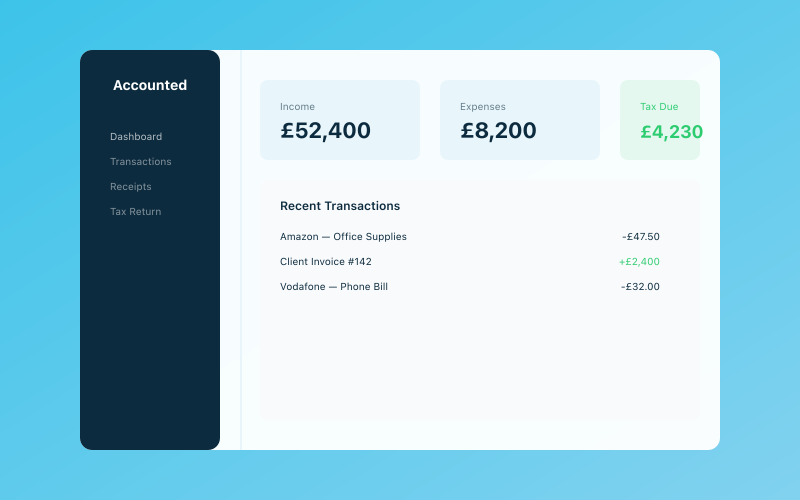 Your Accounted dashboard — income, expenses, and tax at a glance
It's not urgent (until it is). Admin tasks rarely have immediate consequences. Missing a client deadline means losing a client. Missing an afternoon of bookkeeping means... nothing, today. The urgency only appears when tax season arrives and you're facing a mountain of unsorted receipts. Our brains are wired to prioritise the urgent over the important, which means admin perpetually loses to whatever feels more pressing right now.
It's not rewarding. Client work gives you a sense of accomplishment. Marketing brings new leads. Networking opens doors. Bookkeeping gives you... a categorised bank transaction. The dopamine reward for admin work is essentially zero, which makes it incredibly difficult to motivate yourself to start.
It triggers anxiety. For many sole traders, admin — particularly financial admin — is wrapped up in anxiety about money, tax, and the fear of getting something wrong. The spreadsheet doesn't just represent numbers. It represents the possibility that you've made a mistake, that you owe more than you expected, that you're not doing as well as you thought. Avoiding the admin becomes a way of avoiding those uncomfortable feelings.
It's boring. There's no polite way to say this. Admin is boring. It's repetitive, detailed, and unglamorous. After spending your day on creative, intellectually stimulating client work, sitting down to categorise expenses feels like punishment.
It's cumulative. The longer you put it off, the bigger the task becomes, which makes it even more daunting, which makes you put it off longer. It's a vicious cycle, and it's remarkably easy to get trapped in.
The Compound Cost Of Avoidance
Before we get to solutions, let's quantify what admin procrastination actually costs you.
Time. Five minutes of bookkeeping done daily takes roughly twenty-five minutes a week. The same bookkeeping done quarterly takes entire days, because you have to reconstruct three months of transactions from memory, track down missing receipts, and untangle expenses you've forgotten about. Procrastination doesn't save time. It multiplies it.
Money. Missed expense claims are the hidden cost of admin avoidance. When you don't track expenses as they happen, you forget about them. That business lunch, the train ticket, the software subscription — if they're not recorded, they can't be claimed, and you end up paying more tax than you should.
Stress. The constant background awareness that your admin is piling up is a form of low-grade chronic stress. It doesn't spike dramatically (until January), but it's always there, draining your energy and occupying mental bandwidth that could be used for actual productive work.
Penalties. In serious cases, admin procrastination leads to late tax returns, missed deadlines, and penalties from HMRC. These aren't hypothetical — HMRC issued over 800,000 late filing penalties for Self Assessment in 2024-25. Many of those weren't from people who couldn't do the work. They were from people who kept putting it off until it was too late.
Strategy 1: Make It Smaller
The most effective anti-procrastination technique for admin is reducing the size of each individual task. When you think of "doing your admin" as a single, monolithic activity, it's overwhelming. When you break it into tiny, specific actions, it becomes manageable.
Instead of "do my bookkeeping," try "categorise today's three transactions." Instead of "sort my receipts," try "photograph the two receipts in my wallet." Instead of "prepare for tax season," try "check that last month's records are up to date."
Each of these tasks takes less than five minutes. Five minutes isn't scary. Five minutes doesn't require motivation or willpower. Five minutes is just... five minutes.
The trick is doing these micro-tasks frequently rather than saving them up. A little admin every day (or even every other day) prevents the accumulation that makes admin feel insurmountable.
Strategy 2: Attach It To Something You Already Do
Habits stick best when they're anchored to existing routines. Rather than trying to create a standalone "admin time" that requires its own motivation, attach your admin to something you already do consistently.
After morning coffee: Spend five minutes reviewing yesterday's transactions. After lunch: Photograph any receipts from the morning. Before shutting down for the day: Check that your records are current. Friday afternoon: Do a fifteen-minute admin review of the week.
The existing habit provides the cue, and the admin becomes an automatic extension of something you were doing anyway. You don't have to remember to do it or convince yourself to start — it just happens, the way brushing your teeth happens after you get out of bed.
Strategy 3: Remove The Friction
Procrastination thrives on friction. Every barrier between you and the task — however small — is an excuse not to start. So remove as many barriers as possible.
Keep your tools accessible. If you need to dig through a drawer to find your login details every time you want to do your books, you won't do your books. Bookmark the page, save your login, keep the app on your home screen.
Use software you actually like. If your bookkeeping tool is clunky, confusing, or unpleasant to use, you'll avoid it. This isn't a character flaw — it's a design problem. Find something that feels intuitive and simple.
Automate the repetitive bits. The less manual input required, the less there is to procrastinate on. This is the principle behind Accounted. Penny connects to your bank account, categorises your transactions automatically, and keeps your records up to date with minimal input from you. Instead of facing a mountain of uncategorised transactions every month, you're just confirming what Penny has already done. It transforms admin from a dreaded chore into a quick check-in.
Have everything in one place. If your receipts are in one app, your bank transactions in another, and your invoices in a third, the admin feels more complicated than it actually is. Consolidate where you can.
Strategy 4: Use The Two-Minute Rule
Borrowed from David Allen's Getting Things Done methodology, the two-minute rule is simple: if a task takes less than two minutes, do it now. Don't add it to a list. Don't schedule it for later. Just do it.
This works brilliantly for admin because most individual admin tasks are quick. Photographing a receipt: thirty seconds. Categorising a transaction: ten seconds. Sending a follow-up on an invoice: one minute. None of these merit being added to a to-do list. They just need doing.
The accumulation of two-minute tasks done immediately means that when your scheduled admin time arrives, there's very little left to do. The mountain never forms because you've been clearing rocks as they appear.
Strategy 5: Reward Yourself (Seriously)
Your brain avoids admin because there's no reward. So create one.
This doesn't need to be elaborate. Finish your weekly bookkeeping review? Have a biscuit. Complete your monthly expense reconciliation? Take the afternoon off. File your tax return? Go out for dinner.
The reward gives your brain a reason to do the task beyond "because you should." Over time, the positive association builds, and the resistance decreases. It sounds simplistic, but it works. Our brains are remarkably responsive to basic incentive structures.
Strategy 6: Make Yourself Accountable
One reason admin gets postponed is that nobody knows (or cares) whether you've done it. There's no boss checking your work, no deadline enforced by anyone but yourself, no consequences today if you skip it.
Create accountability. Tell a friend or fellow freelancer that you're committing to doing your books every Friday. Set up a standing appointment with yourself and treat it as non-negotiable. Use an accountability partner — someone who checks in with you weekly about whether you've done the thing you said you'd do.
Some people find it helpful to join online communities of sole traders who share their admin wins. It sounds small, but posting "done my bookkeeping for the week" in a group chat and receiving a thumbs-up from a stranger is oddly motivating.
Strategy 7: Address The Anxiety Underneath
If your admin procrastination is rooted in financial anxiety — a fear of looking at your numbers, a worry about what they'll reveal — the strategies above will help with symptoms but not the cause.
Financial anxiety is incredibly common among self-employed people, and it's nothing to be ashamed of. The unpredictability of freelance income, combined with the complexity of the UK tax system, creates a perfect breeding ground for money-related stress.
Here's the counterintuitive truth: avoiding your finances makes the anxiety worse, not better. When you don't look at your numbers, your imagination fills in the gaps — usually with worst-case scenarios. When you do look, the reality is almost always more manageable than the fear.
Start gently. You don't need to do a full financial review. Just look at your bank balance. Just open your bookkeeping software and glance at the dashboard. Just see where things stand. That's enough for today.
Over time, as you build the habit of looking at your finances regularly, the anxiety diminishes. Familiarity breeds calm. The numbers stop being scary and start being useful.
If the anxiety runs deeper, it's worth speaking to someone — whether that's a financial coach, a counsellor, or simply a trusted friend. We've explored the link between financial stress and mental health in our piece on the mental health cost of self-employment.
The Nuclear Option: Automate Everything
If you've tried all the strategies above and you're still procrastinating on your admin, consider the nuclear option: remove the admin from your plate entirely.
Tools like Accounted are designed precisely for people who hate admin. Penny connects to your bank, categorises your transactions, tracks your expenses, and keeps your records HMRC-ready — automatically. Your bookkeeping essentially happens without you having to do anything except occasionally confirm Penny's categorisations.
This isn't cheating. It's smart business management. The time and energy you save on bookkeeping can be redirected towards the work that actually grows your business.
For more on automating the admin that drains your time, have a look at our guide on automating your admin as a sole trader. And if the broader challenge of managing burnout as a freelancer is resonating, that's worth a read too — admin overload is one of the earliest burnout triggers.
The admin will always be there. The question is whether it controls you, or you control it.
Related reading:
- How to Automate Your Admin as a Sole Trader
- The Mental Health Cost of Being Self-Employed
- Freelancer Burnout — Signs and Solutions
Accounted helps UK sole traders stay on top of their bookkeeping and tax. Start your free 30-day trial at getaccounted.co.uk.
Related Reading
- Morning Routines That Actually Help Your Business
- Working From Home vs Coworking — Which Is Better for Your Business?
Start your free trial and see how Accounted simplifies your bookkeeping.
Business & Operations Advisors
Our business advisors cover the practical side of running a UK sole trader business — from HMRC registration to managing growth. Content is written for real business owners in plain English, not accountants.
Ready to try Accounted?
Join UK sole traders who are simplifying their bookkeeping and tax.
Start your 14-day free trial