Working From Home vs Coworking — Which Is Better for Your Business?
The morning commute is a walk down the hallway. Your office dress code is "whatever's comfortable." And you can make a cup of tea whenever you like without anyone judging your biscuit consumption. Working from home as a sole trader has a lot going for it.
But it's not perfect. The isolation can be grinding. The fridge is right there, calling to you every twenty minutes. And when your living room doubles as your office, switching off at the end of the day becomes surprisingly difficult.
That's where coworking spaces come in — shared workspaces designed for freelancers, remote workers, and small businesses. They offer the structure of an office without the overhead of renting your own premises.
So which is better for your business? The honest answer is: it depends. Let's compare the two across the dimensions that matter most — cost, productivity, networking, tax implications, and wellbeing — so you can make an informed choice.
The Cost Comparison
Working from home
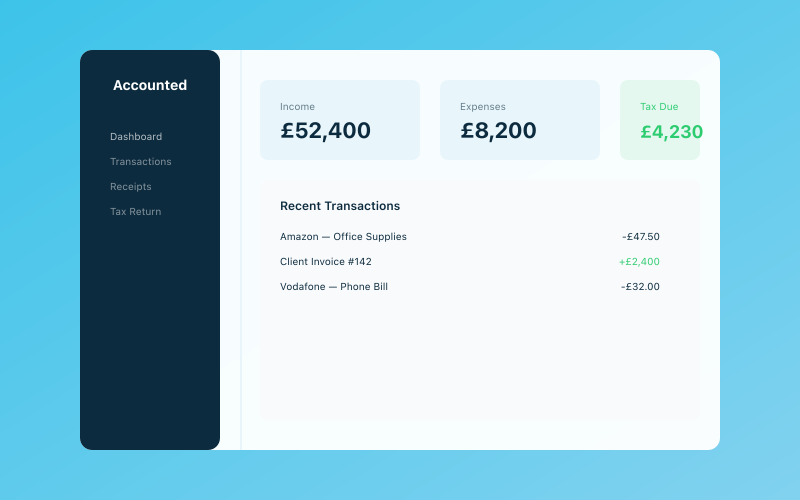 Your Accounted dashboard — income, expenses, and tax at a glance
The financial case for working from home is strong. Your biggest "rent" expense is the mortgage or rent you're already paying, and the additional costs of using your home as an office are relatively modest:
- A bit more on heating and electricity
- Broadband (which you'd probably have anyway)
- Office furniture and equipment (a one-off cost, largely)
- Tea, coffee, and the aforementioned biscuits
For the 2025/26 tax year, you can claim a portion of your household bills as a business expense. HMRC allows two methods:
Simplified expenses (flat rate):
- 25–67 hours per month working from home: £10 per month
- 51–100 hours: £18 per month
- 101+ hours: £26 per month
Actual costs method: Calculate the proportion of your home used for business and claim that percentage of household bills (mortgage interest/rent, council tax, utilities, broadband, etc.). This often works out higher than the flat rate, but requires more record-keeping.
For a detailed breakdown, check out our guide on working from home expenses for 2025/26.
Coworking spaces
Coworking costs vary enormously depending on your location and the type of arrangement:
- Hot desking (pay-as-you-go): £10–£30 per day
- Hot desking (monthly membership): £100–£300 per month
- Dedicated desk: £200–£500 per month
- Private office: £400–£1,500+ per month
In London, expect prices at the higher end of these ranges (and sometimes beyond). In smaller cities and towns, you'll find more affordable options.
The entire cost of a coworking membership is a deductible business expense, which reduces your taxable profit. If you're a basic rate taxpayer (20% on income from £12,571 to £50,270), a £200/month coworking membership effectively costs you £160 after tax relief. That said, it's still a significant monthly outgoing that you wouldn't have if you worked from home.
The bottom line on cost
Working from home is almost always cheaper. Even with the most generous home office expenses claim, your costs will be a fraction of a coworking membership. If budget is your primary concern, home wins hands down.
But cost shouldn't be the only factor. If coworking makes you twice as productive, it could easily pay for itself in additional billable hours.
Productivity and Focus
The home advantage
Working from home offers uninterrupted focus — in theory. Without colleagues popping over for a chat, you can get into deep work mode and stay there. You control your environment: the temperature, the lighting, the music (or silence), even the chair you sit in.
For tasks that require sustained concentration — writing, coding, design work, strategy — a quiet home office can be ideal.
The home challenge
But home also comes with unique distractions. The doorbell rings. The washing machine finishes its cycle and beckons. Your partner/housemate/child wants a word. Social media is right there, and nobody's watching.
For many sole traders, the biggest productivity killer at home isn't any single distraction — it's the lack of structure. Without a commute to signal the start of the day and colleagues to create accountability, it's easy for the working day to expand into an amorphous blob that starts late, finishes late, and somehow still doesn't feel productive.
The coworking advantage
Coworking spaces provide structure and a professional atmosphere that can dramatically boost productivity. The simple act of getting dressed, leaving the house, and sitting down at a desk in a dedicated workspace signals to your brain that it's time to work.
There's also the "social accountability" factor. When you're surrounded by other people working, you're more likely to stay focused. It's the same reason people study better in libraries than in bed.
The coworking challenge
Coworking spaces aren't distraction-free either. Open-plan layouts can be noisy. If you need deep focus, you may need to book a private meeting room or wear noise-cancelling headphones.
Networking and Community
This is where coworking spaces really shine. Working from home can be isolating — just you, your laptop, and the cat. Weeks can pass without meaningful professional interaction, and that loneliness can take a toll on both your mental health and your business growth.
Coworking spaces bring you into contact with other freelancers, entrepreneurs, and small business owners. These connections can lead to:
- Referrals and new business — Fellow coworkers recommend each other to their clients
- Collaborations — Finding complementary skills for joint projects
- Knowledge sharing — Learning from others' experiences and expertise
- Accountability partnerships — Having someone to check in with on goals
- Friendship — Simply having people to have lunch with
Many coworking spaces also organise events, workshops, and social gatherings that create additional networking opportunities. If growing your professional network is a priority, coworking has a significant edge.
That said, networking doesn't require a coworking space. Online communities, industry events, and local business groups can all serve a similar purpose. It just takes more deliberate effort when you're working from home.
Professional Image
Client meetings
If you regularly meet clients face-to-face, a coworking space provides a professional meeting environment that a spare bedroom simply can't match. Most coworking spaces include access to meeting rooms — some as part of the membership, others for a small additional fee.
Working from home doesn't have to mean meeting clients in your kitchen, though. Coffee shops, hotel lobbies, and hired meeting rooms (available by the hour through services like Zipcube or HeadBox) all provide professional alternatives.
Business address
Coworking memberships often include a business address you can use on your website, invoices, and correspondence. This can be valuable if you'd rather not put your home address on public documents.
Tax Implications
Both working arrangements offer tax advantages, but they work differently:
Home office expenses
As mentioned earlier, you can claim a proportion of your household costs as business expenses. Using the actual costs method, this might include portions of:
- Mortgage interest or rent
- Council tax
- Electricity and gas
- Water rates
- Home insurance
- Broadband and phone
Important note on capital gains: If you use a room exclusively for business, it could affect your capital gains tax exemption when you sell your home. Using the room for some personal purposes as well (even just occasionally watching television in there) avoids this issue. Your accountant can advise on the specifics.
Coworking expenses
The full cost of your coworking membership is an allowable business expense, including:
- Monthly membership or daily passes
- Meeting room hire
- Additional services (printing, postal address, etc.)
- Travel costs to and from the coworking space (if it's a temporary workplace)
The travel cost point is worth noting. If the coworking space is your regular, permanent place of work, your commute to it is generally not a deductible expense (just as an employee can't claim their commute). However, if you work from home most of the time and use a coworking space occasionally, the travel costs may be claimable.
For more on what you can and can't claim, see our complete list of sole trader expenses.
Wellbeing and Work-Life Balance
The home challenge
The blurred boundary between work and personal life is one of the biggest downsides of working from home. When your office is ten steps from your sofa, it's hard to truly switch off. Many home-based sole traders find themselves checking emails at 10pm, working weekends, and never quite feeling "off duty."
Physical isolation is another concern. Humans are social creatures, and spending all day every day alone can lead to loneliness, reduced motivation, and even depression. If you live alone, this effect can be particularly pronounced.
The coworking advantage
The physical separation between work and home that a coworking space provides is valuable for mental health. When you leave the coworking space, you leave work behind. That clear boundary helps you recharge and be more present in your personal life.
The social aspect of coworking also combats isolation. Even if you're just exchanging a few words with someone making coffee, that human interaction matters.
Finding your balance
Of course, it doesn't have to be all or nothing. Many sole traders find a hybrid approach works best:
- 2–3 days at a coworking space for collaborative work, meetings, and social interaction
- 2–3 days at home for deep focus work and flexibility
This gives you the best of both worlds: the cost savings and flexibility of home, plus the structure and community of coworking. Many coworking spaces offer part-time memberships specifically designed for this pattern.
Making Your Decision
Here's a quick framework to help you decide:
Working from home might be better if you:
- Are on a tight budget
- Do deep focus work (writing, coding, design)
- Have a dedicated room or space for your home office
- Are self-disciplined and good at creating structure
- Don't need regular face-to-face client meetings
A coworking space might be better if you:
- Struggle with isolation or loneliness
- Find it hard to focus at home
- Want to expand your professional network
- Need a professional meeting space
- Value the separation between work and home life
A hybrid approach might be best if you:
- Want flexibility depending on the type of work you're doing
- Want social interaction some days but deep focus on others
- Can afford a part-time coworking membership
- Value both the cost savings of home and the benefits of coworking
Whichever you choose, make sure you're tracking your expenses correctly. Whether it's your home office costs or coworking fees, these are legitimate business expenses that reduce your tax bill. Tools like Accounted make it simple to categorise and track these costs, so you can claim everything you're entitled to come Self Assessment time.
Wrapping Up
There's no universally "right" answer here — it depends on your personality, your work style, your budget, and your business needs. The important thing is to be intentional about your workspace choice rather than defaulting to whatever's easiest.
Try both if you can. Many coworking spaces offer free trial days or pay-as-you-go options, so you can test the waters before committing to a monthly membership. You might discover that the change of environment transforms your productivity — or you might confirm that your home office is exactly where you do your best work.
Accounted helps UK sole traders stay on top of their bookkeeping and tax. Start your free 30-day trial at getaccounted.co.uk.
Related reading:
- Working From Home Expenses for 2025/26
- The Complete List of Sole Trader Expenses You Can Claim
- How to Take a Holiday When You're Self-Employed
Related Reading
Start your free trial and see how Accounted simplifies your bookkeeping.
Business & Operations Advisors
Our business advisors cover the practical side of running a UK sole trader business — from HMRC registration to managing growth. Content is written for real business owners in plain English, not accountants.
Ready to try Accounted?
Join UK sole traders who are simplifying their bookkeeping and tax.
Start your 14-day free trial