Working from Home Tax Relief: What You Can Claim in 2025/26
Two Ways to Claim
If you're self-employed and work from home, you can claim tax relief on a proportion of your household costs. HMRC gives you two methods — and choosing the right one can make a meaningful difference to your tax bill.
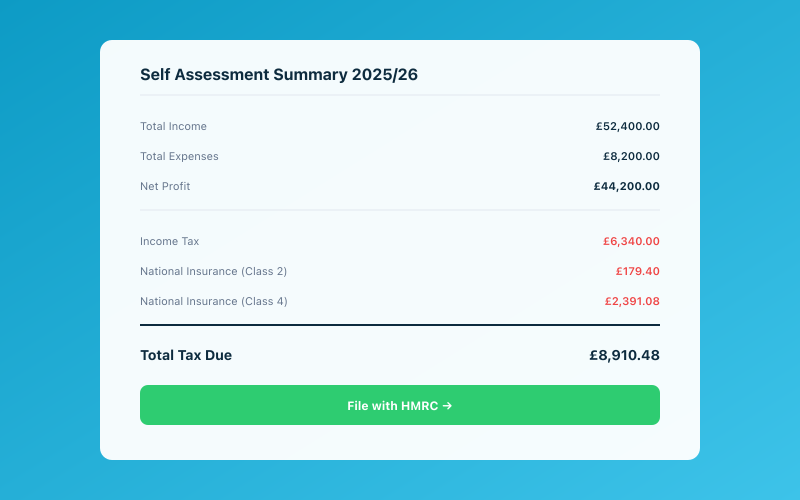 Your Accounted dashboard shows your real-time tax position
You can switch between methods each tax year, but must use the same method for the entire year.
Method 1: The Simplified Flat Rate
HMRC's flat rate based on monthly hours worked at home:
| Hours per Month | Monthly Rate | |----------------|-------------| | 25 to 50 | £10 | | 51 to 100 | £18 | | 101+ | £26 |
No receipts needed. Full-time home workers claim £26 × 12 = £312/year. At the basic tax rate, that saves £62.40. At 40%, it's £124.80.
The flat rate suits people who work from home occasionally, have low household bills, or want zero admin.
Method 2: Actual Costs
More record-keeping, but typically saves far more. Calculate the business proportion of your allowable household costs.
What You Can Claim
Rent, mortgage interest (not capital), council tax, electricity, gas, water, home insurance, broadband, and repairs to your workspace.
You cannot claim mortgage capital repayments, food, clothing, or the cost of furnishing your home office (claim furniture separately as capital expenditure).
Calculating Your Proportion
Room-based: One room as an office in a five-room house = 20%.
Area-based: 12m² office in an 80m² home = 15%.
Time-adjusted: If the room isn't exclusively for business, reduce further. Using a room 40 hours out of 168 per week = ~24%. At 25% room proportion: 25% × 24% = 6%.
A Worked Example
Sarah freelances from home full-time, using one room exclusively in a five-room house.
| Expense | Annual Cost | |---------|------------| | Mortgage interest | £6,000 | | Council tax | £1,800 | | Electricity | £1,200 | | Gas | £900 | | Water | £400 | | Home insurance | £350 | | Broadband | £360 | | Total | £11,010 |
At 20% business use: £11,010 × 20% = £2,202 deduction. Compare that to the £312 flat rate. At the basic tax rate, actual costs save Sarah an extra £378. At 40%, an extra £756.
Record-Keeping
Keep utility bills, mortgage statements, council tax bills, and a note of your calculation method for at least five years. Using Self Assessment software like Accounted makes storing digital copies straightforward.
What Counts as "Working from Home"?
HMRC's definition is straightforward: you work from home if your home is your principal place of business, or if you regularly work from home as part of your normal working pattern.
You don't need to work from home exclusively. If you work from home three days a week and visit clients two days, you can still claim — just make sure your proportion calculation reflects actual usage.
HMRC won't accept:
- Choosing to work from home when you have a separate business premises. If you rent an office but prefer working from home sometimes, you can't claim home office expenses on top of office rent.
- Occasional use. Working from home once a month doesn't qualify.
- Capital improvements. Building an extension or converting a loft to create a home office is a capital expense, not a revenue deduction.
The Capital Gains Tax Question
Using a room as a home office doesn't affect your Private Residence Relief provided the room has some personal use too. If a room is used exclusively for business with zero personal use, a proportion could theoretically be subject to CGT. To be safe, ensure your office has occasional personal use.
Claiming on Your Tax Return
The deduction goes in the expenses section of your Self Assessment self-employment pages (SA103). For those using Accounted, the expense is tracked automatically and included in your real-time tax calculations.
Which Method Should You Choose?
- Flat rate: Occasional home working, low bills, zero admin
- Actual costs: Regular home working (especially full-time), willing to keep basic household bill records
For most freelancers and home-based sole traders, actual costs wins significantly. The extra work is perhaps an hour per year collecting annual statements. The saving typically runs into hundreds of pounds.
Get Started with Accounted
Accounted tracks your working from home expenses alongside all your business costs, giving you a real-time tax position throughout the year. Start your free trial today — no credit card required.
Related Reading
Penny, your AI bookkeeper, tracks your tax position in real time and flags opportunities to reduce your bill. Meet Penny →
Tax & Compliance Specialists
Our tax specialists have decades of combined experience in UK sole trader and small business taxation, MTD compliance, and HMRC submissions. All content is reviewed against current HMRC guidance before publication and updated quarterly to reflect legislative changes.
Ready to try Accounted?
Join UK sole traders who are simplifying their bookkeeping and tax.
Start your 14-day free trial